Omerica
 | This article or section is in the process of an expansion or major restructuring. You are welcome to assist in its construction by editing it as well. If this article or section has not been edited in several days, please remove this template. If you are the editor who added this template and you are actively editing, please be sure to replace this template with {{in use}} during the active editing session. Click on the link for template parameters to use.
This article was last edited by [[User:>TheKitKatProject|>TheKitKatProject]] ([[User talk:>TheKitKatProject|talk]] | [[Special:Contributions/>TheKitKatProject|contribs]]) 5 years ago. (Update) |
United Republics of Omerica | |
|---|---|
 Coat of arms
| |
| Capital | Port-des-Saints |
| Largest city | Charlescourt |
| Official languages | |
| Government | Federal parliamentary republic |
| Christina van der Hout | |
| Julie Thibault | |
| Legislature | Federal Diet |
| House of Plenipotentiaries | |
| House of Representatives | |
| Area | |
• Total | 149,729 km2 (57,811 sq mi) |
| Population | |
• Estimate | 67,720,740 |
• Density | 452/km2 (1,170.7/sq mi) |
| Currency | Omerican florin |
| Time zone | URST |
| Date format | dd-mm-yyyy AD |
| Driving side | left |
| Internet TLD | .or |

Omerica (/ˌɒməˈri(ː)kə, ˌoʊ-/; Gallic: Omerique, [ɔmʁik]), officially known as the United Republics of Omerica, is a sovereign state and federation of twenty-six republics. Omerica is a cosmopolitan and multilingual state and shares a sense of community founded upon common historical ties, maritime symbolism and shared liberal democratic values.
Etymology
The modern name “Omerica” ultimately derives from the archaic Anglian “Homerike”, roughly meaning “home realm”. By the time of the Octarchy, the initial “h” had been deleted by the process of h-dropping, which was a universal process in vernacular Omerican Anglian during said era.
The name was ultimately borrowed into Gallic as “Omerique” and Latinised as “Omerica”, but the Latinisation did not come to prevail in common Anglian parlance until after the fall of the Saltsteadish Regency régime. Non-Anglian Germanic languages continue to use calques of “home realm”, such as Saltsteadish “Heimrijħ”, to refer to Omerica, whereas most other languages tend to borrow the name “Omerica” as is.
Politics
Omerica is governed as a federal parliamentary democratic republic. The three Basic Laws of Omerica govern the set-up of the Omerican state and the prerogatives and duties of its institutions. The bicameral Federal Diet of Omerica exercises legislative power and scrutinises the executive. The directly-elected House of Representatives is the lower house and consists of 300 members elected to a four-year term by universal and secret suffrage.
The House of Plenipotentiaries is the upper house and consists of 100 members representing the republics of Omerica. Plenipotentiaries are indirectly elected, with each republic’s delegation appointed to represent its government; delegations to the House can be recalled their appointing republic at any time, meaning that each republic’s elections affects the composition of the upper house.
The Governor General is the ceremonial head of state and is elected for a single, nonrenewable seven-year term by a joint sitting of the Federal Diet. The Prime Minister is the head of government and chair of the Federal Council of Ministers, which is charged with executing the domestic and foreign policy of the state. The Council directs and coordinates the work of government institutions under the leadership of the Prime Minister; the Council bears full responsibility for all executive acts of the federal government and must consequently answer to the Federal Diet for all executive acts.
The Omerican political system has historically been characterised as a "three-party system", with Omerican Socialist Party on the left and Reformist Party and Liberal Democratic Union on the right predominating elections. These three parties have continuously been the largest in the Federal Diet since the introduction of universal suffrage, though the regionalist Federation of Civic Forces, environmentalist Federal Social Greens and centrist Radical Left have gained prominence in the late 20th and early 21st century.
Direct democracy
Direct democracy is a political tradition older than Omerican independence, originating with the people’s assembly, where citizens gathered to set policy and budgets for the local community; the assembly is maintained in a majority of municipal governments as the direct governing body of the locality. The modern Omerican Charter of Rights defines four principal direct electoral rights—election, referendum, initiative and recall—which complement a representative democratic system, leading to the characterisation of Omerica as a semi-direct democracy.
A referendum is mandatory when a proposal to amend the Omerican constitution is passed by the Federal Diet or a majority of republican legislatures representing the majority of the population and requires a double majority to succeed, namely a majority of valid votes cast nationwide and a majority of valid votes cast in a majority of the republics. Additionally, voters may challenge laws passed by the legislature via a so-called “citizens’ veto”; if enough signatures are collected within a defined time period, a referendum is scheduled where voters decide whether to accept or reject the law, with a simple majority sufficient to repeal.
Voters may also recall elected representatives before the end of their terms. In most republics and at the federal level, the recall takes the form of a by-election, which (depending on the jurisdiction) the incumbent may or may not be allowed to contest, whereas other republics hold a referendum to decide whether the incumbent should be removed and a simultaneous ballot to decide their replacement if the recall succeeds.
Administrative divisions
Omerica is a federation of twenty-five republics, which enjoy permanent constitutional status and, in comparison with other countries, a large degree of autonomy. Each republic is constitutionally equal in status and is fully self-governing, with its own constitution, parliament, government and judiciary. However, the republics display significant diversity, with areas ranging from slightly over 200 km² to over 24,000 and populations ranging from less than 300,000 to more than seven million people.
| Republic | Gallic name | Code | Seat of government | Population | Area (km²) | Density | GDPpc (NSD) | Official language(s) |
|---|---|---|---|---|---|---|---|---|
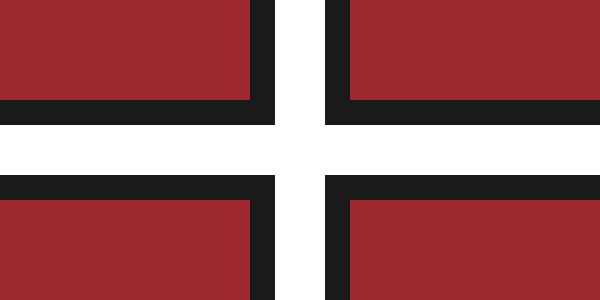 Alleos Alleos
|
Tessèlle | TE | Volubourg | 4,029,325 | 11,741 | 343 | 41,202 | Gallic |
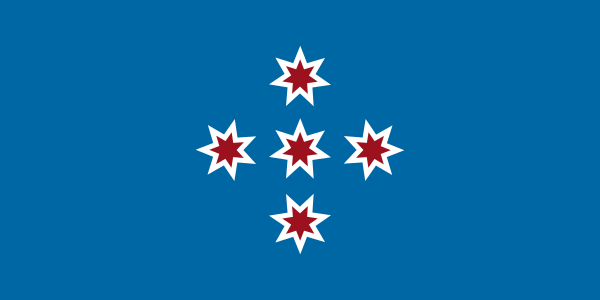 Altomare Altomare
|
Haut-Mer | HM | Romainbourg | 4,626,931 | 3,051 | 1,517 | 47,653 | Gallic |
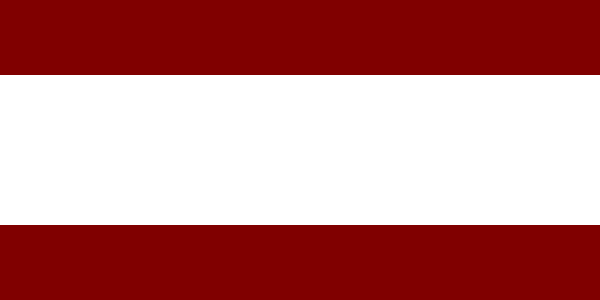 Braganza Braganza
|
Bragance | BR | Sassari | 2,514,572 | 3,852 | 653 | 42,408 | Gallic |
 Bridgecastle Bridgecastle
|
Pontchâteau | PC | Saint-Jean | 2,585,645 | 7,258 | 356 | 50,251 | Gallic |
 Charlescourt Charlescourt
|
Charlescourt | CH | Old Charlescourt | 5,692,376 | 558 | 10,201 | 47,893 | Gallic |
 Cinnabar Island Cinnabar Island
|
Île Cinabre | CN | Castlerock | 293,388 | 682 | 430 | 62,294 | Anglian |
 Coleraine Coleraine
|
Coleraine | CR | Derry | 3,673,500 | 8,010 | 459 | 42,938 | Anglian |
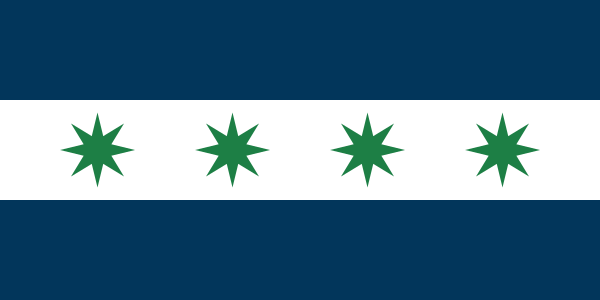 East Calaverde East Calaverde
|
Calaverde-de-l'Est | CE | Saint-Christophe | 6,640,425 | 8,382 | 792 | 46,575 | Gallic |
 Eastavon Eastavon
|
Avon-de-l'Est | EA | Falconhurst | 3,925,900 | 4,646 | 845 | 43,839 | Anglian |
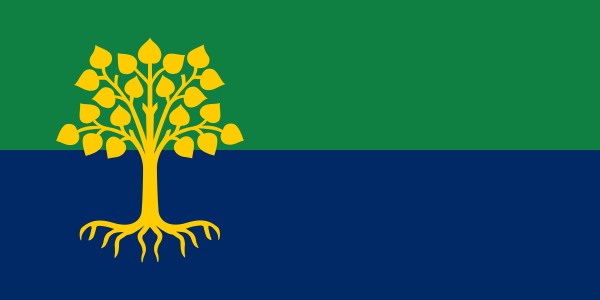 Emerald Isles Emerald Isles
|
Îles Émeraude | EM | Wharfland Ferry | 1,980,760 | 6,224 | 318 | 44,341 | Anglian |
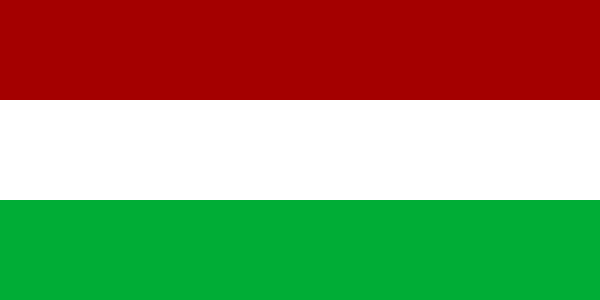 Free State Free State
|
État Libre | FS | Nassau | 6,463,963 | 6,958 | 929 | 43,555 | Anglian |
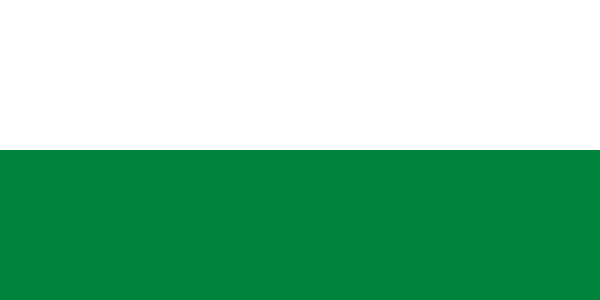 Great Arden Great Arden
|
Grande Ardenne | GA | Templemore | 2,736,853 | 7,447 | 368 | 46,910 | Anglian |
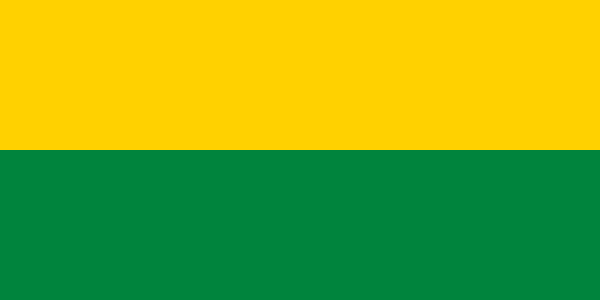 Heathmoor Heathmoor
|
Bruyèrelande | HE | Chaplain's Green | 2,055,811 | 8,210 | 250 | 40,927 | Anglian |
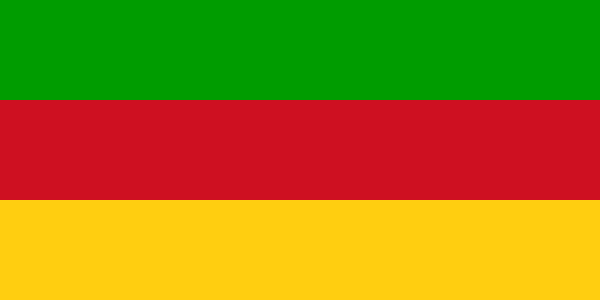 Marche Rouge Marche Rouge
|
Marche Rouge | MR | Châlons | 662,517 | 1,695 | 391 | 44,679 | Gallic |
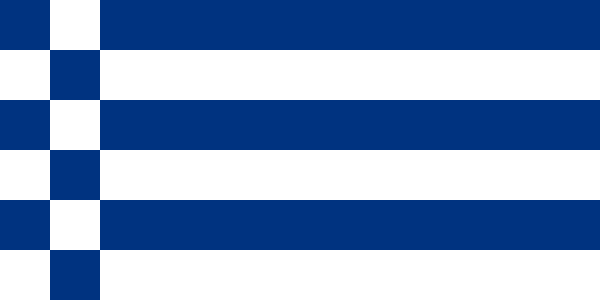 Mespalia Mespalia
|
Mespalia | MS | Christiana | 7,461,993 | 1,310 | 5,696 | 53,416 | Anglian |
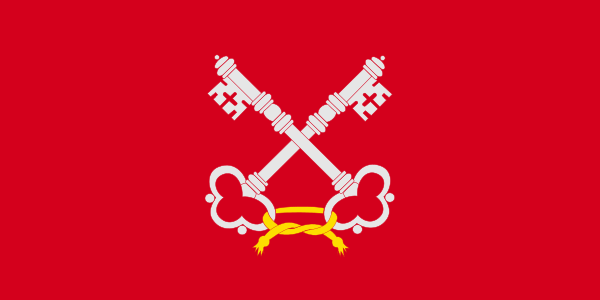 New Vaucluse New Vaucluse
|
Nouveau-Vaucluse | NV | Bayonnette | 1,793,968 | 5,768 | 311 | 43,606 | Gallic |
 North Hesperia North Hesperia
|
Hespérie-du-Nord | NH | Stockbridge | 2,395,329 | 12,725 | 188 | 45,835 | Anglian |
 North Provence North Provence
|
Provence-du-Nord | PN | Carthagène | 3,126,017 | 9,395 | 333 | 40,911 | Gallic |
 Northavon Northavon
|
Avon-du-Nord | NA | Forestia | 2,602,058 | 6,060 | 429 | 45,453 | Anglian |
 Port-des-Saints Port-des-Saints
|
Port-des-Saints | ST | Avonmouth | 1,918,846 | 820 | 2,340 | 60,658 | Anglian |
 Romainbourg Romainbourg
|
Romainbourg | RG | Centre-Ville | 3,327,160 | 204 | 16,310 | 63,451 | Gallic |
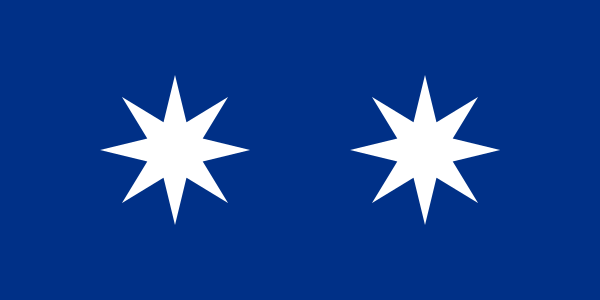 Seafoam Islands Seafoam Islands
|
Îles Écume | SE | Saint Anne | 1,256,475 | 1,477 | 851 | 50,994 | Anglian |
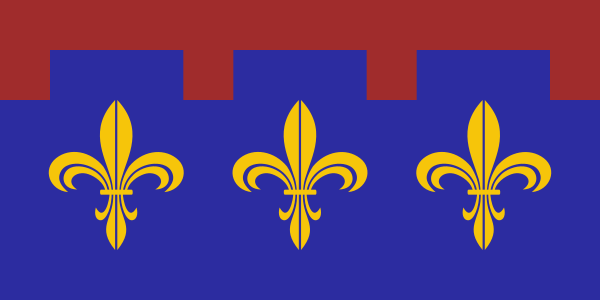 South Provence South Provence
|
Provence-du-Sud | PS | Syracuse | 3,435,538 | 9,408 | 365 | 38,979 | Gallic |
 Terreneuf Terreneuf
|
Terreneuf | TN | Épiteaux | 915,022 | 1,806 | 507 | 38,049 | Gallic |
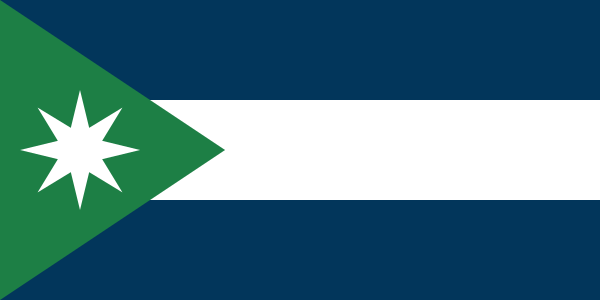 West Calaverde West Calaverde
|
Calaverde-de-l'Ouest | WC | Westhaven | 4,743,633 | 16,044 | 296 | 43,699 | Anglian |
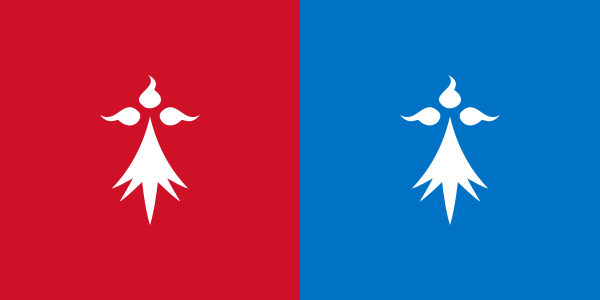 Westavon Westavon
|
Avon-de-l'Ouest | AW | Brétolles | 2,809,766 | 5,998 | 468 | 43,716 | Gallic |
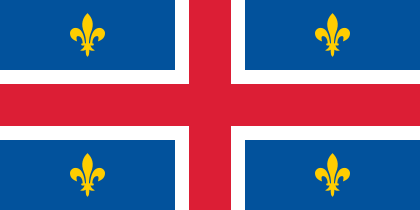 Omerica Omerica
|
Omerique | OR | Port-des-Saints | 83,667,771 | 149,729 | 559 | 46,467 | Anglian, Gallic |
On aggregate, the republics spend more money than the federal government, though the federal government has used its spending powers and its power to make financial grants to the republics to incentivise republics to pursue specific policies in areas where the Union does not have legislative power; republics can opt out of these national policies, but rarely do so in practice. The republics set aside part of their revenue to be used for federal equalisation payments, which aim to ensure that all republics have a uniform capacity to raise revenue.
Republics have plenary power to enact any law they wish, subject to certain limits set out by the Omerican constitution, whereas the Federal Diet may only legislate on specifically enumerated subject areas. However, where the Federal Diet has concurrent power to enact legislation, federal law prevails over republican law to the extent of any inconsistency. Almost all criminal law is enacted by the republics, as well as most laws relating to healthcare, social welfare, law enforcement, public education, job training and promotion of the arts and sciences.
Economy
The Omerican economy is almost exclusively classified as developed, with above average per capita GDP and human development index. Omerican economic policy is defined by the concept of the État marchand (roughly translated as “merchant state”), whereby private corporations compete with the government for service provision in certain sectors, and by economic tripartism. The right of labour to unionise is protected by constitutional law and major labour unions hold considerable political clout.
The florin (ORF, symbol: ƒ) is the currency of Omerica, which is subdivided into 100 pence (Gallic: deniers, symbol: d). Issued by the Federal Monetary Authority of Omerica, the nation’s central bank, the florin is roughly equivalent to 20 NationStates cents.
Culture
Omerica is characterised as a cultural mosaic, a conglomeration of regional and ethnic subcultures, which was first articulated by early Omerican writer Jean-Martin Michelakis: “For every two Omericans, there are three cultures.” Omerica is defined by its diversity, evident in the fact that Anglian and Gallic are co-official at the federal level.

Omerican culture has been further shaped by the immigration of African and Asian nationals. Omerican national identity is centred on the nation’s common history, ubiquitous maritime background and common cultural and political values, namely neutrality, direct democracy, social solidarity and universal human rights.

Media
Freedom of the press and the right to free expression are constitutionally protected by the Omerican Charter of Rights. Due to its cultural diversity and strong economy, Omerica has had a strong tradition in the media sector. Omerica boasts a large number of published newspapers in proportion to its population, though competition from online news outlets have led to newspapers and magazines folding in increasing numbers. Nonetheless, most towns and all major cities have at least one daily newspaper and a number of national papers circulate throughout the country, the largest being The Northern Times, Le Financier, La Travailliste and The National.
Television and radio broadcasts heavily influence modern Omerican media and culture. Système fédérale de radiodiffusion (Anglian: “Federal Broadcasting System”), a federation of republican broadcasters, is the oldest and largest broadcaster on both media, airing three general programming stations, six special interest stations and several foreign language networks for non-Omerican audiences. SFRD’s competitors include the federally-operated Radiotélévision nationale (Anglian: “National Radio-Television”), three for-profit networks and several pay and non-profit radio and television services.
Cuisine
Traditional Omerican cuisine is noted for its strong and heterogeneous tastes, significant regional diversity and large degree of simplicity; Omerican cuisine, regardless of region, traditionally relies on the quality of ingredients rather than elaborate preparation. Omerican dishes are traditionally characterised by generous use of such ingredients as garlic, olives, vinegar and fish and the country is noted for its significant diversity and quality of wines, cheeses, coffee and confectionery.
The coastal regions of the country make heavy use of seafood in the diet, with rice featuring heavily in many of the eastern coast’s iconic dishes. Goat and lamb dishes form a distinctive characteristic of eastern Omerican gastronomy, as well as generous use of octopus in the south-east. In the interior, beef and pork begin to appear more regularly, while vegetarian dishes are more prominent in the west. Salting and pickling are commonplace around coastal regions to preserve meats and seafood.
Sport
Association football is the most popular sport in Omerica, with the OPSL Premier Division drawing hundreds of thousands to millions of viewers per match. Clubs compete in the Omerican football league system, incorporating 64 professional clubs and hundreds of amateur clubs, while the Omerica national team competes in international tournaments such as the World Cup and Independent Associations Championship. The biggest rivals to football in popularity are basketball, ice hockey and volleyball.