Tylastrona
Theocratic Republic of Tylastrona Θεοκρατική Δημοκρατία της Τυλάστρονας ティラストロナ神権共和国 Tylastrona Teokratik Cumhuriyeti | |
|---|---|
 Flag | |
Motto: Eusebia, Xenia, Arete Piety, Hospitalidade, Virtue | |
Anthem: Λευκό Βουνό (White Mountain)  | |
 Location of Tylastrona | |
| Capital and largest city | Smyrnaphos |
| Official languages | N/A |
| Recognised national languages | Greek Japanese Turkish Tylastronian Creole |
Most common immigrant languages | Albanian Bulgarian Croatian |
| Ethnic groups (2026) | Greek (45.2%) Japanese (25.2%) Turkish (12.3%) Mixed (7.1%) Other (10.3%) |
| Religion (2026) | Hellenic Polytheism (65%) Buddhism (11.7%) Shinto (6.1%) Islam (5.3%) Other (11.9%) |
| Demonym(s) | Tylastronian Tylastronan |
| Government | Federal theocratic republic |
• High Priestess | Elara Papadopoulos |
• Prime Minister | Melina Michelaki |
• President of Council of Temples | Helena Zenouli |
| Legislature | The House of Eunomia |
| Establishment | |
• Unification of the Tylastronian States under the House of Astona | 1668 |
• Establishment of the Tylastronian Republic | 1845 |
• Military Junta | 1889-1924 |
• Single-Party State | 1924-1970 |
• Theocratic Revolution | 14th September 1970 |
• Fourth Republic Constitution | 1971 |
| Population | |
• 2026 census | 50,986,000 |
| GDP (PPP) | 2026 estimate |
• Total | 1.601 trillion USD |
• Per capita | 31,400 USD |
| GDP (nominal) | 2026 estimate |
• Total | 1.334 trillion USD |
• Per capita | 26,150 USD |
| Gini (2026) | 0.19 low |
| HDI (2026) | 0.922 very high |
| Currency | Dracma (TYD) |
| Time zone | UTC+2 (Tylastronian National Time) |
| Date format | mm/dd/yyyy HA |
| Driving side | right |
| Calling code | +157 |
| Internet TLD | .ty |
Note: The political system of Tylastrona is inspired by the political system of an Imaginary Elections scenario I've created some months ago. For a deeper understanding of this system, since it has some differences from Tylastrona, check the original system here
Tylastrona is a country located in Esportiva, in the northwestern part of the region. It is a massive nation known for its environmental beauty, calm and friendly citizens, and strong state-interventionist economy. The citizens are known to be compassionate and law-abiding, as well as slightly patriotic. The nation pursues an economic self-sufficiency policy and has a significant environmental agenda.
Tylastrona is bordered by Zeta Reka to the west and by the Cnidian Sea to the north and east.
Tylastrona is described by foreigners as "if Mediterranean culture somehow ended up in the Nordic winterlands" due to its strong winters and mild summers, and its economic policies and citizens' behaviour. Most of its landscape is filled with ice-capped mountains, agricultural fields (especially those used for growing cereals) and huge coniferous forests. Literature, music and a fervent winter sports culture are also among the nation's notable attributes.
As a federated state, Tylastrona is divided into five states and one capital territory. It is governed as a republic under a presidential theocratic democracy, in which the High Priestess is elected for life by direct, non-partisan universal suffrage. The Prime Minister is elected every five years by the House of Eunomia, which is chosen through party-list proportional representation.
Etymology
Tylastrona's name came from the first hellenic settlers that got mesmerised with the immense beauty of the territory and the harsh weather conditions. They found it as a refuge from Roman persecution and the highest peak of the territory appeared to touch the brightest constellation of the sky, Ursa Minor. Therefore, the first Hellenes named the territory "The Resilient Star" or "The Hardous Star" from the composition of two Greek words τύλος (tylos/tilos) and ἄστρον (astron/ástron). The 18th-century historian and naturalist Rhesus (1729-1774) analysed several pre-Independence documents that described the territory as Τιλος ᾽Αστρον "Tilos Astron" dated from the 11th-13th centuries. By the 15th century, the registers mostly from the Astona region already registered the portmanteau Τιλἄστρον "Tilástron". By the end of the 17th century the conversion from multilexical word to single portmanteau was completed as many royal decrees and civil registries named the nation as Τυλαστρονα (Tylastrona) or as Τιλαστρονα (Tilastrona), however the later was stopped being used by the end of the House of Astona Period (1810s-1840s).
History
Main article: History of Tylastrona
Prehistory
Humans have inhabited the Tylastrona region since around 35,000 years ago during the Upper Paleolithic period. The oldest objects were found around the Rina River, near Kannela. The cave drawings of Mount Smyrnaca are the most popular and significant artistic creations, supposedly dating back around 25,000 years. Not much remains from the hunter-gatherer populations that lived in Tylastrona. However, the first indigenous people, the Xami, who lived in Tylastrona before the Hellenic arrivals, domesticated reindeer and developed an agricultural system adapted to the cold environment of the area. The Xami dominated the Tylastronian territory following the Mesolithic warming period 10,000 years ago. For millennia, the Xami were the only people in Tylastrona. They developed their own language, visual culture, and naturalistic/animistic spiritualism. The 18th-century historian and naturalist Rhesus (1729-1774) wrote extensively about the Xami, primarily through interviews with survivors of the ethnic group in the 1750s.
Pre-Independence
Many Tylastronian historians refer to the pre-independence period as the time between the first arrival of the Hellenes and the end of the War of Unification. The first Hellenic settlers arrived in Tylastronian territory in the 3rd century BCE; many of them had fled Greece due to the Roman invasion. This was a sustained migration that saw large influxes around the 200s and 140s BCE, the latter of which coincided with the Fall of Corinth. The main cities that the Hellenic settlers came from were Athens, Corinth, Delphi, Eleusis, Ephesus, Mytilene, Samos and Smyrna, among others. Despite finding hostile conditions, they were attracted by the beautiful landscapes and named the place "The Resilient Star" (tylos + astron) or "The Hardous Star". Their interactions with the Xami were dominated by suspicion at first, followed by curiosity and a deep need of contact and learning. The first Hellenic settlements were located near the Cnidian Sea, mostly around the areas of what is today Smyrnaphos and Cnidio. By the 4th century CE, the Greek-Tylastronian population was around every single point of the current Tylastronian territory, many tried to learn the Xami language, others celebrated marriages between the two ethnicities. Despite few punctual tensions, the relationship between the Greeks and the Xami was one of peacefulness and education.
The second wave of Hellenic settlements occurred around the 4th and 9th centuries CE. The reasons for these migrations were different from those of the first wave. This was when the Roman Emperor Constantine the Great began a century-long persecution of pagans, including practitioners of Hellenic polytheism. To avoid persecution, injury or even death at the hands of Christian mobs, many Hellenic polytheists fled Greece, taking the same routes as their ancestors had centuries before to reach Tylastrona. The Greek-Tylastronians, who had not been in contact with the Greek mainland for at least seven centuries, recognised the new arrivals with uneasy recognition. The cities grew exponentially; the new settlers brought priestesses, artists, philosophers and mathematicians. Tylastronian Greek began a new linguistic process as Koine Greek met Tylastronian Greek. The cities of Kannela, Astona and Cnidio grew rapidly. Many of the new settlers had to move to the 'Misty Mountains' (now known as Youkailand) or the Xami settlements in an area now known as Thebetta. By the end of the sixth century CE, the Hellenic presence in Tylastrona was firmly established. The coastal lowlands and river valleys predominantly spoke Tylastronian Greek, practised Hellenic Polytheism and lived according to Hellenic customs. The interior highlands remained predominantly Xami, although Hellenic culture was increasingly influential even there. The first Turkish people arrived to Tylastrona during the 10th century. Many of them were Oghuz Turks with small minorities of Laz people, stablishing themselves mostly in the areas of Kannela and Old Towers.
The city states grew in influence and power, with families gaining recognition. Astona, Smyrnaphos, Cnidio and Kannela were the strongest city states and the ones with more economic power. These cities had to manage a second wave of Turkish settlers (XV-XVI centuries) that were escaping Ottoman rule, many of them going to Kannela and Old Towers, bringing Islam and cultural traditions different from the Oghuz Turks of the 10th century. Tylastronian Middle Ages and Modern Ages were marked by the games of power between the city states that culminated in the War of Unification (1663-1668) that put the Astonian Coalition (Astona, Misty Mountains, Cnidio, Old Towers), the unifiers against the Kannelian Coalition (Kannela, Smyrnaphos), the authonomous which ended with the Astonian Coalition victory and the signing of the Treaty of Astona on 7 Thargelion 0 HA, proclaiming the Kingdom of Tylastrona .
House of Astona
During the reign of Markos I (1668-1678), two significant events occurred within the House of Astona. Markos I himself declared a group of royal decrees that granted the nobility of the main cities autonomy and a presence at the Royal Council. They also introduced the first magic regulation laws: only nobles and priestesses could use the advanced magic of the time, while commoners could only use elemental magic in their daily lives. The spiritual mandate was decreed by the Council of Temples and formalised in 1670 with the signing of the Council of Temples Code and the Priestess Code. Historians refer to this period as the Feminist Consolidation of the Temples, which began in the 1640s and continued until the end of the century. Men could not be priests and could only serve as lay members. This philosophy has continued until the present day. The most important monarch of the early House of Astona was Demeas I (reigned 1697-1743). He was the third longest-ruling head of state in Tylastrona's history, with a reign of 46 years and 191 days. During his reign, he stabilised the economy, expanded the nation's magical knowledge, and contributed to the architectural arts and expansion of education. Astonianism was a cultural movement that flourished during the golden age of visual arts, literature and theatre. He compassionately managed the third wave of Turkish settlers (1680s-1730s). However, his reign was also marked by the Tylastronian Civil War (1708-1712). During this period, Demeas's younger brother rallied the nobles of Kannela and the Misty Mountains in an attempt to take over Astona and reclaim the crown. The war was quickly resolved after the victorious Battle of Semasus on 16th Thargelion 43 HA, which almost completely demoralised the rebels.
The period between the reigns of Demeas I and Giannis I was marked by economic stagnation and ethnic conflict between Greek and Turkish Tylastronians, which erupted into a small civil war in 1758, known as the Pixesos ethnic unrest. The two kings who ruled during this period, Markos II (1743-1751) and Markos III (1751-1761), were considered unpopular. They were expected to uphold the legacy of Demeas's 46-year reign and the monarchy's golden age, but they were unable to do so. However, one of the most significant things Markos III ever did was appoint Rhesus (1729-1774) as the kingdom's chief historian in 1755. Markos III's death marked one of the worst political crises in Tylastrona: the 1761 Succession Crisis between his three cousins. To avoid a second civil war, Daphne Gianniadi, the third Chiefess of Hellenismos, and leader of the Council of Temples since 1736, decided to mediate the conflict, rallying the Council to support Giannis, Markos III's closest cousin. Giannis I (1761-1816) was the longest-reigning head of state in Tylastrona, ruling for 55 years and 212 days. A diplomat, regulator, pragmatist and good speaker, he was highly regarded. He maintained healthy relationships with the Council of Temples. He granted greater autonomy to the cities, promising a federal monarchy. He increased the value of the dracma, which caused the Tylastronian economy to boom. Culture flourished, and Post-Astonianism, characterised by intimacy and nostalgia, dominated the visual arts. Meanwhile, Timandra (1745-1791) was writing her feminist epics. Aris Demas (1702-1778), Tylastrona's most important playwright, released his magnum opus. The discovery of biological magic in 1778 allowed magic to reach its full potential, and the agricultural cycle was reduced. The maritime presence in the Cnidian Sea also increased, and the education of the general population expanded exponentially thanks to the magical printing press and the construction of more schools, as well as more permissive education measures for commoners. However, the latter part of Giannis I's reign was marked by some disturbances, primarily the Constitutional Crisis (1799-1802). Inspired by the ideals of the Enlightenment and the liberal revolutions in France and the United States, the lower nobles started to pressure Giannis I to relinquish power and adopt a constitution. Giannis did not falter, even when the crisis reached boiling point in 1801, with the constitutionalist nobles withholding taxes to lend weight to their demands. Once again, the Council of Temples intervened, this time under the auspices of Alexandra Maloglou, Chiefess of Hellenismos, who had only been in office since 19 January 1802. Although the constitutionalists were defeated, their unrest would ultimately lead to the end of the monarchy in 1845. Giannis I, in fear of a new civil unrest, created a federated police force in 1809, the Phalanx of the State which still is the only police force of the nation.
The death of Giannis I in 1816 marked the end of the second Astonian Golden Age. His sucessors, Giannis II (1816-1819), Giannis III (1819-1839) and Georgios II (1839-1845) couldn't control the civil unrest and further separation between liberal figures and conservative figures. However, this period was also marked by the first Japanese migration wave between the 1820s and the 1830s, which shaped the Tylastronian linguistic and cultural background radically. Most of the Japanese settlers were from the Tōkai-Tōsan, Kantō and Hokkaido regions and they settled in the southern Cnidio region (Iwakura), Smyrnaphos and Misty Mountains. The republicans and liberals tried to persue a revolution in 1835 that was quickly crushed by the Phalanx of the State. However, Georgios II reign was marked by deep social and economic crises, mainly the 1842-1844 economical crisis that led to the hunger of 140,000 Tylastronians according to official sources. This led to the 15th February 1845 Republican Revolution, that deposed and exiled Georgios II and installed the First Republic.
First Republic
The First Republic, also known as the Republic of Tylastrona (1845-1889), was initially stable but was later plagued by economic and ethnic shifts, culminating in the military coup of 8 April 1889. The Revolution Party, led by the revolutionary, liberal republican Seyfettin Vassiliou (1804-1880), quickly took over. A parliament was established and the Constitution of 1845 was written and enacted, becoming the nation's first constitutional legislation. The prime minister acted as both head of government and head of state, thereby taking power away from the monarch. Parliament became the legislative power, replacing the Royal Council. Parliament would be elected by indirect suffrage; only men could vote. The courts became independent of the state, and private investment was permitted. A period of forced secularisation also occurred during Vassiliou's tenure. His party launched a vicious campaign against the Council of Temples and its network by separating the temples from the state and making them pay higher taxes than ordinary buildings. However, this campaign was discontinued after Sofoklis Makris (1811-1892) was elected in 1850 and again in 1855. Makris was from a social liberal party called the Republican Party. During his ten-year tenure, he collaborated with the Temples, promulgated religious freedom and recognised Turkish as a second official language. He managed to recover the economy from the financial shock of the revolution and make society more progressive. Culture and industry exploded exponentially. He maintained a close relationship with Eliana Afroudaki (1815-1880), Chief Priestess of the Temple of Artemis, who fought against the exponential growth of industry in the nation's interior. This led to the creation of the world's first environmental measures around the 1850s.
The end of Sofoklis's tenure marked the beginning of the second wave of Japanese migration (1860s-1880s), which saw people settle in Youkailand (the Misty Mountains) and Smyrnaphos. Most of these migrants came from the Tohoku, Hokkaido and Saga regions. They brought late Edo cultural practices with them and quickly integrated with the other Japanese settlers, who were already in their second generation. Contact between the Japanese and Greek-speaking people, primarily in Smyrnaphos and Cnidio, resulted in the development of the Tylastronian Creole language and Tylastronian Creole people. The multilingual society of the First Republic was tolerated by the government and saw an increase in social science and technology research. Many philologists of the time developed communication methods between the various ethnic groups. The period of dominance of the Republican Party was ultimately marked by two severe political crises. The first occurred in 1868 when the parliament was dissolved following the 1865 election. The Prime Minister, Panayiotis Spyrou (1826-1900), attempted to govern with a minority alongside the Agrarian Party, a communitarianist Hellenismos party. This angered the secularists (the Revolution Party), who made up the majority of the opposition and did not want anti-secularists to support the government. It also angered the right wing because the government promised to support the agricultural sector, but only improved industry and heavily taxed the remaining Astonian nobility to fund their liberal programmes. (Progressive Party and Monarchic Revival). The crisis reached boiling point in March 1868, when Spyrou resigned after the entire opposition voted against a vote of confidence, while their coalition partners, the Agrarians, abstained. The second political crisis occurred between 1873 and 1875. Osman Shehu, who was also from the Republican Party, was elected Prime Minister in 1868. He was more secularist than his successors, which satisfied the left and liberal centre but angered his own party caucus and the right wing. Nationalism and conservatism were on the rise, influencing the military. Then Shehu made a move that angered the Revolutionary Party: he asked Eliana Afroudaki for help. He increased the proportion of GDP coming from agriculture and reduced it from industry and the tertiary sector. This prompted the Revolutionary Party to call a vote of no confidence, which passed, and Shehu had to resign.
Apollon Michailidis (1841-1927) was then the next Prime-Minister, he was elected in 1875 and in 1880, the Revolutionary Party president led a ten years terror campaign against the Temples, instead of the taxes that Vassiliou implemented, Michailidis forced the Temples to the underground. Despite this darker part, Michailidis government managed to fix the political environment during the first years of his tenure, magical and technological development increased. The presence in the Cnidian Sea increased as well. However, the last five years of his tenure were quickly marked by three events: the 1880-1881 flu epidemic that killed 250,000 people only in 1880, including Chiefess of Hellenismos, Despina Papada who was only chosen to be Chiefess 12 days before her death, many people accuse the government of mismanagemnt of the epidemic; contributing to this, the increase of the nationalism and conservatism in the military and the police forces was growing secretly, they were easily converting people by using populist tactics and stating the obvious: the First Republic betrayed the nation and the Theoi; thirdly the 1883-1885 economic crisis, deriven by the lack of workers due to the epidemic, caused famines in rural areas and led to the violent 1885 National Protests led mostly by farmers, industry workers, minority people and syndicalists. In 1885, Sinan Kartal was elected Prime-Minister, the socialist received a nation in the brink of civil unrest, he quickly mobilised the workers and declared a policy of grain equality, environmental protections, minority protections, forced secularisation, free education, free magic teaching and the power to the Tylastronian Proletariat, the economy relieved a bit but stagnated, the dracma was worthless due to the crisis of the late Michailidis tenure, the far-right rallied the military and on 8th April 1889 they acted with the military coup. They invaded the parliament, the Palace of the Prime-Minister, murdering Kartal, and the public institutions. The coup was led by the general Costas Christodoulou, who wanted to return Tylastrona to its greatness, and bring back the monarchy. But what he started, he couldn't prevent. He says that the decisions he took on 8th April 1889 were his biggest regret. The First Republic ended in blood.
Authoritarian Period
Military Junta
Costas Christodoulou quickly suspended the 1845 Constitution and appointed himself Prime Minister until a smooth transition could be achieved. He maintained the status quo in Tylastrona and established the Military Transitionary Committee in 1890. A devout Hellenic polytheist, Costas was known for his kindness towards others, his love for the gods and his relationships with the temples. During his tenure, he allowed the Council of Temples to formally organise itself and had a close partnership with Hermione Dimakos, the Chiefess of Hellenismos, who led the religion and the Council between 1880 and 1914. Costas wanted to restore the old regime, seeking the freedom of the First Republic alongside the piety of the House of Astona. He held talks with the remaining Astona nobles about reinstating the monarchy. However, the Military Transitionary Committee betrayed him. The covenant, consisting of military personnel who had grown up in the culture of the First Republic, was secularist. They believed in a strong state and did not want a monarch or the temples back. In 1895, during a committee meeting, they demanded Costas' suspension and exile, and the election of Yannis Nicolau. Costas returned to his house in Kannela, where he was poisoned by the state in 1922.
Although Yannis Nicolau's tenure was short, he maintained a grip on the Military Transitionary Committee throughout the five years he commanded the nation by ordering the expulsion and eventual execution of previous military members who supported Costas' ideology. However, Nicolau was respectful of minorities. He did not want ethnic unrest and collaborated with the Turkish-Tylastronian community to maintain peace in Old Towers during minor unrest in 1898. He also had a passion for the arts and technology and improved the economy, which had been in decline since the end of the First Republic. He sold industries to private Esportivan investors to ensure the state had a decent budget. Nevertheless, he differed from Costas in that he did not want the Temples to influence his restoration programme. Instead, he continued the First Republic's persecution of the Temples and the Priestesses until they went underground. On 9th May 1900, during the Military Transitionary Committee meet to elect a new head of state, a group of right-wing secularist militars, supported by a convicing Theofanis Dimitriou formed the Tylastrona Militar Movement, a party that only purpose was to consolidate the junta's power and to never contribute to the transitions that Costas' and Yannis' had previously defended. The TMM was an authoritarian conservatist, militarist, corporativist, cultural conservatist and hellenic ethnonationalist party. Theofanis was elected in 1900 and quickly begun the actual authoritarian period when the Constitution of 1905 was enacted. It begun the persecution of Turkish-Tylastronians, Japanese-Tylastronians, Creole people, queer people, Priestesses and Hellenismos believers, old First Republicans, Costas' supporters, Monarchy supporters, anything that the regime declared a threat to stability. Magical propaganda and torture were allowed, the death penalty was formalised into the nation's "Penal Code" and this only contributed to the rise of the most controversial figure of Tylastronian history, Gianis Mylonas.
Theofanis, by 1915, was tired, he had won the 1905 and 1910 nominations of the Military Committee by a 100% margin. Seeing the figure of Mylonas, Theofanis decided it was time to give the power to the economist. Mylonas created the National Union in 1915, claiming to be the civilian counterpart of the TMM. By the end of 1915, Theofanis allowed the merge of the two parties and gave all power to Mylonas who worsened the previous presecution politics, instaured a cult of personality and continued the propaganda machine, by 1924, Mylonas had personally written the Constitution of 1924 and had enacted the begining of the single-party rule on 7th August 1924.
Single-Party State
Mylonas' Tylastrona was led by his own party and enacted by his own constitution. The National Union was a socially conservative, ultra-nationalist, para-fascist, right-wing corporatist party. Although Mylonas never defended the Axis Powers during his long tenure (1915-1948; 1924-1948), he did have close ties with Salazar and Franco in the latter years of his tenure. Mylonas' administration was characterised by a cabinet that remained in power for ten years, chosen by the party and approved by Mylonas himself. The administration focused on economic stability, primarily maintaining the guild system created by Theofanis, which the Fourth Republic later adopted and democratised following the 1970 revolution. To stabilise the economy, Mylonas enacted protectionist policies, demanding the return of sold industries from foreign investors and increasing taxes on foreign products. Additionally, Mylonas invested in public infrastructure and an energy transition. The discovery of magical energy in the 1930s led to the creation of the first magical energy centres, which were highly polluting.
Mylonas' Tylastrona was diplomatically isolated, only maintaining relations with Spain and Portugal, this was deriven to various characteristics of the single-party state. Firstly, the creation of a political police in 1926 alongside the Phalanx of the State to surveil the population. The creation of magical propaganda, of a extreme cult of personality, the censorship of press media and of radio; and the persecution of artists, intellectuals, Turkish-Tylastronians, Japanese-Tylastronians, Creole people, Priestesses, Hellenismos devotees, religious minorities, queer people and many others. The regime arrested Japanese and Turkish parents who gave their children Turkish or Japanese names, the regime forced the minorities to adopt Greek names. Additionally the regime was responsible for more than 85,000 executions of innocent people, the 1937 Semasus Massacre that killed 1,500 Japanese-Tylastronians, children included. Prisoneers, mainly the political ones, were arrested and tortured. Many intellectual and religious voices were murdered, the most studied cases include the "Tragic Sapphic Trio": Edvoxia Alexalli (1902-1937), Virginia Bala (1895-1937) and Aura Constantinoglou (1900-1941), a group of visual artists that were part of the Smyrnaphos Dada Group, an avant-garde resistance art group, Alexalli and Bala were arrested in 1937 after a militar officer found them hand-holding, they were executed. Constantinoglou moved to the Old Towers and died with a broken heart in 1941. The second case was of the 10th Chiefess of Hellenismos, Fotini Oikonomou (1889-1944), the warrior Priestess, a Senior Priestess of the Temple of Ares who led the temple resistance of the 1930s-1940s. On 25th May 1944, Fotini was caught by the Political Police and was executed on the spot. Fotini's martydom accelarated the wisdom of resistance with the Council of Temples starting the long preparation that was enacted in 1970. Alongside the executions, Mylonas' regime was responsible for several environmental crimes and to the reduction of several animal and plant species. Many of the critically endangered species nowadays are a direct consequence of Mylonas' crimes. Culturally, Mylonasism was everywhere: Architecture, Visual Arts, Literature, Theathre, Music, Opera, Puppetry, Variety; and one of the worst cultural crimes was the stealing of the minority traditions and commercialisation of the same.
Mylonas also tried to go on war against southern esportivan states (1941-1943), the result was a massive lost for Tylastrona and humiliation for his regime.
On 19th November 1948, Gianis Mylonas dies at 71. He leaves a stagnant economy, an isolated Tylastrona and a nation with a demographic winter. His successor, Akito Georgiou, decided that the regime needed a "clearance". The party left the initially ideologies and moved towards paternalistic conservatism, conservative liberalism, technocratic conservatism and civic nationalism; the cabinet tenure period was reduced from 10 to 5 years. The Political Police name was changed to Union for the Protection of the State. But the political police continued to be the political police, the minority persecutions continued to happen which blew out of propostions during the killings of 870 Turkish-Tylastronians during the 1958 Pixesos Massacre. Georgiou's administration was responsible for 45,000 executions of innocent people. Despite his attempts at keeping the economy at bay and control migration, Tylastrona became economically and demographically stagnant, which prompted the 1966-1968 economic crisis that aditionally cost the life of 14,000 people due to famines in Youkailand and Old Towers. The demographic shift worsen after Georgiou promised the support of Portugal in the Colonial War, Tylastrona sent 25,000 men between 1961-1970 to a war they didn't have anything to do with it. However, the 1960s also saw the Cinema Golden Age, with directors placing quiet resistance motifs on the films. The Temples were carefully building the mobilisation under Fotini's sucessor, Helena Papadaki who ruled between 1944 and 1962, and Papadaki's successor Maria Makris who would become the first High Priestess of the Fourth Republic in 1970.
On 14th September 1970, a group consisted of Priestesses, left-wing activists, centre-right and right-wing activists, minority representants and military led by Maria Makris and Theodora Papadopoulos moved towards the Parliament, the Ministry of National Defense, the National Radio and Television building and the headquarters of the Political Police. They declared that the decadence of fascism was over and that the Theoi returned to their convenant, the Radio played "Let it Be" by the Beatles as a signal of betters days to come. The Theocratic Revolution was in course and they deposed and exiled Georgiou to Brazil. The Tylastronian Salvation Covenant was immediatly proclaimed, comprising civilians, priestesses, and military personnel, and took over the position of Head of State and Government, with the Chiefess of Hellenismos, Maria Makris, presiding.
Fourth Republic
In order avoid civil unrest or a possible civil war, the Tylastronian Salvation Covenant quickly consolidated power, electing Maria Makris as the first High Priestess. Maria Makris quickly announced elections for late 1970 with the purpose of writing a constitution. Quickly, the Constitution of 1971 and all the important legislation that carries significance in present day in Tylastrona (Hermes Charter, Hepheastus Charter, Hecate Charter, Penal Code, Civil Code, etc.) was promulgated. Makris' tenure was also marked by the democratisation of sports, culture and the quick transition to non-polluting magical energy and green energy. Maria Makris ruled until 1978, when she unfortunally passed away, the Council of Temples, now freed and with a ammended Code quickly announced the first universal suffrage process to elect a High Priestess, Lydia Giannakopoulou who ruled until her death in 2024. Lydia saw the increasing freedom and progressivness of Tylastronian society that was lost during the single-party period, the 1980 Anti-Discrimination law, Tylastrona joining the Esportivan Union in 1984, the recognition of Tylastronian Creole as a national language in 1990, the Green revolution of the 1990s that led to 40% of the territory being protected and to a total transition to magical energy by the 2000s, the recognition of non-binary people in 2011, the covid-19 pandemic and the enactment of the Fossil Fuel Ban in 2024. Nowadays, Tylastrona is led by Elara Papadopoulos, since 2024, the first High Priestess born in the Fourth Republic and the first High Priestess in a same-sex relationship.
Geography
Tylastrona is located at the northwestern tip of the Esportiva region. The country experiences cold, snowy winters, ranging from a continental climate to a humid maritime climate in the capital and Cnidos. Summers are mild, with around 25–30% precipitation. Tylastrona has three main rivers: the Rina, the Cnidos and the Idofa. Kannella Lake is the largest lake. The country's highest peak is Mount Smyrnaca, which is located near the capital and has an elevation of 2,085 metres and a prominence of 1,875 metres.
| Rank | Mountain Name | Mountain Range | Height |
|---|---|---|---|
| 1 | Mount Smyrnaca | Smyrnaca Range | 2,085 meters |
| 2 | Mount Giona | Smyrnaca Range | 1,882 meters |
| 3 | Mount Tsuge | Youkailands Range | 1,675 meters |
| 4 | Mount Semegea | Smyrnaca Range | 1,099 meters |
| 5 | Mount Imai | Youkailands Range | 1,007 meters |
Climate
| Smyrnaphos, Smyrnaphos Capital Territory | ||||||||||||||||||||||||||||||||||||||||||||||||||||||||||||
|---|---|---|---|---|---|---|---|---|---|---|---|---|---|---|---|---|---|---|---|---|---|---|---|---|---|---|---|---|---|---|---|---|---|---|---|---|---|---|---|---|---|---|---|---|---|---|---|---|---|---|---|---|---|---|---|---|---|---|---|---|
| Climate chart (explanation) | ||||||||||||||||||||||||||||||||||||||||||||||||||||||||||||
| ||||||||||||||||||||||||||||||||||||||||||||||||||||||||||||
| ||||||||||||||||||||||||||||||||||||||||||||||||||||||||||||
According to the Köppen-Geiger climate classification system, Tylastrona has a humid continental climate and a subarctic climate in its interior. The average temperature on the mainland ranges from -16 to 9 °C in the interior, and from -6 to 12 °C in the river basins and coastal areas. The lowest and highest official recorded temperatures are −36.7 °C in Semasus on 17 January 2009 and 30 °C in Iwakura on 8 August 1947. Annual average rainfall in Tylastrona ranges from approximately 5,000 mm to around 1,250 mm, with severe snowfall in winter, heavy rainfall in spring and autumn, and moderate to light rainfall in summer.
Biodiversity
Despite its location, Tylastrona boasts a thriving biodiversity. 90% of the forests consist of Scots pine (Pinus sylvestris), European spruce (Picea abies) and common juniper (Juniperus communis). However, geographical and climatic conditions also facilitate the introduction of exotic species that can later become invasive and destructive to native habitats. The Tylastronian Environmental Agency runs a well-funded programme to monitor these populations. The TEA has also reported that, in 2026, 40% of Tylastronian mammal species (105 in total), 41% of bird species (348 in total), 29% of reptile species (21 in total), 39% of amphibian species (18 in total) and 17% of fish (256 in total) were at risk. The association is still mapping populations and studying the behaviour of invertebrates and plants. To save as much biodiversity as possible, the Tylastronian government has designated 40% of the inland area as nature reserves.
| Class | Total Number | Total Number in the Red Book | Total Number EN/CR | Total Number Invasives |
|---|---|---|---|---|
| Fish | 256 | 44 | 12 | 19 |
| Amphibians | 18 | 7 | 1 | 0 |
| Reptiles | 21 | 6 | 2 | 7 |
| Birds | 348 | 141 | 37 | 24 |
| Mammals | 104 | 42 | 11 | 15 |
| Total | 747 | 240 | 63 | 65 |
Politics
Tylastrona has been presidential representative democratic federal theocratic republic since the ratification of the Constitution of 1971, with Smyrnaphos as its capital. The Constitution grants the division or separation of powers among five sovereignty bodies: the High Priestess, The House of Eunomia, the government, the council of temples and the courts. The head of state is High Priestess, elected to a life-long term by direct, universal suffrage.
Legislative Power
Most of the legislation is done by The House of Eunomia but the government can legislate by decree. The House has 180 seats and its unicameral, they have the role to draft, debate and pass laws; they vote for the Prime-Minister, they approve the national budget, the foreign treaties and the taxation laws and they can censure the government or initiate a dissolution of the assembley with 2/3 majority. All laws are reviewed for impiety or cosmic imbalance by the Court of Themis and by the High Priestess. The electoral system it's a propositional one driven by the D'Hondt method. Whereas 126 seats are elected through the National Circles (including Diaspora) and the remaining 54 are elected through Temple Circles (theocratic).
Executive Power
Executive power is shared between the Archonate and the Ministries. The archonate consists of the High Priestess and the Prime Minister. The ministries are the government's operational divisions. The Prime Minister (PM) leads the Council of Holy Ministries, directs state administration and appoints Holy Ministers. Although they are primarily legislative figures, they are often paired with the executive section of the Holy Ministries as part of the Prime Ministry of Zeus. The Prime Minister is elected by the House of Eunomia after a legislative election and confirmed by the High Priestess. The High Priestess is the theocratic leader and leader of the Council of Temples. She is also the high chief of the army and of foreign affairs. She is also the leader of Hellenismos (Hellenistic Polytheism) in Tylastrona. She is the most revered and loved figure in the Republic. She approves laws and can veto them, as well as confirming the Prime Minister and Ministry appointments. She can also change the names of the ministries. She can promote priestesses. She can call for the direct dissolution of the assembly and the dismissal of the government. She is elected for life by direct, universal suffrage. She is a symbolic and spiritual leader and protector of divine harmony. The Holy Ministries are the cabinets that are filled by the PM after their election. The spots are fixed and are named after the Greek Theoi. Only the Council of Temples or the High Priestess can change the names or the numbers of Holy Ministries: Defense, Ambient, Education and Innovation, Agriculture, Health, Foreign Affairs, Economy and Finances, Culture, Industry and Labour, Justice, Internal Affairs; Family, Youth and Social Welfare; Infrastructures and Transportation. Secretaries are picked by the government, the Theoi name given by the Temple Circles.
List of Ministries and Secretaries of Tylastrona
- Prime-Ministry of Zeus - Prime-Minister
- Secretary of Ananke - State Secretary to the Presidency of the Council of Ministers
- Secretary of Pistis - State Secretary for Theocratic Affairs
- Ministry of Ares - Ministry of Defense
- Secretary of Amphitrite - Secretary of State for the Navy
- Secretary of Aeolus - Secretary of State for the Air Force
- Secretary of Odysseus - Secretary of State for the Infantry and Cavalry
- Ministry of Artemis - Ministry of the Ambient
- Secretary of Oceanus - State Secretary for the Sea
- Secretary of the Horae - State Secretary for Energy Transition and the Climate Crisis
- Secretary of Pan - State Secretary for Nature Conservation and Forests
- Secretary of Gaia - State Secretary for Animal Welfare
- Ministry of Apollo - Ministry of Culture and Art
- Secretary of Calliope - State Secretary for Arts
- Secretary of Thalia - State Secretary for Culture
- Secretary of Metis - State Secretary for Communication with Cultural Institutions
- Ministry of Athena - Ministry of Education and Innovation
- Secretary of Clio - State Secretary for Education
- Secretary of Phoebe - State Secretary for Higher Education and Research
- Secretary of Urania - State Secretary for Science, Technology and Innovation
- Ministry of Demeter - Ministry of Agriculture
- Secretary of Euthenia - State Secretary for Food Security
- Secretary of Glaucus - State Secretary for Fisheries and Sea Food
- Secretary of Silenus - State Secretary for Forestry and Foraging
- Secretary of Aristaeus - State Secretary for Animal Husbandry
- Ministry of Hephaestus- Ministry of Industry and Labour
- Secretary of Iris - State Secretary for Labour
- Secretary of Talos - State Secretary for Industry and Manufacturing
- Secretary of Bia - State Secretary for Energy Transition and Industry
- Secretary of Eunomia - State Secretary for Services and Civil Labour
- Ministry of Hera - Ministry of Family, Youth and Social Welfare
- Secretary of Aphrodite - State Secretary for Family Issues
- Secretary of Hebe - State Secretary for Youth and Sports
- Secretary of Harmonia - State Secretary for Welfare and Solidarity
- Secretary of the Charites - State Secretary for Disabled and Vulnerable People
- Secretary of Eirene - State Secretary for the Maintenance of the Social Covenant
- Ministry of Hermes - Ministry of Foreign Affairs
- Secretary of Angelia - State Secretary for Esportivan Affairs
- Secretary of Palaemon - State Secretary for Internationalisation
- Secretary of Peitho - State Secretary for Diplomacy and Cooperation
- Secretary of Pandia - State Secretary for Diaspora Issues
- Ministry of Hecate - Ministry of Magic
- Secretary of Pasiphaë - State Secretary for Energy Transition and Magic
- Secretary of Circe - State Secretary for Magic
- Ministry of Hestia - Ministry of Internal Affairs
- Secretary of Kratos - State Secretary for the Phalanx of the State Issues
- Secretary of Soteria - State Secretary for Civil Protection and Fire Force
- Secretary of Mnemosyne - State Secretary for Digital Governance and Adaption
- Secretary of Rhea - State Secretary for Regional Development and Federal Response
- Secretary of Proteus - State Secretary for Equality and Migrations
- Ministry of Hygieia - Ministry of Health
- Secretary of Asclepius - State Secretary for Health
- Secretary of Iaso - State Secretary for Pharmacy and Chemical Medicine
- Secretary of Geras - State Secretary for the Elderly and Nurse Care
- Secretary of Panacea - State Secretary for Public Health and Epidemic Concerns
- Ministry of Plutus - Ministry of Economy and Finances
- Secretary of Homonoia - State Secretary for Federal Budget and State Budgets
- Secretary of Hades - State Secretary for Finances
- Secretary of Ponos - State Secretary for Tax and Wage Matters
- Secretary of Tyche - State Secretary for National Treasury
- Secretary of Cadmus - State Secretary for Tourism and Trade
- Secretary of Arete - State Secretary for Integration of Circular Economy
- Ministry of Poseidon - Ministry of Infrastructures and Transportation
- Secretary of Atlas - State Secretary for Public Infrastructures
- Secretary of Charon - State Secretary for Transportation
- Secretary of Ceraon - State Secretary for Energy Transition and Transportation
- Secretary of Telesphorus - State Secretary for Theocratic Infrastructures
- Secretary of Ourea - State Secretary for Spatial Planning
- Secretary of Persephone - State Secretary for Rural Mobility
- Secretary of Hestia Hiera - State Secretary for Housing
- Ministry of Themis-Dike - Ministry of Justice
- Secretary of Dike - State Secretary for Justice
- Secretary of Themis - State Secretary for Constitutional Law
- Secretary of Nemesis - State Secretary for Protection of Minorities
Judicial Power
The law and justice are overseen by the order of the Courts of Themis and Dike. Both believe in no punishment without virtue assessment, ritual forgiveness exists but must be earned and that truth is found through both logos (reason) and pathos (ethos). There's also a lower courts and civic justice system that are controlled by the Court of Dike: Court of Hepahistos (Court of Work), Court of Hera (Family Court), etc. The Court of Themis is the sacred court, it works as the Constitutional Court. Their jurisdiction lays on constitutional matters and theocratic issues. On the other hand, the Court of Dike is the civil court. It's jurisdiction lays on local court appeals, civil and criminal law, electoral challenges, family law (Court of Hera), work and industrial conflict (Hepahistos Court).
Theocratic Power
The theocratic power is shared between the High Priestess and the Council of Temples. The High Priestess is the Priestess of all Theoi and Leader of the Council of Temples. The Council of Temples is an organization of the main figures of each hellenic temple. The Council can be summoned by the High Priestess herself or when the mandate of the High Priestess ends due to death, abdication or impeachment.
Temple Oversight Commission
An independent investigation commission composed by nine members appointed yearly by the High Priestess directly (6) and deliberately by the Council of Temples (3) and confirmed by a majority vote at the House of Eunomia. The commission can include high-ranking priests, philosophers, judges and independent civilians It has several responsibilities: insuring the integrity of all electoral processes, monitoring voting spots for coercion, bribery, or impiety and reviewing party compliance with the Republic values and oaths and auditing annual reports of wealth declarations, temple donations, ritual attendance, and civic behaviour.
Foreign Relations
Tylastrona only started to open itself to the rest of Esportiva during the Fourth Republic. The head of diplomacy in Tylastrona is the High Priestess, followed by the Prime-Minister and the Minister of Hermes. Tylastrona is member of the Esportivan Union since 1984, applying for membership in 1974. Neverthless, due to their committement to peace, Tylastrona never intended to join any particular militar alliance. Tylastrona has more interest in productive bilateral relationships that promote economic, social and cultural relationships. Tylastrona tries to have good relationships with their origin countries as well. As of 2026, Tylastrona has the following diplomatic missions:
In Esportiva:

Other worlds:
- Albania
- Algeria
- Australia
- Belgium
- Brazil
- Bulgaria
- Cabo Verde
- Canada
- China
- Croatia
- Denmark
- Egypt
- Finland
- France
- Germany
- Greece
- Iceland
- India
- Indonesia
- Ireland
- Italy
- Japan
- Morocco
- Netherlands
- New Zealand
- Norway
- Poland
- Portugal
- South Africa
- South Korea
- Spain
- Sweden
- Thailand
- Turkey
- United Kingdom
- Ukraine
Culturaly, Tylastrona is a member of the International Broadcasting Alliance since 2026, participating for the first time in the 127th edition of the WorldVision Song Contest. Additionally, it is member of UN, UNESCO, UNICEF, UNEP, WHO, UNHCR, WFP, Global Alliance on Health and Pollution, Global Biodiversity Information Facility, Global Green Growth Institute, IUCN, International Council of Museums, World Association of Zoos and Aquariums and many other organisations.
Military
Since the beginning of the Fourth Republic in 1970, the military in Tylastrona has seen an incredible reduction. The Ares Protection Forces went from 450,000 personnel in 1970 to just 100,000 in 2026. Tylastrona is ranked 52nd in Esportiva for its advanced military. This is due to constant growth from both sides of the political spectrum, as well as from theocratic institutions, which work to keep the nation peaceful. Defence spending is negligible in the state's financial accounting, but most of these costs are transferred to foreign aid. Tylastrona is the 10th most pacific nation in Esportiva and the 2nd with the highest foreign aid spending. Consequently, many APF missions involve assisting other nations in times of disaster, providing supplies during periods of scarcity or war, and escorting political figures to foreign events.
Human Rights
Tylastrona has a fairly good degree of human rights. It recognised same-sex marriage in 1979 and adoption by same-sex couples in 1981. Transgender people have been able to undergo social transition since 1992 and medical transition since 1988. The High Priestess recognised non-binary people in 2011. Discrimination based on race, gender, faith or language has been illegal since 1980. Abortion is legal. Euthanasia is legal.
Law Enforcement
Tylastrona has one of the lowest crime rates in Esportiva, ranking 55th. This is thanks to a number of factors, including low wealth inequality, effective welfare systems, theocratic elements in society and well-funded law enforcement. A host of state agencies combat crime, including the Temple Oversight Commission, the Ministry of Internal Affairs (Ministry of Hestia), the Ministry of Justice (Ministry of Themis-Dike), the Commission of Demetrian Affairs (food and economic safety regulator), and the Organisation for National Soteria (intelligence agency and national security body). Tylastrona has only one police agency: the Phalanx of the State, which was founded in 1809 during the period of the House of Astona. The Phalanx of the State is divided into five divisions: the Urban Affairs Division (responsible for city protection, transit and other issues); the Rural-Work Affairs Division (responsible for rural, labour, transit and environmental issues); the Athena Affairs Division (responsible for criminal investigations); the Foreigners Division (responsible for border control and immigration regulation); and the Hecate Affairs Division (responsible for magic crime and legal issues relating to magic). Tylastrona has only two prisons, one in the capital city and one in Astona. The 1971 Constitution removed the extensive powers enjoyed by prisons and police officers during the period of military rule and one-party politics. This included the destruction or transformation of several prisons built for "political crimes". The current constitution prioritises logic, respect and preservation over punishment. In 2026, Tylastrona had only 1,236 inmates. The only two operational prisons offer workshops, reintegration education, psychological counselling, and the presence of a permanent doctor and priest. Incarceration is considered a last resort and carries a maximum sentence of 15 years with no possibility of parole. Instead, most offenders receive a combination of the following: magical binding; prohibition of leisure activities, internet access, etc.; fines or reparations; community labour; rehabilitation programmes; and psychological counselling.
Crime
As previously mentioned, Tylastrona's crime rate is very low. The nation hasn't recorded any murders since 1995. The country has had a liberal drug policy since the decriminalisation of consumption in 1998; however, possession of amounts greater than "10 days' worth for personal use" is punishable by fines. Prostitution is legalised and the workers of this sector receive total state protection and access to healthcare, just like any citizen. Most crimes fall into one of the following categories: environmental crimes; public intoxication; breach of the peace; noise nuisance; property crimes, such as theft, vandalism, scams and bribery; and other white-collar crimes. Tylastronians view breaking the law, or even failing to respect social norms, as an act of treason against the nation and the gods. However, they also believe that criminals are people who have lost their way and require rehabilitation in order to lead ethical lives.
Administrative Regions
Tylastrona is divided into five states and one territory. Each state is divided into municipalities, which are further divided into agoras. The territory is divided into neighbourhoods. The states and territory have a state assembly, a state president and they have autonomy in state-related politics. The number of seats in the state legislatures are built relating to the population, and keeping the proportions of civil-temple circles.
| State | Abbreviation | Capital | Population | Municipalities | State Leader | |
|---|---|---|---|---|---|---|
| 1 | Astona | AST | Astona | 9,105,783 | 2 | Rafail Kanelotis (UT) |
| 2 | Cnidio | CND | Cnidio | 4,815,337 | 2 | Michaella Vascoglou (NDP) |
| 3 | Kannela | KAN | Kannela | 16,460,897 | 5 | Evangelos Chaconiades (SDA) |
| 4 | Old Towers | OT | Pixesos | 2,468,244 | 2 | Kostas Dikmen (ESP) |
| 5 | Youkailand | YKL | Semasus | 3,495,904 | 3 | Nakayama Tai (SDA-PCM) |
| Smyrnaphos Capital Territory | SCT | Smyrnaphos | 14,639,835 | 10 | Angelina Kappide-Nakagome (ESP-SDA-ABL) | |
Political Parties
Following the abolition of the 'Single Party' policy in 1970, the first elections were held in 1971, with parties that had officially formed that year participating. Unlike traditional left-right systems, political competition revolves around four main themes:
- Theocratic vs Anti-Theocratic - How much governing authority should religious institutions formally exercise?
- Environmentalist vs Industrialist - Should ecological preservation override industrial expansion?
- Nationalist vs Pluralist - Is Tylastrona culturally singular or pluralistic?
- Welfare Universalist vs Welfare Corporatist - How should welfare be structured and distributed?
Far-Left
People’s Revolutionary Front
Founded: 1971
A Marxist–Leninist party that is strongly anti-theocratic, environmentalist, pluralist and in favour of universal welfare. The PRF advocates increased state ownership of energy and transport, the removal of formal clerical advisory powers and the provision of universal social guarantees. It is sceptical of international blocs and favours economic self-reliance.
Syndicalist Workers’ Confederation
Founded: 1971
A Maoist party that is moderately anti-theocratic, industrial-focused, civic nationalist and welfare corporativist. With roots in labour syndicates, the SWC promotes the management of industries by workers organised by sector. While it supports welfare expansion, it favours a structured approach through organised labour institutions rather than universal expansion.
Left
Democratic Socialist Union
Founded: 1971
It is a democratic socialist party that is moderately anti-theocratic, environmentalist, pluralist and universalist in its approach to welfare. The DSU supports expanding healthcare, housing and education, as well as reducing temple involvement in civil governance. The party also emphasises minority rights and ecological transition policies.
Pluralist Civic Movement
Founded: 1990
They are a progressive party with a neutral view of the theocracy. They are environmentalists, pluralists and take an universalist approach to welfare. They advocate the protection of minority languages, such as Tylastronian Creole and Slavic languages, and decentralised cultural governance. They also advocate inclusive welfare distribution.
Centre-Left
Ecological Solidarity Party
Founded: 1985
They are a green party with moderate theocratic leanings. Theocratic power is seen as a model of ethical guidance. They are strong environmentalists, civic pluralists and universalists of welfare. They prioritise climate policy, the expansion of renewable energy and the empowerment of the Tylastronian Environmental Agency (TEA). They frame environmental protection as a moral duty.
Social Democratic Alliance
Founded: 1971
It is a social democratic party that has been in government for most of the Fourth Republic. It has a balanced vision for the environmental transition, a neutral view on the nation-pluralism axis, and a proposal for a mixed welfare state: a universal base with an additional sector supplement. The SDA supports the constitutional partnership between the temple and the state, as well as a regulated mixed economy.
Centre
Animal & Bioethics League
Founded: 2010
A centre party with soft theocratic ethics that is strongly environmentally focused and pluralist, defending an ethical expansion of the universal welfare view with regard to animals. The party focuses on animal rights, humane agriculture and the ethical regulation of scientific and magical experimentation.
Civic Balance Party
Founded: 1990
It started as a union of several centre-left, centre and centre-right parties ranging from liberalism and regionalism to religious freedom, pacifism and reformism. They are moderately theocratic and advocate modernised industrialisation, civic nationalism and welfare corporatism. An advocate of efficiency reforms in welfare administration, fiscal discipline and responsible industrial growth.
Centre-Right
National Development Party
Founded: 1987
They are a liberal, internationalist and populist party. They are theocratic, industrialist, nationalist and welfare corporatist. They support strategic industries, defence expansion and strong national identity policies. Welfare is maintained, but is targeted and sector-based.
Republican Civic Party
Founded: 2006
It is a small, unremarkable party with personalist, social conservative and classical liberal tendencies. It has a mild anti-theocratic tendency and is industrialist, civic nationalist and welfare corporatist. It advocates administrative streamlining, the privatisation of non-essential services and limited clerical advisory power.
Right
Union of Tradition
Founded: 1971
It is a conservative, isolationist and patriotic party. It is strongly theocratic and supports a robust industrial state over green reforms. It is also deeply nationalist and conditionalist when it comes to welfare. It emphasises temple authority, cultural continuity and restricted immigration. Its welfare policies prioritise traditional family structures.
Tylastronan Renewal Party
Founded: 1971
It is a classic liberal and socially conservative party. It is strongly theocratic, moderately industrialist and strongly nationalist, and it defends a mixed welfare state. It is popular among conservative youth and small business sectors. It combines patriotic rhetoric with pragmatic welfare support.
Far-Right
National Preservation Movement
Founded: 2015
It defends the supremacy of theocracy and is hard-line on industrialism and nationalism, with a policy of welfare exclusivism. It is a breakaway nationalist faction from the UT that advocates expanded temple governance and strict immigration controls. It has a small parliamentary presence, but a strong rhetorical impact.
Extinct Parties
Fourth Republic
Worker's Party of Tylastrona
Founded: 1919
Allowed: 1971
Extinct: 1988
The WPT was strongly anti-theocratic, industrialist, civic nationalist and welfare corporativist party. The main ideologies were Stalinism and Anti-revisionism. They merged with the SWC in 1988
Creole People Party
Founded: 1980
Extinct: 1990
The CPP was a moderately theocratic and environmentalist party, extremely pluralist and universalist welfare defense. They were social democrats but their agenda was the recognition of Tylastronian Creole. In 1990 they ceased to exist, many of the members went to PCM.
Earth Radical Movement
Founded: 1978
Extinct: 1985
Extremely environmentalist and anti-theocratic. Pluralist and welfare universalist. They defended Eco-socialism, Radical environmentalism and the Degrowth movement. They ended up merging with the left wing of the Party of Gaia to found the ESP, the extremists went to PRF.
Party of Gaia
Founded: 1971
Extinct: 1985
PG was extremely environmentalist and theocratic. It was the first party with green politics. However they were mostly Georgists and Eco-capitalists, defending some conditional industrialism and liberal welfare politics. The party ended in 1985, the majority of the caucus went to the National Development Party, the fringe caucus formed the ESP.
Humanist Party
Founded: 1971
Extinct: 1990
Mildly anti-theocratic and mildly industrialist. The Humanist Party was a centre political movement that defended the common human being, their core included pluralistic tendencies and extreme welfare universalism. Their main ideologies were Humanism, Social liberalism and Welfarism. They were one of the 5 parties to create CBP.
Democrat Party of Tylastrona
Founded: 1971
Extinct: 1990
A technocrat, libertarian and constitutional liberal party. Mildly anti-theocratic and mildly industrialist, pluralist but welfare corporativist. They were one of the 5 parties to create CBP.
Free Tylastronian Electorate
Founded: 1983
Extinct: 1990
Defended that Tylastrona should become a Direct democracy state. They were anti-theocratic, mildly environmentalist, pluralist and neutral about welfare. They defended an open-source government, localist democracy and a revamp of the constitution to create the direct democracy state. They were one of the 5 parties to create CBP.
Hellenic Democracy Party
Founded: 1971
Extinct: 1990
A pro-theocratic, mildly environmentalist, unionist, welfare universalist party. These were the defenders of the Theocracy in the early days. Their "unionism" comes from the belief that a Tylastronian is a ethnic group composed of various backgrounds. This view in Tylastronian Politics is often common in the centre-right. Their main ideologies were Hellenismos Theodemocracy, Green capitalism, Liberal conservatism and Green conservatism. They were one of the 5 parties to create CBP.
Kinship Party
Founded: 1975
Extinct: 1990
A centre-left party that defended social liberalism, communitarianism, economic mutualism and cultural liberalism. Their name comes from the initial ideas of kinship corporativism which were abandoned in 1976. The party is mildly theocratic, mildly environmentalist, pluralist and welfare universalist. They were one of the 5 parties to create CBP.
Liberal Party
Founded: 1971
Extinct: 2006
Perhaps the most tragic centre-right party of the list. The LP defended classical and social liberalism, internationalism and pacifism. They were theocratic, industrialist, mildly nationalist and welfare unionist. Their caucus was divided, though, the most conservative figures ran to form the NDP, which is still the same core as LP but with more nationalism on the axe. In 2006, the paleolibertarians won the internal elections and ended in the Party. The remnants went to CBP, NDP and to the new party, the RCP.
Second and Third Republic
Tylastrona Militar Movement
Founded: 1900
Extinct: 1924
It was the rulling party of the militar junta, it was dissolved after merging with Mylonas' National Union. It was authoritarian conservatist, defended militarism, conservative corporatism, cultural conservatism and hellenic ethnonationalism. Founded by Theofanis Dimitriou in order to consolidate the military power in Tylastrona.
National Union
Founded: 1915
Extinct: 1970
Founded by Gianis Mylonas, the National Union was a social conservative, ultra-nationalist, para-fascist, right corporativist party. Under Akito Georgiou, the party had a small shift in their politics and added paternalistic conservatism, conservative liberalism, technocratic conservatism and civic nationalism. It was the single-party political movement, and was instantly dissolved after the Theocratic Revolution.
First Republic
Revolution Party
Founded: 1840
Extinct: 1889
This party was a classical liberal, republican, secularist party. They defended private property and civil rights. They were the ones that started the Temples persecution during the forced secularism imposed by the PM Seyfettin Vassiliou. It was dissolved by the military junta.
Republican Party
Founded: 1845
Extinct: 1889
It was a humanist, secularist and social liberal party. Unlike their rivals, the republicans believed that the temples and the state could live together. However their governments between 1850 and 1875 raised taxes on land owned by the Hellenismos clergy. It was dissolved by the military junta.
Progressive Party
Founded: 1856
Extinct: 1889
It was a protectionist, conservative party. They never got in government but were a loud reactionary voice in the first republic government. It was dissolved by the military junta.
Agrarian Party
Founded: 1851
Extinct: 1889
A Hellenismos communitarianist party. They defended agrarianism, administrative unionism, the end of the republic's secular politics and the protection of farmers. It was dissolved by the military junta.
Monarchic Revival
Founded: 1848
Extinct: 1889
They defended the restoration of House of Astona monarchy. They were cultural conservative and defended the end of the republic's secular politics and liberal conservatism. It was dissolved by the military junta.
Socialist Republican
Founded: 1875
Extinct: 1889
Broke away from the Republican Party, this party defended reformist socialism, ultra-secularism, revolutionary socialism and blanquism. It was dissolved by the military junta.
List of heads of government
First Republic
Following the republican revolution. The prime-minister, according to the 1845 constitution acted as the head of state and as the head of government.
| No. | Name (Birth–Death) |
Elected | Term of office | Political party | ||
|---|---|---|---|---|---|---|
| Took office | Left office | Time in office | ||||
| 1 | Seyfettin Vassiliou (1804-1880) |
1845 | 15th February 1845 | 20th February 1850 | 5 years, 5 days | Revolution Party |
| 2 | Sofoklis Makris (1811-1892) |
1850 1855 |
20th February 1850 | 20th February 1860 | 10 years, 0 days | Republican Party |
| 3 | Panayiotis Spyrou (1826-1900) |
1860 1865 |
20th February 1860 | 8th March 1868 (Resigned after failed vote of confidence) |
8 years, 17 days | Republican Party |
| 4 | Osman Shehu (1840-1919) |
1868 1873 |
18th March 1868 | 3rd January 1875 (Resigned after vote of no confidence) |
6 years, 291 days | Republican Party |
| 5 | Apollon Michailidis (1841-1927) |
1875 1880 |
18th January 1875 | 28th January 1885 | 10 years, 10 days | Revolution Party |
| 6 | Sinan Kartal (1854-1889) |
1885 | 28th January 1885 | 8th April 1889 (Murdered during coup) |
4 years, 70 days | Socialist Republican |
Military Junta (Second Republic)
The 8th April 1889 coup brought the military power and begun the 81 year period of authoritarian period. The 1905 Constitution kept the head of state and head of government powers in the same person. Only the military junta could elect the representative.
| No. | Name (Birth–Death) |
Elected | Term of office | Political party | ||
|---|---|---|---|---|---|---|
| Took office | Left office | Time in office | ||||
| 7 | Costas Christodoulou (1844-1922) |
1889 | 9th April 1889 | 17th June 1895 | 6 years, 70 days | Military Junta |
| 8 | Yannis Nicolaou (1854-1932) |
1895 | 17th June 1895 | 9th May 1900 | 4 years, 326 days | Military Junta |
| 9 | Theofanis Dimitriou (1866-1944) |
1900 | 9th May 1900 | 23rd October 1915 | 15 years, 167 days | Tylastrona Militar Movement |
| 10 | Gianis Mylonas (1877-1948) |
1915 1924 |
23rd October 1915 | 7th August 1924 (Approved 1924 Constitution, continued as Single Party leader) |
8 years, 289 days | National Union |
Single-Party State (Third Republic)
On 7th August 1924, Gianis Mylonas approved the 1924 Constitution giving all authoritarian power to the National Union.
| No. | Name (Birth–Death) |
Elected | Term of office | Political party | ||
|---|---|---|---|---|---|---|
| Took office | Left office | Time in office | ||||
| 10 | Gianis Mylonas (1877-1948) |
1915 1924 |
7th August 1924 | 19th November 1948 (Died in Office) |
24 years, 104 days | National Union |
| 11 | Akito Georgiou (1905-1991) |
1948 | 21st November 1948 | 14th September 1970 (Deposed in the Theocratic Revolution) |
21 years, 297 days | National Union |
Fourth Republic
On 14 September 1970, the Theocratic Revolution overthrew Akito Georgiou's government and swiftly established the framework of the Theocratic Republic. Political parties were legalised, the High Priestess was elected, and the 1971 Constitution was drafted. The following are the Prime Ministers/Archons of Tylastrona.
| No. | Name (Birth–Death) |
Elected | Term of office | Political party | ||
|---|---|---|---|---|---|---|
| Took office | Left office | Time in office | ||||
| 12 | Antonios Georgakis (1932-2018) |
1970 | 20th November 1970 | 22nd November 1975 | 5 years, 2 days | Social Democratic Alliance |
| 13 | Kostakis Demirović (born 1946) |
1975 1980 |
22nd November 1975 | 19th November 1985 | 9 years, 362 days | Democratic Socialist Union |
| 14 | Alekos Mylonas (born 1954) |
1985 | 19th November 1985 | 20th November 1990 | 5 years, 1 day | Tylastronan Renewal Party |
| 15 | Martha Nikolaidou (born 1963) |
1990 1995 |
20th November 1990 | 21st November 2000 | 10 years, 1 day | Ecological Solidarity Party |
| 16 | Hiroya Takanashi (1962-2021) |
2000 | 21st November 2000 | 17th November 2005 | 4 years, 361 days | Civic Balance Party |
| 17 | Cyprien Giannou (born 1968) |
2005 2010 |
17th November 2005 | 20th November 2015 | 10 years, 3 days | Social Democratic Alliance |
| 18 | Melina Michelaki (born 1987) |
2015 2020 2025 |
20th November 2015 | Incumbent | 10 years, 137 days | Ecological Solidarity Party |
List of heads of state
House of Astona (1668-1845)
| No. | Monarch | Term of office | Time in office | Coronation | ||
|---|---|---|---|---|---|---|
| Took office | Left office | |||||
| 1 | Markos I (1611-1676) |
17 May 1668 | 7 March 1678 | 9 years, 294 days | 23 May 1668 | |
| 2 | Georgios I (1636-1697) |
7 March 1678 | 1 April 1697 | 18 years, 303 days | 12 March 1678 | |
| 3 | Demeas I (1665-1743) |
1 April 1697 | 14 July 1743 | 46 years, 191 days | 8 April 1697 | |
| 4 | Markos II (1692-1751) |
14 July 1743 | 4 February 1751 | 7 years, 205 days | 15 July 1743 | |
| 5 | Markos III (1725-1761) |
4 February 1751 | 10 March 1761 | 10 years, 34 days | 7 February 1751 | |
| 6 | Giannis I (1731-1816) |
10 March 1761 | 8 October 1816 | 55 years, 212 days | 18 March 1761 | |
| 7 | Giannis II (1760-1819) |
8 October 1816 | 12 March 1819 | 2 years, 155 days | 10 October 1816 | |
| 8 | Giannis III (1793-1839) |
12 March 1819 | 8 May 1839 | 20 years, 57 days | 14 March 1819 | |
| 9 | Georgios II (1814-1905) |
8 May 1839 | 15 February 1845 (Deposed by the Republicans) |
5 years, 283 days | 15 May 1839 | |
First Republic (1845-1889)
Same as heads of government.
Military Junta / Second Republic (1889-1924)
Same as heads of government.
Single-Party State / Third Republic (1924-1970)
Same as heads of government.
Fourth Republic (1970-present)
This section covers the list of High Priestesses of the Theocratic Republic of Tylastrona.
| No. | High Priestess | Term of office | Time in office | Temple | Election | ||
|---|---|---|---|---|---|---|---|
| Took office | Left office | ||||||
| 1 | Maria Makris (1917-1978) |
30 September 1970 | 9 April 1978 | 7 years, 191 days | Temple of Hermes | 1970 | |
| 2 | Lydia Giannakopoulou (1953-2024) |
20 April 1978 | 18 November 2024 | 46 years, 212 days | Temple of Athena | 1978 | |
| 3 | Elara Papadopoulos (born 1999) |
1 December 2024 | Incumbent | 1 year, 126 days | Temple of Athena | 2024 | |
List of Chiefess of Hellenismos (1668-present)
Hellenic Polytheism in Tylastrona is overseen by the High Priestess and the Council of Temples since 1970, however, during the House of Astona and during the repression periods of the secular first republic and the authoritarian second and third republics, the Chiefess was picked by the Council for life. Normally in secrecy during the republics periods.
| No. | Priestess | Term of office | Time in office | Temple | Conclave/Election | ||
|---|---|---|---|---|---|---|---|
| Took office | Left office | ||||||
| 1 | Hermione Callili (1627-1706) |
18 July 1668 | 17 March 1706 | 37 years, 242 days | Temple of Zeus | 1668 | |
| 2 | Ifigeneia Tassa (1667-1736) |
20 March 1706 | 8 August 1736 | 30 years, 141 days | Temple of Demeter | 1706 | |
| 3 | Daphne Gianniadi (1703-1781) |
15 August 1736 | 29 November 1781 | 45 years, 106 days | Temple of Aphrodite | 1736 | |
| 4 | Katia Kelliade (1724-1802) |
7 December 1781 | 5 January 1802 | 20 years, 29 days | Temple of Apollo | 1781 | |
| 5 | Alexandra Maloglou (1743-1830) |
19 January 1802 | 6 June 1830 | 28 years, 138 days | Temple of Hestia | 1802 | |
| 6 | Persephone Dukakis (1781–1852) |
17 June 1830 | 25 October 1852 | 22 years, 130 days | Temple of Demeter | 1830 | |
| 7 | Eliana Afroudaki (1815-1880) |
11 November 1852 | 7 March 1880 | 27 years, 107 days | Temple of Artemis | 1852 | |
| 8 | Despina Papada (1813-1880) |
15 March 1880 | 19 March 1880 | 12 days | Temple of Hera | 1880 | |
| 9 | Hermione Dimakos (1829-1914) |
21 March 1880 | 10 April 1914 | 34 years, 20 days | Temple of Demeter | 1880 | |
| 10 | Fotini Oikonomou (1889-1944) |
25 April 1914 | 25 May 1944 killed by Single Party |
30 years, 30 days | Temple of Ares | 1914 | |
| 11 | Helena Papadaki (1887-1962) |
3 June 1944 | 17 August 1962 | 18 years, 75 days | Temple of Hestia | 1944 | |
| 12 | Maria Makris (1917-1978) |
24 August 1962 | 9 April 1978 | 15 years, 228 days | Temple of Hermes | 1962 1970 | |
| 13 | Lydia Giannakopoulou (1953-2024) |
20 April 1978 | 18 November 2024 | 46 years, 212 days | Temple of Athena | 1978 | |
| 14 | Elara Papadopoulos (1999-...) |
1 December 2024 | Incumbent | 1 year, 126 days | Temple of Athena | 2024 | |
Legislation
Constitution of 1971
The Constitution of Tylastrona (formally the Holy Constitution of the Theocratic Republic of Tylastrona) is the supreme law of the Theocratic Republic of Tylastrona. Ratified on 30 Boedromion in the 303rd year of the Astonian calendar (1971) and confirmed by High Priestess Maria Makris, it has been amended up to the 358th year (2026). The Constitution established the Fourth Republic following the Theocratic Revolution of 14 September 1970. The Constitution was drafted in the immediate aftermath of the Theocratic Revolution, which overthrew the single‑party state and the controversial 1924 Constitution.
Foundational principles include:
- Federal theocratic democratic republic: sovereignty resides jointly in the People and in the divine covenant with the Hellenic Theoi.
- Motto: Eusebia (piety), Xenia (hospitality), Arete (virtue).
- Welfare state: healthcare, housing, education, and social security are constitutional obligations, not subject to revocation.
- Environmental stewardship: at least 25% of inland territory protected; an environmental organisation of the state will be constitutionally mandated and indissoluble. (As of today, 40% is protected).
- No official language: four national languages (Greek, Japanese, Turkish, Tylastronian Creole) for civic and governmental use; all languages protected.
The Constitution guarantees an extensive catalogue of rights, many of which were progressive for 1971:
- Dignity and equality
- Religious freedom
- Linguistic rights
- Social and economic rights
- Personal life rights
- Magical rights
Title III (Articles 16-20) describes the theocratic framework, something that the on Article 16 is quoted as The Covenant of the Republic. This establishes the powers of the High Priestess, the TOC and the Council of Temples within the constitutional framework, and specifies the 54 seats for the Temple Circles. Titles IV-VI (Articles 21-29) set out the separation of powers in the legislative, executive and judicial branches. Titles VII-VIII (Articles 30-37) describe the economic system and the consolidation of the welfare state.
Amendments require the approval of two thirds of the House of Eunomia and confirmation by the High Priestess or a popular referendum. The Eternal Articles are articles protected by the Covenant of the Republic and may never be amended.
Hecate Charter of 1971
The Hecate Charter (formally the Charter on the Ethical Practice, Regulation and Protection of Magic in the Theocratic Republic of Tylastrona) is a supplementary legislative act to the 1971 Constitution. Promulgated by High Priestess Maria Makris, it was ratified by the House of Eunomia on 30 Boedromion HA 303 (1971) and countersigned by Prime Minister Antonios Georgakis. The Charter was a direct response to the abuses of magic committed by the military junta (1889–1924) and the single-party state (1924–1970).
Its foundational principles include the following:
- Magic is a natural phenomenon and a gift of the Theoi.
- All citizens possess an inherent magical capacity.
- This right cannot be revoked, though its active exercise may be regulated.
- Magical imbalance is a recognised medical condition.
- Ethical magical practice rests on three virtues: eusebeia (piety), sophrosyne (self-restraint) and dikaiosyne (justice).
The Charter classifies magic according to the degree of practice: free (permitted without prior approval), prohibited (absolutely forbidden), or regulated (allowed only under licence, registration, or specific conditions). The prohibition of any magic article cannot be revoked by any revision or amendment.
The Charter establishes the Hecate Affairs Division of the Phalanx of the State and defines its scope and limitations, as well as its responsibility to protect the Tylastronian people.
Amendments require a two-thirds majority in the House of Eunomia, confirmation by the High Priestess, and endorsement by the Council of Temples. Newly discovered magical categories are classified as Regulated (Pending Classification) until formally assessed.
Hermes Charter of 1971
The Hermes Charter (formally the Charter of Commercial Life, Trade, and Economic Organisation of the Theocratic Republic of Tylastrona) is the foundational commercial law of the Theocratic Republic of Tylastrona. Promulgated by High Priestess Maria Makris, it was ratified by the House of Eunomia on 30 Boedromion HA 303 (1971) and countersigned by Prime Minister Antonios Georgakis. It has been ammended through 358 HA (2026).
Its foundational principles include the following:
- Commerce exists to serve the People, not as an end in itself nor as a vehicle for private accumulation;
- Commercial activity is subordinate to the public good; including welfare of citizens, protection of the environment, preservation of cultural heritage, and fair working conditions.
- The state is the primary economic actor; State Enterprises are the primary vehicle of economic production, with Public Worker Cooperatives as the preferred form of private enterprise.
- The Hermes Oath, sworn before a registrar and a priest/priestess, binds every commercial actor to honest dealing; its deliberate violation is an aggravating circumstance in legal proceedings.
- The Social Obligation of Property: property employed in commerce must serve a useful social purpose.
- The Republic pursues economic self-sufficiency in essential sectors; foreign trade supplements domestic production.
- The creation of the Court of Hermes (Commercial Court).
The Charter recognises three and only three forms of commercial organisation:
- State Enterprises: owned and operated by the state; may enter any sector; not required to operate at a profit.
- Worker Cooperatives: owned collectively by workers, governed democratically (one member, one vote); receive preferential treatment in state procurement, subsidy allocation, and licensing.
- Private Companies: permitted only where they serve a demonstrable social purpose; subject to strict regulation including a 49% foreign ownership cap, mandatory worker representation, 15% profit-sharing, and a minimum corporate tax rate of 40%. No private company can be formed in education, health, energy, transportation, pharmacy or agriculture.
The banking system comprises the Central Bank of Tylastrona, mutual savings banks, credit unions, and specialised state lending institutions. Private for-profit banking is absolutely prohibited from accepting public deposits.
Insolvency law's key provisions include:
- Early Intervention - court-appointed administrator works with management, workers, and creditors to develop a restructuring plan;
- Bankruptcy Process - liquidation with absolute priority: 1st Workers' Claims, 2nd Administrative Costs, 3rd Secured Creditors, 4th Unsecured Creditors, 5th Shareholders;
- Worker Conversion Right - workers of an insolvent private company have the right of first offer to convert it into a Worker Cooperative within 60 days;
- Discharge for Honest Debtors - a natural person acting in good faith is entitled to discharge of remaining debt;
- Exemption from seizure: primary family home, tools of trade, and sacred property.
Hephaestus Charter of 1971
The Hephaestus Charter (formally the Charter of Labour, Work, and the Rights of Workers of the Theocratic Republic of Tylastrona) is the foundational labour law of the Theocratic Republic of Tylastrona. Promulgated by High Priestess Maria Makris, it was ratified by the House of Eunomia on 30 Boedromion HA 303 (1971) and countersigned by Prime Minister Antonios Georgakis. It has been ammended through 358 HA (2026). The purpose of this document is to guarantee constitutional rights to the workers that work in institutions defined by the Hermes Charter, in state agencies, theocratic organisations and freelancing.
Its foundational principles include the following:
- The establisment of the Court of Hephaestus, labour disputes.
- The naming of eternal labour provisions that cannot be ammended.
- Prohibition of forced labour (Eternal Provision).
- Definitions and scopes of the employment contracts, including probationary periods.
- Every worker is entitled to a gross monthly wage of not less than the constitutional minimum wage.
- Minimum wage may be raised by act of the House of Eunomia. It may never be lowered (Eternal Provision).
- Wages must be paid monthly, 16 times (12 months + 4 holidays) per month with a provided payslip for every payment provided by the employer.
- Standard working day: 8 hours. Standard working week: 32 hours. Extra time must come willingly from the worker and not forced by the employer (Eternal Provision).
- Lunch break should be 1 hours mininum. Other breaks, 30 minutes mininum.
- Every worker is entitled to a minimum of twenty-eight days of paid annual leave per calendar year (Eternal Provision).
- No employer can terminate the contract due to illness. Sick leave can be taken with a sickness declaration by the worker (1-3 days) or medical certificate (+3 days). Phased return is mandatory for returning sick workers who were on sick leave for more than one week.
- Birth parent leave: 20 weeks for the birthing parent; Non-birth parent leave: 12 weeks; Adoption and other parenthood: 12 weeks.
- Bereavement leave: spouse, child, parent, sibiling: 10 days; grandparent, grandchild, aunt, uncle, close friend or a pet: 5 days.
- Employers mustn't prohibit their workers to take a day leave for religious observances, this includes minority religions (Eternal Provision).
- Occupational health services must be assured by the employer: this includes a doctor, a nurse, a psychologists and a priestess/magic disease specialist (Eternal Provision).
- Every worker has the right to unionise, organise, to go through collective bargaining and go on strike, with Essential Services being only suggested to healthcare, emergency
services, water and sanitation and magical emergency response (Eternal Provision).
- Protection for vulnerable workers including disabled workers, magical disabled workers, chronic ill workers.
- Every employment location should teach and be aware of discrimination and report to the Court or to security forces under the 1980 Anti-Discrimination law.
- Definitions, limits and privacy of Magical Work.
- Procedures for contract termination, all terminations must be done with just cause with the minium of one month notice depending on the time the worker has been working with the employer. Unfair dismissals can be contested in the Court of Hephaestus.
- Employers are obliged to provide vocational training and professional development for their workers.
- Regulations for self-employed and freelance workers
Criminal Code
The principal criminal law instrument of the Theocratic Republic of Tylastrona. Enacted in Year 304 of the Astonian Calendar (c. 1972) and confirmed by High Priestess Maria Makris, it has been amended several times since, including the addition of Amendment I on Internet Crimes in Year 349 (2017).
The Code rejects retributive justice. Its threefold purpose is to restore what was taken, to protect the community and to create conditions that will enable the offender to return to a virtuous life. Key principles include:
- No capital punishment, no life imprisonment: the maximum custodial sentence is 15 years.
- Incarceration is a last resort: alternative sentences (community labour, fines, civic suspension, magical binding, rehabilitation programmes) are preferred.
- Virtue assessment: a panel (assessor, psychologist, priest/priestess) must assess every offender before custodial or binding sentences.
- Rehabilitation as primary purpose: every sentence plan includes a rehabilitation component.
The Code originally had 8 categories of crimes, where the Code describes the crimes and the punishments: crimes against people, property crimes, environmental crimes, crimes against public order, white‑collar crimes, magic crimes, constitutional/political crimes and crimes against Xenia / against Humanity. In 2017, a 9th category of crimes was addeed as the first amendment to the Code: Internet Crimes.
Articles 51-53 of the Code outline the prison system, the prohibition on constructing additional prisons without a two-thirds majority in the House of Eunomia and confirmation by the High Priestess, and inmates' rights.
Civil Code
The Civil Code (formally the Civil Code of the Theocratic Republic of Tylastrona) is the fundamental law that governs private legal relationships, including those relating to persons, families, property, contracts, civil liability, digital personhood and welfare entitlements, in the Theocratic Republic of Tylastrona. Enacted in Year 306 of the Astonian Calendar (c. 1974) and confirmed by High Priestess Maria Makris, it has been amended up to Year 358 (2026). The Civil Code is the primary instrument for daily legal affairs, complementing the Constitution, the Hecate Charter, and the Penal Code.
The Code is explicitly theocratic in character and imbued with Hellenic values: Eusebia (piety), xenia (hospitality) and arete (virtue). It affirms that a contract sworn before Hermes is witnessed by the gods, and that Nemesis governs civil liability as righteous retribution. However, its provisions apply equally to all people, regardless of their faith, and the community customs of other religions are recognised with equal dignity.
The Code has 8 "books": persons and legal personality, family law, property and inheritance, contracts and obligations, tort and civil liability, data and digital personhood, welfare entitlements as civil rights and the final provisions.
Traffic Code
The Traffic Code (formally the Road Excellence Code of the Theocratic Republic of Tylastrona) is the fundamental law which governs the use of public roads, pathways, and designated travel corridors within the Republic. Enacted in Year 308 of the Astonian Calendar (c. 1976) and confirmed by High Priestess Maria Makris, it has been amended several times, with the most important one happening in the Year 356 (2024) in preparation to the Fossil Fuel Ban. The code applies the values of the Constitution to the behavior in traffic.
Its key provisions include:
- Hierarchy of Road Users with the most vulnerable road users (pedestrians, children, eldery, cyclists) receiving the greatest legal protection.
- Since Year 356 (2024), no vehicle powered wholly or partially by fossil fuels may be registered or operated on public roads. Propulsion is limited to electric, magical, human, or animal power.
- National Vehicle Register, a public document in aggregated form that records the vehicle's make, model, and year of manufacture; its fuel or propulsion type; its unique registration plate; its registered owner; its current roadworthiness certification status; and its insurance status.
- Depending on the category of vehicle, license is always required, minimum age for full license is 18, minors aged 15-17 can get a license for C-type vehicles with guardians authorisation. The mininum age has no exception for any reason including emergency purposes. For Heavy and Public Transport vehicles, the driver must have the license for V-type vehicles first before doing specific study. The same for A-type vehicles, the driver must do a formation in TEA about animal welfare and animals in road.
- In order to get the license one must have 75% on the code exam and 80% on the driving test. Beforehand, a driver must do a medical and psychological examination to check if they can drive.
- Drivers must renew their licenses every 10 years, the period drops to people who are aged 55-70 years (5 years) and +70 years (1 year).
- The license has points, initially the license has 12 points, points deducted are restored after a period of three years. If a driver loses all points, their license might be revocked and they have to retake both exams two years later.
- The Seven Vehicle Categories:
| Category | Vehicles | Max Speed | Requires License? |
|---|---|---|---|
| P | Wheelchairs Mobility scooters |
15 km/h | No |
| C | Bicyles Tricyles Cargo cycles |
35 km/h | Mandatory for electric cycles |
| M | Motorcycles Brooms Light magical conveyances |
30-120 km/h | Yes |
| A | Carriages Sleds Carts (Drawn by Animals) |
25 km/h | Yes and must include a TEA license |
| V | Four-wheleed vehicles designed for the private transport of up to eight people. |
30-120 km/h | Yes |
| T | Public road transport (carrying +8 people) |
30-90 km/h | Yes and must include a Operator License |
| F | Freight Vehicles Heavy Vehicles (exceeding 3,500 kg in weight) |
30-90 km/h | Yes and must include a Operator License |
| S | Emergeny Vehicles Maintenance Vehicles Racing Cars |
N/a | Special registration and operating permits |
- Magical vehicles require Hecate Affairs Division certification alongisde the driver's license.
- Traffic signals and information signals, including street names, must be written in the four National Languages.
- The code has specific categories for each type of vehicle with duties and rights for each type, initiating with pedestrians and ending with Magical Vehicles.
- Impaired Driving: people can't drive if they are found: with 0.5 g/l of alcohol on the blood,, the value is lower for T and F-type vehicles (0.2 g/l); controlled or uncontrolled substances on blood or saliva; and magical exhaustion/imbalance.
- It has specific rules for registered processions for any faith in the nation.
| Offence | Tier | Fine (TYD) | Points Deducted |
License Action |
|---|---|---|---|---|
| Exceeding speed limit | Minor (1-20 km/h) | 80-200 | 1 | No |
| Serious (21-40 km/h) | 300-600 | 3 | 30 days | |
| Grave (+41 km/h) | 800-2000 | 6 | 90 days | |
| Failure to yield to pedestrian at crossing |
Serious | 400 | 3 | No |
| Use of handheld device while driving |
Serious | 300 | 3 | No |
| Technopathic interference with another vehicle |
Grave | 2000 | 6 | Revocation Criminal Referral |
| Driving with BAC | Serious (0.5-0.79 g/l) | 500 | 4 | 60 days |
| Grave (+0.8 g/l) | 1500 | 8 | 180 days Criminal Referral | |
| Driving under substance impairment |
Grave | 1500 | 8 | 180 days Criminal Referral |
| Driving under magical impairment |
Grave | 1500 | 8 | 180 days Criminal Referral |
| Refusing alcohol or impairment test |
Grave | 2000 | 12 | Immediate Suspension Criminal Referral |
| Operating | Minor (Vehicle without winter tyres in required conditions) |
120 | 1 | No |
| Serious (Unregistered vehicle) | 600 | 3 | Immobilisation of vehicle | |
| Serious (Uninsured vehicle) | 800 | 4 | Immobilisation of vehicle | |
| Grave (Fossil fuel vehicle) | 1000 | 4 | Immobilisation of vehicle Revocation | |
| Failure to | Serious (stop for emergency vehicle) |
500 | 3 | No |
| Grave (stop following a collision) |
2000 | 8 | Revocation Criminal Referral | |
| Animal welfare violation | Serious | 600 | 3 | Certificate suspension |
| Dangerous | Serious (Overtaking) | 500 | 4 | 30 days |
| Minor (Parking/Blocking) | 100-150 | 1 | No |
Priestess Code
The Priestess Code (formally the Temples Servitude Code) is the foundational regulatory document that governs the ordination, conduct, hierarchy, rights, and discipline of priestesses in Hellenic polytheist temples in Tylastrona. Originally issued by the Council of Temples in HA 2 (1670) during the early House of Astona period, it has been revised several times, most notably after the Theocratic Revolution (HA 303/1971).
The Code was first written in the second year of Markos I's reign (1670), when the Council of Temples formalised the ancient, orally transmitted traditions of temple service. It remained largely unchanged until the First Republic (HA 177/1845), which introduced a secular revision that removed certain religious protections while preserving the core hierarchy. Although the military junta and single-party state (1889-1970) did not formally abolish the Code, they routinely ignored its provisions and used temples as instruments of state control.
Following the Theocratic Revolution of 1970, High Priestess Maria Makris oversaw a thorough revision of the Code during the Fourth Republic (HA 303/1971), restoring its original spirit, removing ethnic restrictions and aligning it with the new constitution. Further amendments followed: HA 312 (1980) incorporated anti-discrimination principles, HA 343 (2011) opened ordination to non-binary persons, and HA 358 (2026) extended ordination to all persons who do not identify as male.
Its foundational principles include the following:
- Service to the Temples is defined as sacred service freely offered not forced (hierodouleia).
- Service to the Temples is a vocation, not a profession. It may be entered and departed freely, without shame or bitterness.
- No one may be forced to enter servitude nor no one may be denied entry to service on grounds of ethnicity, ancestry, language, economic status or magical capacity.
All people 15 or older who do not identify as men are eligible to enter temple servitude. Male persons may serve as lay devotees, scholars, artisans or administrators, but cannot be ordained.
The document also describes an hierarchy of ranks within temples.
| Rank | Role | Vow | Minimum stipend |
|---|---|---|---|
| Junior Priestess | Candidate in formation; minimum 3 years, max 7. | Threshold | 60% of national minimum wage |
| Intermediate Priestess | Full priestess; performs all public ceremonies. | Service | 100% of national minimum wage |
| Senior Priestess | Experienced authority; can ordain Junior Priestesses and act as interim Chief | Depth | 150% of national minimum wage |
| Chief Priestess | Head of a single temple; member of Council of Temples. Ordanied by the High Priestess | Duty | 200% of national minimum wage |
| High Priestess | Supreme theocratic authority; head of state; leader of Council of Temples. | Investidure | 150% of national average wage |
The code also states the ethical obligations of all priestesses: eusebia, sophrosyne, dikaiosyne and xenia. The code also includes rights, protections, material provisions (wage, housing, healthcare, retirement pension, etc), disciplinary procedures and departure clauses.
Council of Temples Code
This is the fundamental procedural and constitutional document that governs the Council of Temples, which is the supreme collective body of Hellenic polytheism in Tylastrona. High Priestess Maria Makris restated it in its Fourth Republic form in HA 303 (1971), though the Council itself predates the Republic by centuries.
The Council of Temples predates Tylastronian independence. Therefore, two years after the independence declaration, HA 2 (1670), the Chief Priestesses of the twelve Dodekathron temples formally assembled for the first time, formalising an existing tradition of sacred deliberative governance. The Council continued to meet throughout the monarchy (1668-1845), the First Republic (1845-1889) and the authoritarian period (1889-1970), although during the junta and single-party state, its powers were limited to ceremonies, and many deliberations were held in secret. The following year the Theocratic Revolution, the Council restated its Code under the new Constitution.
This incorporated earlier amendments from HA 102 (1770), which admitted the Cthonic temples, and HA 122 (1790), which admitted the extended temples (the elemental gods, Titans, Muses, nymphs, heroes and daemons).
Its foundational principles include the following:
- The Council does not derive its authority from the Constitution; rather, the Constitution recognises an authority that predates the Council itself.
- The Council serves the Theoi first, the Republic second, and no other power thereafter.
- It is not a political body; its deliberations are theological, pastoral, and theocratic in nature.
Membership of the Council of Temples began with the twelve Dodekathron temples and Hestia in 1670. Then, through amendments, the Council expanded in 1770 to include the six Cthonic temples, and again in 1790 to include the Elemental Theoi, Titans, Muses, Nymphs, Heroes, and Daemones. The latest temple to enter the Council was the Temple of Hermaphroditos in 1980. As of 2026, the Council comprises 41 permanent members. All members are summoned, and each Chief Priestess may miss one meeting with proper justification. For a new Temple to enter the Council, an ammendement to the Code must be done and approved by 2/3 of the summoned Chief Priestesses.
The Code also outlines the High Priestess's powers within the Council: she presides over all sessions. As she is above the vote, she is not a voting member. She has the power to summon or dissolve the Council and can veto any decision within thirty days. However, a vetoed decision can be overridden by a two-thirds majority of the Council following a second deliberation. The President of the Council is elected for a 5 years tenure by a voice system. The President sets agendas, maintains records, presides in the High Priestess’s absence, and assumes collective leadership during succession.
The Code outlines the reasons for the Council to convene:
- Ordinary Sessions at least four times per year.
- Extraordinary Sessions convened by the High Priestess or by petition of a non-council member.
- Succession Assembly automatically upon vacancy of the High Priestess.
All voting is by open declaration unless a secret ballot is requested. In the event of a vacancy in the position of High Priestess (due to death, abdication or impeachment), the Council collectively assumes the High Priestess's theocratic functions under the President's administration. The Temple Oversight Commission is then activated to administer an election by direct universal suffrage. The newly elected High Priestess is then installed by the full Council in the Temple of Athena.
All meetings must be recorded and stored in archives, under the custodianship of the Chief Priestess of the Temple of Mnemosyne.
Economy
Tylastrona has a state-controlled economy with high taxation, but the average citizen can generally afford to live comfortably. The richest 10% receive 1.4 times more than the poorest 10%, and the wealth gap is virtually non-existent. The currency of Tylastrona is the dracma (D), which is worth 2.15 NSD. Most industries, businesses and financial institutions are concentrated in the three major metropolitan areas. Private investment is rare, with most services, industries and production being state-owned. The major industries are information technology, book publishing, food products and winter textiles. From 2000 to 2026, the gross agricultural product in Tylastrona dropped from 4.5% to 2.5% of the total GDP. Employment rates are growing; in 2020, 43.50% of the population was in work, whereas in 2026 this figure increased to 44.53%. These low percentages are due to a large proportion of elderly people and students, as well as children, since the unemployment rate was only 4.1% in 2026. Tylastrona has the 7th largest welfare programme, the 15th most subsidised industry, and the 12th highest tax rate in Esportiva.
Wages
The minimum monthly gross wage in Tylastrona is 10,138 dracmas, while the average is 12,166 dracmas. All wages are paid 16 times a year: 12 monthly salary payments plus four additional payments for holiday bonuses. Although the state has a high taxation rate of 65.5%, this is to fund social programmes, public services and retirement funds. After taxes, the average wage is 4,197 dracmas, whereas the minimum wage is 3,497 dracmas.
Taxes
The income tax of 65.5% integrates the social security contributions. The income tax profit is used by the state to keep the welfare state (social programmes, public services and retirement funds). The value-added tax (VAT) is fixed at 9%, with 4.5% fixed for common goods. The state property tax (SPT) is charged by the states and not by the federal government, it is an annual tax on real estate, based on assessed value and location, it is progressive normally ranging between 0.5%-2.5% of assessed value. Inheritance tax is levied on transfers of wealth above a generous exemption, it is progressive, ranging 20-40% on amounts above exemption. There's also a luxury goods tax which is 30% of the total value; magical energy tax on companies, 5% of commercial energy bills; tourist bed tax, tourists who spend the night in any housing in Tylastrona must pay an additional 5 dracmas per night; and the foreign products tax, all products coming outside of Tylastrona that aren't food or essential goods receive a tax of the VAT times 3.
Sectors
Agriculture
Agriculture currently accounts for 2.5% of Tylastrona's GDP (includes cattle and forestry), and predictions suggest that this figure will rise. The main agricultural produce in Tylastrona is cereals such as wheat, oats and rice. Conifer products and some legumes are also important. Tylastrona produces red wine in the inner regions, which is considered a delicacy. Organic, sustainable and biological farming is subsidised by the state. There is also a mushroom industry, where mushrooms are cultivated and harvested. Tylastrona has a large poultry and eggs industry, producing chicken, duck and turkey meat. In terms of forestry, Tylastrona has a long history of wood production, particularly of pine and spruce.
Fisheries
The ports of Cnidio and the capital are currently the major hubs of the fishing industry. Most of the production is for the nation, and there are catch periods for protected species. As well as fish, some molluscs and crustaceans are also caught. Fishing industry currently accounts for 2.3% of Tylastrona's GDP.
Industry
The industry sector currently accounts for 40.7% of Tylastrona's GDP. The main industries are information technology, book publishing, food production and winter textiles. The IT industry accounts for 37.7% of the total industry share of GDP, while the food industry accounts for 30.9%. The main IT and book publishing industries are located in the capital's metropolitan area. Meanwhile, the food and textile industries are located near the fields that provide these industries' main source of income. Magic industries are also pretty common, contributing 8.5% of the total industry share of GDP. Modern, non-traditional, technology-based industries such as aerospace, biotechnology, and cybersecurity are beginning to gain traction in the capital. It is predicted that biotechnology will account for 17.5% of the total industry share of GDP by 2035.
Services
The tertiary sector has grown, producing 54.5% of the GDP and providing jobs for 59% of the working population. The most significant growth rates are found in the trade sector, due to the introduction of modern means of distribution, transport and telecommunications.
Science and Technology
Despite its current ranking of 25th Most Scientifically Advanced in Esportiva, Tylastrona is experiencing exponential growth in science, with a focus on biotechnology, information technology, neuroscience and data science. Scientific communication is commonplace in communication with the average citizen. Scientific research is conducted by state-funded universities and institutions, which enjoy freedom of research and opinion.
Tourism
Tylastrona is the 17th most popular country on Esportiva. Most tourists visit during the winter. It is estimated that tourism contributes 1.7% to the annual GDP. Popular tourist destinations include Smyrnaphos, Kannela, Astona, and the mountain ranges of Smyrnaca and Youkailands. Most tourists come to Tylastrona to enjoy sports, experience biodiversity, engage in cultural exchange and learn about magic.
Transport
Tylastrona is ranked 16th for public transport in Esportiva. Although rural and inner areas remain a concern, they are well connected to the main cities. 67% of the population prefer to use public transport rather than private vehicles. Tickets are free as the state funds everything. However, tolls are charged on motorways, with the amount depending on the type of vehicle. The most popular modes of transport are the train, bus and subway. Some cities have tram and subway systems that operate using magical circuits. Since 2015, people have received state support if they own an electric vehicle, and since 2024, fossil fuel vehicles have been banned. Tylastrona has two main airports: one in Smyrnaphos and one in Kannela.
Energy
Magical energy accounts for 71% of Tylastrona's total energy supply, with solar and wind energies following behind. The nation imposed a ban on fossil fuels in 2024. There has been much debate about nuclear power since the early years of the Fourth Republic (1970), and talks to build a nuclear power plant have always been stopped.
Demographics
| Year | Pop. | ±% |
|---|---|---|
| 1845 | 3,820,000 | — |
| 1850 | 4,010,000 | +5.0% |
| 1855 | 4,220,000 | +5.2% |
| 1865 | 4,590,000 | +8.8% |
| 1870 | 4,810,000 | +4.8% |
| 1875 | 5,050,000 | +5.0% |
| 1880 | 5,330,000 | +5.5% |
| 1885 | 5,590,000 | +4.9% |
| 1890 | 5,820,000 | +4.1% |
| 1900 | 6,380,000 | +9.6% |
| 1910 | 7,100,000 | +11.3% |
| 1920 | 8,300,000 | +16.9% |
| 1930 | 9,250,000 | +11.4% |
| 1940 | 11,400,000 | +23.2% |
| 1950 | 10,000,000 | −12.3% |
| 1960 | 11,000,000 | +10.0% |
| 1970 | 10,700,000 | −2.7% |
| 1976 | 15,500,000 | +44.9% |
| 1982 | 27,900,000 | +80.0% |
| 1988 | 31,800,000 | +14.0% |
| 1994 | 35,600,000 | +11.9% |
| 2000 | 39,200,000 | +10.1% |
| 2006 | 42,500,000 | +8.4% |
| 2012 | 45,800,000 | +7.8% |
| 2018 | 48,700,000 | +6.3% |
| 2024 | 50,200,000 | +3.1% |
| 2026 | 50,986,000 | +1.6% |
| Census Statistics (1845-2024) | ||
As of 2026, Tylastrona's population was 50,986,000, 55.6% of whom were female and 44.4% of whom were male. The median life expectancy in 2026 was 91.05 years. Historically, the population has been culturally diverse, with most people adhering to Hellenic polytheism and speaking Greek.
Tylastrona's estimated fertility rate in 2026 was 1.90 children per woman. Tylastronian society displays relatively high levels of socioeconomic equality, with the richest 10% earning 1.4 times more than the poorest 10%.
| Female | Age group | Male | ||
|---|---|---|---|---|
| Share | ← | → | Share | |
| 1.8% | ██████████████████ | 90+ | ████████ | 0.8% |
| 2.1% | █████████████████████ | 85-89 | ███████████ | 1.1% |
| 2.5% | █████████████████████████ | 80-84 | ███████████████ | 1.5% |
| 2.8% | ████████████████████████████ | 75-79 | ███████████████████ | 1.9% |
| 3.0% | ██████████████████████████████ | 70-74 | ██████████████████████ | 2.2% |
| 3.1% | ███████████████████████████████ | 65-69 | ████████████████████████ | 2.4% |
| 3.2% | ████████████████████████████████ | 60-64 | █████████████████████████ | 2.5% |
| 3.3% | █████████████████████████████████ | 55-59 | ██████████████████████████ | 2.6% |
| 3.4% | ██████████████████████████████████ | 50-54 | ███████████████████████████ | 2.7% |
| 3.5% | ███████████████████████████████████ | 45-49 | ████████████████████████████ | 2.8% |
| 3.6% | ████████████████████████████████████ | 40-44 | █████████████████████████████ | 2.9% |
| 3.7% | █████████████████████████████████████ | 35-39 | ██████████████████████████████ | 3.0% |
| 3.8% | ██████████████████████████████████████ | 30-34 | ███████████████████████████████ | 3.1% |
| 3.7% | █████████████████████████████████████ | 25-29 | ██████████████████████████████ | 3.0% |
| 3.5% | ███████████████████████████████████ | 20-24 | ████████████████████████████ | 2.8% |
| 3.2% | ████████████████████████████████ | 15-19 | ██████████████████████████ | 2.6% |
| 3.0% | ██████████████████████████████ | 10-14 | ████████████████████████ | 2.4% |
| 2.9% | █████████████████████████████ | 5-9 | ███████████████████████ | 2.3% |
| 2.8% | ████████████████████████████ | 0-4 | ██████████████████████ | 2.2% |
| Female total: 55.6% · Male total: 44.4% · Total population: 50,986,000 · Source: TSO 2026 census | ||||
| Years | 1960 | 1970 | 1976 | 1982 | 1988 | 1994 | 2000 | 2006 | 2012 | 2018 | 2024 | 2026 |
|---|---|---|---|---|---|---|---|---|---|---|---|---|
| Deaths/1,000 live births | 78.0 | 55.0 | 38.0 | 22.0 | 14.0 | 8.5 | 5.2 | 3.1 | 1.9 | 1.2 | 0.9 | 0.89 |
Immigration
According to Tylastronian Statistical Organisation (TSO), the number of immigrants increased by 7.5% between 2000 and 2026, rising from 0.5% to 8% of the population. By 2026, the number of legal foreign residents was 4,078,880, accounting for around 8% of the population. The largest immigrant groups are: Turkish, Bulgarian, Croatian, Pakistani and Chinese.
Diaspora
Tylastronians that live away from Tylastrona is estimated to be 470,000. The number used to be higher pre-Theocratic Revolution, mostly due to the authoritarian machine of the single-party state, the economic stagnation of the 1940s-1960s and cruelity of the regime regarding its own citizens. After the Theocratic Revolution, the first three cabinets (1970-1985), under the collaboration with the High Priestesses Maria Makris and Lydia Giannakopoulou, started the project "Férte tous píso" that brought 80% of the diaspora that was living outside Tylastrona.
| Country | Number | % | Year |
|---|---|---|---|
| Alanis Star | 12,770 | 2.72% | 2026 |
| Algeria | 320 | 0.07% | 2026 |
| Andorra | 850 | 0.18% | 2026 |
| Argentina | 180 | 0.04% | 2026 |
| Australia | 35,772 | 7.61% | 2026 |
| Belgium | 3,780 | 0.8% | 2026 |
| Brazil | 470 | 0.1% | 2026 |
 Brenecia Brenecia |
670 | 0.14% | 2026 |
| Canada | 4,955 | 1.05% | 2026 |
| Cape Verde | 1,088 | 0.23% | 2026 |
| Chile | 895 | 0.19% | 2026 |
| China | 22,813 | 4.85% | 2026 |
| Cyprus | 115 | 0.02% | 2026 |
| Czech Republic | 1,670 | 2026 | |
| Denmark | 2,105 | 0.36% | 2026 |
| Egypt | 1,450 | 0.31% | 2026 |
| France | 26,370 | 5.61% | 2026 |
| Finland | 770 | 0.16% | 2026 |
| Greece | 35,000 | 7.45% | 2026 |
| Iceland | 80 | 0.02% | 2026 |
| India | 28,770 | 6.12% | 2026 |
| Indonesia | 8,775 | 1.87% | 2026 |
| Ireland | 18,000 | 3.83% | 2026 |
| Italy | 29,110 | 6.19% | 2026 |
| Japan | 19,750 | 4.20% | 2026 |
 Kanzlia Kanzlia |
15,000 | 3.19% | 2026 |
| Luxembourg | 3,115 | 0.66% | 2026 |
| Malta | 110 | 0.02% | 2026 |
| Morocco | 450 | 0.1% | 2026 |
| Netherlands | 3,332 | 0.71% | 2026 |
| New Zealand | 490 | 0.1% | 2026 |
| Norway | 980 | 0.21% | 2026 |
 Paradystopia Paradystopia |
6,700 | 1.43% | 2026 |
| Portugal | 32,775 | 6.97% | 2026 |
 Robostania Robostania |
910 | 0.19% | 2026 |
| South Africa | 7,225 | 1.54% | 2026 |
| South Korea | 770 | 0.16% | 2026 |
 South Newlandia South Newlandia |
8,990 | 1.91% | 2026 |
| Spain | 58,500 | 12.45% | 2026 |
| Sweden | 695 | 0.15% | 2026 |
| Switzerland | 11,700 | 2.49% | 2026 |
 Sylestone Sylestone |
780 | 0.17% | 2026 |
 TJUN-ia TJUN-ia |
1,110 | 0.24% | 2026 |
 Tumbra Tumbra |
780 | 0.17% | 2026 |
| Tunisia | 560 | 0.12% | 2026 |
| Turkey | 21,000 | 4.47% | 2026 |
| United Kingdom | 30,750 | 6.54% | 2026 |
| United States | 6,750 | 1.44% | 2026 |
Urbanization
According to the TSO, around 59.98% of the population lives in the 10 most populous cities in the nation. The Smyrnaphos Capital District is sometimes referred to as the Smyrnaphos Metropolitan Area in geography books. The other two metropolitan areas in Tylastrona are Kannela-Mytidos and Astona-Aperikon.
| Name | Population | State |
| Smyrnaphos | 9,893,940 | Smyrnaphos Capital District 1874007 |
| Kannela | 9,783,002 | Kannela |
| Astona | 3,233,008 | Astona |
| Mytidos | 2,225,776 | Kannela |
| Cnidio | 1,345,976 | Cnidio |
| Semasus | 1,112,399 | Youkailand |
| Pixesos | 888,000 | Old Towers |
| Aperikon | 790,289 | Astona |
| Thebetta | 671,899 | Old Towers |
| Iwakura | 631,335 | Cnidio |
Ethnic Groups
Tylastrona is a pluralist society since the first Hellenic settlementss of the 3rd century BCE. The positive contacts with the indigenous Xami people and the concept of Xenia always brought positive conversations between different ethnicities. Only during the period of the authoritarian period that ethnic persecution happened, mostly to Turkish-Tylastronians, Japanese-Tylastronians and Mixed people.
Ethnic Groups in Tylastrona (2026)
The 1971 Constitution and the 1980 Anti-Discrimination Law protect the ethnic minorities of Tylastrona.
Greek-Tylastronian
The Hellenes arrived to the territories of Tylastrona around the 3rd century BCE, through two migration periods that started on that century and ended on the 9th Century CE. The migrations were by sea and had bigger intensive periods of settlement. Mainly during the Roman Invasions of Greece and during the Hellenic Polytheist practioneers persecution conducted by Christians. They quickly brought their language, religion and philosophy to the land, interacted and mixed in with the local Xami and quickly became the dominant ethnicity of the territory. The Hellenes defined to this day the majority of the Tylastronian law, culture and political legislation.
Despite all of this, the ethnic group isn't a singular cohesive group of people. The culture and the language suffered variations depending on the city or state people come from. Greek-Tylastronians that are from Cnidio are more devotees of Poseidon, love the sea and many of their regional mythology and legends are based on the sea. Greek-Tylastronians that live in Youkailand are more close to the Japanese-Tylastronian tradition, often incorporate Shinto or Buddhist elements on their Hellenismos practices and have forest-based regional myths such as the Great Feline Beast of Semasus. Many of the Youkailand popular myths come from the actual mythology of the ancient Xami people. Kannelians are more fond of the Eleusinian Mysteries, deep devotees of Demeter and Persephone, their cultural production goes around the harvesting of the land, the Kannela Lake and the interaction with the Turkish-Tylastronian people. Old Towers Greek-Tylastronians share the interactions with Turkish-Tylastronians and some regional myths with the whole Xami cosmology, mainly the praise of nature and geography, Artemis and Gaia are, deriven from these ancient interactions, the most praised Theoi of the region. Astonians are culturally conservative, they mostly are proud of their past as the capital of the Monarchy, their regional myths consist of epic heroes and heroines and the praise of Theoi like Zeus, Plouton and Hera are the most popularised. Finally, the Smyrnaphos Greek-Tylastronians are mix of everything, product of the multicultural and pluraristic society of Tylastrona, but they still have deeper ancient regional myths deriven from the first Hellenic settlers that include the Myth of the Naming of Tylastrona and the Sea Serpent of the Sea. Their most praised Theoi include Athena, Hera, Hecate, Hermes and Apollo.
Turkish-Tylastronian
The Turkish arrived to Tylastrona through three different waves, the first that was dominated by Oghuz Turks happened during the 10th century, the second one happened during the 15th century and the third and last one happened during the 17th century. Although Tylastrona noticed in recent census an increase of contemporary Turkish migration to Tylastrona since the 1980s The Turkish settled mostly in Kannela and Old Towers, they brought their language, their culture and religion. Lived in geral peace with the Hellenes until the authoritarian period. Nowadays, the Tylastronian state is still paying a debt of 81 years that critically reduced the number of Turkish people in the nation. The biggest gesture was the official visit of the High Priestess Lydia Giannakopoulou to Turkey in 1992 where she met with the Turkish Foreign Affairs Minister of the time, Hikmet Çetin and with the Turkish Prime-Minister, Süleyman Demirel. Elara Papadopoulos is planning a future visit to Turkey in order to meet with Recep Tayyip Erdoğan and Hakan Fidan in order to further build relationships between Turkey and Tylastrona.
Japanese-Tylastronian
The Japanese people were the most surprising arrival, they same from two different migration waves both sharing a zone, Hokkaido. The first wave (1820-1840) came from the Tōkai–Tōsan, Kantō and Hokkaido area. The second wave of speakers (1860-1880) came from the Tohoku, Hokkaido and Saga areas. The two waves, mainly the second one critically shaped Tylastronian culture. The Japanese people brought their art, their language, their religion and their cuisine. The Japanese cuisine got adapted to the Tylastronian reality and a new hybrid appeared in the late 1880s. Like the Turkish people, the Japanese were persecuted during the authoritarian period and to this day Tylastrona is still trying to pay the debt of that persecution. High Priestess Lydia Giannakopoulou did visit Japan in three different occasions: 1990 when she met with the Emperor Akihito and with Prime-Minister Toshiki Kaifu, 1999 when she met with Prime-Minister Keizō Obuchi and with Foreign Affairs minister Masahiko Kōmura and 2019 when she met with Emperor Naruhito and Prime-Minister Shinzo Abe. Elara Papadopoulos visited Japan in 2025, meeting with Emperor Naruhito and Prime-Minister Shigeru Ishiba.
Mixed Ethnicity
The first mixed people were, according to Rhesus, the children of the marriages between the first Hellenic settlers and the indigenous Xami. That identity is still claimed by 1.5% of the population as Xami according to the 2026 Census. However, a part of the 7.1% of the people who said that they were of mixed ethnicity came from the late 15th century marriages between Hellenics and Turkish people and a majority come from the Tylastronian Creole population, the children of the marriages between Greek and Japanese people in the late 1870s-1880s. The apperance of the pidgin driven from the contact between Japanese and Greek and the eventual L1 acquisition from the children of Iwakura and Semasus created the cultural identity of these people. The Creole people invented the syncretic religion of Naturalismos that mixes Hellenismos with Shinto, they invented several new martial art styles and made the bases for the visual culture movements of the 2000s-2010s mainly the Maximalism movement. It is expected that by 2050, 12% of the population will identify as Mixed with 70% of that percentage identifying as Tylastronian Creole.
Others
The TSO report of 2026 conceals a 10.3% percentage of people who state that are from other ethnicities. Most from the late 20th century-early 21st century migration waves. Starting with the South Slavic and Albanian migrations that started in the late 1980s and stagnated in the mid 2000s. The Hindustani and South Asian migration waves that started in the 1990s but increased in the 2010s-2020s. The Chinese and Southeast Asian migrations of the 1990s-2010s. The Romanian and Moldovan waves of the 1990s-2000s. The Ukrainian waves of the 2010s-2020s. Early migrations from during the First Republic and authoritarian period include various western european groups such as Scottish, Irish, French and Portuguese people; Jewish people, mostly European, Sephardic, Romaniote and Ethiopian Jews. From the House of Astona, Rhesus mentions the arrival of some Celtic people, the Laz people who brought the lazboard and Mongolic people.
Religion
Tylastrona only had mandatory secularity policies during the period of the First Republic. The current republican system allows freedom of religion; however, most of the population practises Hellenic polytheism. According to the 2026 studies:
Religion in Tylastrona (2026)
Surprisingly, the 1971 Theocratic Constitution enshrined the freedom of religion and cult. However, anti-discrimination laws did not come into effect until the 1980 legislation. Tylastronians view religious discrimination as hubris and a lack of xenia, as well as a scar left by 81 years of suppression and an authoritarian regime led by the junta and the single-party state
Hellenic Polytheism
Hellenic polytheism, also known as Hellenismos, is the main religion in Tylastrona, with 65% of the population practising it. It is also enshrined in the 1971 constitution, and the High Priestess is the religion's highest leader in Tylastrona. The Council of Temples is the governing body for Theocratic Power, and the TOC (Temple Oversight Commission) is the civilian and political body. Every state in Tylastrona, including the capital, has temples. This practice is also featured in households, which have domestic shrines or temples for families or individuals.
The Dodekathron is the most highly praised of the Theoi, followed by the Cthonic Theoi (particularly Hecate), the Muses, the Nymphs, and the Theoi of the Elements. Of the 65%, 45% are Homeric, 23% are Orphic, 13.7% are Eleusinian, 8% are Hesiodic and 3.5% are Platonic. The remaining 6.8% fall under the umbrella of other Hellenismos denominations. The High Priestess is the patroness of all denominations and temples. According to the 2026 Census, 78% of Hellenismos practitioners are ethnically Greek, followed by 13.5% who are Turkish. The remaining 15.5% are of other ethnicities.
Buddhism
Buddhism is the second most popular religion in Tylastrona and the main minority religion in the nation. In 1976, the year of the first census of the fourth republic, only 4.5% of people admitted to following Buddhism. This was due to the constant oppression during the years of the military junta and single-party state (1889-1970). By 2026, this figure had risen to 11.7%. Buddhism arrived in Tylastrona in two waves: the first during the Late House of Astona period (1820-1840), and the second during the Mid to Late First Republic period (1860-1880). Although it was deeply intertwined with Shintoism, Buddhism managed to maintain its identity in Tylastrona during the First Republic, before being suppressed by the military junta and the single-party state.
Despite the Hellenic Polytheistic nature of the government, Buddhists could practise their religion freely without judgement until the 1970 Theocratic Revolution and the Constitution of 1971. This continued since 1971, and then with the 1980 anti-discrimination legislation. According to the 2026 census, 88% of the 11.7% of people practising Buddhism are of Japanese ethnicity. The remaining 12% are divided between Greek and other ethnicities. Of the Buddhist population, 65% practise Zen Buddhism, 21% practise Nichiren Buddhism and 5.6% practise Pure Land Buddhism; the rest follow other Buddhist schools or new age movements. The Tylastronian Association of Buddhists, which is located in Semasus, is the main governing body for Buddhism in Tylastrona. It has NGO status, which means that it has to follow the law but pays half the building taxes.
Shinto
Like Buddhism, Shinto was introduced to Tylastrona during the two waves of Japanese migration. The two religions were deeply intertwined, forming a syncretic practice. However, Shinto developed independently in Tylastrona, particularly in Smyrnaphos, Cnidio and Youkailand. Shinto's history follows the same narrative as Buddhism: a brief period of freedom during the First Republic, followed by 80 years of authoritarian oppression, and finally emancipation through the 1971 Constitution and the 1980 anti-discrimination legislation. In Creole culture, Shinto practice is not isolated; there is a new religious movement (1997) within the Creole community that combines Shinto and Hellenic polytheism. It is called Natouralismós.
According to the 2026 census, 6.1% of the population identifies as Shintoist. Included in this percentage are the 0.2% of people who practise Natouralismós. The Tylastronian Japanese Friendship Community, which is located in Iwakura, is the main governing body for Shinto in Tylastrona. It has NGO status, which means that it has to follow the law but pays half the building taxes. Tylastrona is home to three temples, two of which can be found in Youkailand and the other in Iwakura.
Islam
Of the three main minority religions, Islam is the oldest, alongside the dominant Hellenic polytheism, with a presence in Tylastrona. The first accounts of the practice of Islam in Tylastrona were recorded in the historical writings of Rhesus (1729-1774). This suggests that Islam has been present in Tylastrona since the early years of the House of Astona. Another registry dates from the late House of Aston period and is a request for the construction of a mosque in Kannela in 1812. Turkish people have been in Tylastrona since middle XVII century. Islam suffered the most during the secular First Republic (1845-1889) and the authoritarian period (1889-1970). Turkish ethnic groups and Islamic practitioners were persecuted and imprisoned for "political reasons". In 1976, the year of the first census of the Fourth Republic, only 0.5% of people admitted to following Islam. It is also interesting to note that, in 1976, 9.5% of people were ethnically Turkish. The 80-year authoritarian period left deep scars on the Islamic community. In 2026, 5.3% of people stated that they practised Islam, which was 0.3% higher than the combined total of all Christian denominations.
According to the 2026 census, 85.8% of the 5.3% of people practising Islam are of Turkish ethnicity. The remaining 14.2% are divided between Pakistani, Greek and other ethnicities. Of the Islam population, 81% practise Sunni Islam, 15% practise Shia Islam and 2.7% practise Sufi Islam; the rest follow other Islamic denominations or new movements. The Tylastronian Islamic Brotherhood and the Tylastronian Association of Islamic Women are both located in Kannela and form the main governing body for Islam in Tylastrona. As NGOs, they must follow the law but pay half the building taxes. There are 8 mosques in Tylastrona: three in Kannela, two in Astona, one in Smyrnaphos, one in Mytidos and one in Aperikon.
Other Religions
The 2026 census also notes the following:
- 5% of people follow Christianity, with 33% identifying as Orthodox, 31% as Catholic and 14% as Protestant. The remaining 22% identify with other Christian denominations. Christianity has existed in Tylastrona since the first wave of South Slavic immigration in the 1980s, mainly from Bulgarians and Croatians. Although there is no official regulatory governing body for Christianity, there are two registered Catholic churches (one in Smyrnaphos and one in Cnidio), as well as three Orthodox churches (two in Smyrnaphos and one in Astona);
- 2% of people follow Hinduism, with the majority (95%) being from Smyrnaphos. Of these, 85% identify as Vaishnavists and 7% as Shaivists. The remaining 8% identify with other Hindu denominations. Hinduism is closely associated with the South Asian immigration wave of the 1990s and 2000s. There is no official regulatory governing body for Hinduism;
- 1.7% of people follow Judaism. Of these, 60% identify with a Rabbinic movement (Orthodox, Reform, Conservative or Humanistic), 37% with a non-Rabbinic movement (Haymanot or Karaite), and the remaining 3% with another denomination. Although there is no official regulatory governing body for Judaism, there are two synagogues in Tylastrona and one in Astona. The presence of Judaism dates back to the early First Republic era, when some European Jews migrated to Tylastrona (1848-1858). This migration followed a second wave during the single-party regime (1929-1949);
- 0.9% of people follow other religions. Like Christianity, Hinduism and Judaism, these religions do not have an official regulatory governing body in Tylastrona. Of this group, 46% follow Sikhism, 19.7% follow Magicism (also known as Tylastronian Esotericism), 18% follow other modern pagan religions, 9.1% follow Western esoteric religions, 2.5% follow Taoism, 2.1% follow New Age religions, 1.8% follow Confucianism, 0.6% follow Jainism and 0.2% follow the Baháʼí Faith.
- 2.3% of people are atheist or secularist, which is a legacy of the mandatory secularism of the First Republic. However, the secularists of the Fourth Republic are different. Of these, 68% follow cultural hellenismos, 23% follow secular hellenismos and the rest either selected atheism, secularism or agnosticism.
Language
Tylastrona has no official language. However, a list of national languages was announced during the First Republic (Greek, Japanese). This list was last updated in 1990 (Greek, Japanese, Turkish, Tylastronian Creole). The multicultural language policy of Tylastrona was suppressed during the military junta and national union periods (1889-1970), only returning in 1971 with the fourth republic (our current one). The most popular foreign languages to learn are English, French, German and Spanish.
Languages L1 in Tylastrona (2026)
| Rank | Language | Percentage L1 | Percentage L2 | Percentage L3 |
|---|---|---|---|---|
| 1 | Greek | 45.7% | 70% | 63.5% |
| 2 | Japanese | 27.5% | 21.6% | 3.9% |
| 3 | Turkish | 11% | 0.5% | 1.7% |
| 4 | Tylastronian Creole | 6.1% | 0.2% | 0.1% |
| 5 | Bulgarian | 5% | 0.6% | 0% |
| 6 | Croatian | 3.1% | 0.1% | 0.3% |
| 7 | Albanian | 1.1% | 0% | 0% |
| 8 | Other South Slavic Language | 0.3% | 0% | 0% |
| 9 | Other Language | 0.2% | 6.9% | 30.5% |
The 1971 Constitution stated that citizens were free to speak any language they wished. Unlike previous regimes, the state did not mandate an official language. The House of Astona (1668-1845) only recognised Greek as an official language, and Ancient Attic Greek was used for religious and legal purposes. The secular First Republic (1845-1889) adopted a dual official language policy: Greek and Turkish. Japanese was recognised only during the peak of the second Japanese migration wave (1860-1880), but not made official. The junta period (1889-1924) and the single-party state period (1924-1970) saw heavy suppression of freedom of speech, including the freedom to speak minority languages. Turkish was deemed an "illegal language" and Japanese lost its official recognition. Greek was the official and mandatory language. Parents who gave their children Turkish or Japanese names were arrested by the political police. Turkish people in particular were forced to adopt Greek names. Then, following the Theocratic Revolution of 1970 and the introduction of the 1971 Constitution, which marked the beginning of the Fourth Republic, and the anti-discrimination legislation of 1980, linguistic freedom was granted. In 1971, the High Priestess announced the National Languages Group, comprising languages to be used in social, political, legal, governmental and theocratic institutions, with the aim of promoting national cohesion and ending 81 years of authoritarian terror. Restrictions from the single-party period were lifted immediately in 1970. Between 1971 and 1990, Tylastrona had three national working languages. Tylastrona had three official languages: Greek, Japanese and Turkish. From 1990 onwards, Tylastronian Creole was officially recognised as a language after being granted special status by the House of Eunomia through the Creole Emancipation legislation of 1984.
Greek
Greek has been the dominant language in Tylastrona since the pre-independence period (before 1668). Tylastronian Greek retained a conservative form of early modern Greek (1500s-1600s) and used the Hellenic script primarily. For example, the dual number was retained until the early years of the First Republic (1850). Contemporary Tylastronian Greek still features a morphological present dative case. Tylastronian Greek was never influenced by the Balkan Sprachbund, and it has two main historical periods: Astonian Greek (1500s-1850s) and Contemporary Tylastronian Greek (1850s-present). Linguists use the loss of the dual number as the main marker of linguistic epochs. It is believed that Middle Tylastronian Greek still had a distinction in length between vowels. Nowadays, Tylastronian Greek features switch-coding with Turkish, Japanese and English. Many borrowed words come from these languages, especially Japanese and Turkish, as well as Tylastronian Creole. In 2026, 45.7% of the population spoke Greek as their first language, 70% as their second language, and 63.5% as their third language. Attic Greek has been used as the theological language in Hellenismos practices since the House of Astona period. Nowadays, some priests and priestesses still use it, while others perform rituals in the four national languages. Greek is regulated by the Tylastronian Academy of Hellenic Letters, part of the Ministry of Apollo (Culture).
Japanese
Japanese is the second most recent national language of Tylastrona; it arrived in the country during the waves of Japanese immigration in the 19th century. The first speakers (1820-1840) came from the Tōkai–Tōsan, Kantō and Hokkaido dialect groups. The second wave of speakers (1860-1880) came from the Tohoku, Hokkaido and Saga dialects. This resulted in a more conservative form of Japanese, similar to the language spoken during the late Edo period, with Hokkaido and Kantō dialects predominating as the main lexifiers of the Tylastronian Japanese dialect. In 1870, the government of the First Republic granted official recognition to the Japanese language. Alexios Stamatopoulos (1829-1895) was the first linguist to study the Japanese language, and he even proposed an adaptation of it to the Hellenic script, known as the Ellino-Niponikós script (1875). However, it was never implemented because 81 years of authoritarian oppression forbade the use of Japanese. Some people tried to hide it in writing by using Stamatopoulos' script. The Japanese language found its freedom after the Theocratic Revolution of 1970 and the subsequent 1971 Constitution, which granted it official status as a national language. Tylastronian Japanese now contains many Greek and Turkish loanwords. By 2026, 27.5% of the population spoke Japanese as their first language, 21.6% as their second, and 3.9% as their third. Japanese is regulated by the Tylastronian Academy of Hellenic Letters, part of the Ministry of Apollo (Culture) and by Tylastronian Japanese Friendship Community, which is located in Iwakura.
Turkish
Turkish is the oldest minority language in Tylastrona. The Turkish people have been present in the region since its pre-independence days. The first Turkish speakers spoke a late version of Old Anatolian Turkish. This resulted in a highly conserved form of Turkish within the region. Subsequent waves of migration brought Ottoman Turkish. By the late House of Astona period, Ottoman Turkish had become the predominant variation in Tylastrona. However, it contained fewer Arabic and Persian loanwords and more Greek ones. This was then named the first instance of an independent Tylastronian Turkish dialect. Tylastronian Turkish was declared an official language in 1845 by the government of the First Republic. For 44 years, Turkish had institutional representation and more direct contact with Greek, and, in later years, with Japanese. Persian and Arabic words were replaced by Greek or Japanese ones. Another linguist, Orestis Roussoglou (1838-1917), created the Ellino-Othomanikí script in 1879, a variation of the Hellenic script for the Turkish language. Unlike Japanese, Turkish was subject to the most severe condemnation and persecution by the military junta and political police during the 81-year authoritarian period. This period was so traumatic that, even today, Turkish is considered less prestigious than Japanese despite its national language status. The 2026 census showed that 11% of the population spoke Turkish as their first language, 0.5% as their second, and 1.7% as their third. The Atatürk language reform never affected Tylastronian Turkish directly, as Turkish was being persecuted during the single-party period when it happened. It was only when the latest waves of Turkish immigration started arriving in the late 1970s and early 1980s that Modern Turkish came into contact with Tylastronian Turkish, and it was found that they were only 45% intelligible lexically. Turkish is regulated by the Tylastronian Academy of Hellenic Letters, part of the Ministry of Apollo (Culture) and by the National Commission of Athena for Integration of the Turkish Language.
Tylastronian Creole
Tylastronian Creole is the most recently established national language, being put in the list in 1990. It is perhaps the language with the most surprising development. At the height of the second wave of Japanese immigration in the 1860s, Japanese migrants and ethnic Greeks found it difficult to communicate with each other. In the urban areas of Smyrna, Cnidus and Iwakura, a pidgin language developed. This pidgin was only spoken, featuring Japanese phonological qualities alongside mainly Greek vocabulary and a mixed Greek-Japanese syntax. By the 1880s, the pidgin had been passed down to the children and Tylastronian Creole had emerged. Linguistically, the language has only two verbal tenses (past and non-past), a phonology similar to Japanese, and a syllabic structure and prosody similar to Japanese. There is high use of particles for marking negation, interrogation and other morphosyntactic features. 70% of the vocabulary is of Greek origin, followed by 14% of Japanese origin, 8.5% of Turkish origin and the rest from South Slavic languages or English. It is usually associated with the mixed ethnicity of the Tylastrona people, who do not identify as Greek, Turkish or Japanese. Linguists of the First Republic believed that this was the result of the Japanese not properly learning Greek. They did not study it, and even declared it to be simply "bad Greek". This idea was perpetuated and enforced by the military junta and the one-party state. Just like the Turkish people, mixed and creole people were persecuted and arrested. Following the Theocratic Revolution of 1970, the 1971 Constitution, anti-discrimination legislation of 1980, the Creole Emancipation legislation of 1984, national recognition in 1990, and the production of literature and cinema in Tylastronian Creole, the language rediscovered its spirit and vitality. It grew from 0.9% of the population speaking it as their first language in the 1976 census to 6.1% in the 2026 census. This was followed by 0.2% of the population speaking it as a second language and 0.1% as a third language. Tylastronian Creole is regulated by the Tylastronian Academy of Hellenic Letters, part of the Ministry of Apollo (Culture) and by the National Commission of Athena for Integration of the Creole language.
Other Languages
The 2026 census also notes the following languages that do not have an official regulator, either institutional or NGO-based.:
- South Slavic languages are spoken by 8.7% of the population as a first language. This includes 5% for Bulgarian, 3.1% for Croatian, and 0.3% for other South Slavic languages. This last category includes: Bosnian (87%), Serbian (7.5%, including Montenegrin), Slovenian (2.8%), and Macedonian (2.7%). The number of people who speak a South Slavic language as their second language is 0.7% of the population (0.6% of whom speak Bulgarian and 0.1% of whom speak Croatian), and 0.3% of the population speak a Slavic language as their third language (only Croatian). South Slavic languages began to emerge during the migration waves of Bulgarian people in the 1980s, followed by ex-Yugoslavian people in the 1990s. This immigration pattern continued to grow until the late 2000s, before plateauing in the 2010s;
- Only 1.1% of the population in Tylastrona speak Albanian as their first language. This stems from a migration wave in the 1990s and 2000s, mainly of ethnic Albanians from Kosovo and southern Serbia. There's no register of Albanian being second nor third language in the census;
- Other L1 Languages: only 0.2% of the population said they spoke a different language as their first language. Within this percentage, the most common languages were Urdu (32%), Chinese (27.5%), Punjabi (11.2%), Cantonese (10.8%), Pashto (6.5%), Kurdish (4.9%), Romanian (2.3%), Hindi (1.3%), English (1.2%), Ukranian (1.1%), French (0.6%) and Korean (0.3%), Amharic (0.2%) and Yiddish (0.1%).
- Other L2 Languages: 6.9% of the population said they spoke a different language as their second language. Within this percentage, the most common languages were Chinese (29.5%), Arabic (22.1%), English (12.4%), Hindi (10.8%), French (6.5%), Urdu (5.6%), Russian (4.1%), Spanish (2.3%), Punjabi (2.3%), Pastho (1.9%), Tamil (1.1%), Nepalese (0.7%), Ukranian (0.4%) and German (0.3%).
- Other L3 Languages: 30.5% of the population said they spoke a different language as their third language. Within this percentage, the most common languages were English (56.5%), French (11.2%), Spanish (10.7%), German (7.1%), Chinese (6.1%), Arabic (4.2%), Hindi (1.5%), Russian (1.2%), Urdu (1.1%), Ukranian (0.2%) and Korean (0.1%). English, French, Spanish and German are mostly learnt at school or university. The other languages originate from the immigrant groups that began arriving in the country between the 1990s and 2020s.
Health
In 2026, Tylastrona was ranked the 9th best public healthcare system in Esportiva. The system is characterised by state-funded healthcare, which is provided free of charge after a large amount of tax has been paid. Big Pharma is regulated by an effective, government-owned, bureaucratic organisation. Private institutions are inexpressive. Obesity is low, with only around 4.1% of the population diagnosed with the condition. This is thanks to the highly successful food production and restaurants sectors, which produce healthy and delicious food. Nevertheless, most Tylastronians die from noncommunicable diseases, particularly cancers, dementia and diabetes-related complications, as well as cardiovascular and pulmonary issues. Tylastronian infant mortality rate (IMR) stood at 0,89 deaths per 1,000 live births as of 2026.
Education
Main Article: Education in Tylastrona
In 2026, the Tylastrona education system was ranked 12th in Esportiva's public education system rankings. Children undergo an extensive curriculum throughout the 12-grade system, with foreign languages, sports, philosophy and critical thinking being introduced from the age of 8. The educational system is divided into preschool (for those under age six), basic education (nine years, in three stages, compulsory), secondary education (three years, compulsory since 1985), and higher education (subdivided in university and polytechnic education). The most popular university courses are in technology and science, followed by law and social sciences, including history, psychology and sociology. The oldest university was founded in 1689 during the monarchy period. Universities welcome foreign students planning to study abroad for more than six months. Entrance is based on the average of their secondary education. National exams are conducted to verify public schools' adherence to the curriculum, but they haven't been mandatory for university entry since 1997. Just like healthcare; preschool, primary and secondary education is free of charge. However, university-level education is not free, although the government offers scholarships covering 40% of the total value, students do not accrue any debt afterwards.
Culture
Tylastrona has developed a unique culture based on Hellenic principles, shaped by Japanese immigration in the 19th century, and influenced by its almost Arctic climate. The rough natural conditions, religious practices and generations of living under various forms of government created this unique cultural expression. Many Tylastronians refer to it as "the Muses of the North". During the First Republic (1845-1889), culture was modernised and liberalised for minorities and the general population. During the period of the junta (1889-1924) and the single-party republic (1924-1970), this emancipated culture was censored and shaped to serve the interests of the regime. It was only with the arrival of the Fourth Republic that censorship was removed and made illegal. Tylastrona's cultural identity is represented through art, sports, cuisine, holidays, folklore and religious practices.
Cinema
Film production in Tylastrona began in the early 1900s. During this period, the country was in the final stages of military rule and slowly transitioning to a one-party state. Consequently, the first seven decades of cinema were dominated by propaganda films, controlled narratives and limited visibility for non-Greek themes and languages. However, one of the most significant legacies of this period for contemporary filmmaking was the state's comprehensive sponsorship of directors and actors.
Historically, Tylastronian films have been noted for their philosophical and religious themes, and for their serious tone. These have included retellings of Hellenic myths, realistic films showcasing life in Tylastrona, and adaptations of Tylastronian literature. Considered to be the greatest Tylastronian film, Odýsseia (1962) was directed by Elias Metaxas (1935-2021) and is the pinnacle of the Tylastronian Golden Age of Cinema (1960-1978).
During the Fourth Republic, films directed in Japanese and Turkish began to appear following the emancipation of ethnic and linguistic minorities brought about by the Theocratic Revolution and the 1971 Constitution. Japanese influence on Tylastronian cinema was evident from the outset, but after 1970 a new era of filmmaking emerged, with themes spreading. Kathréptis (1983) was the first Tylastronian horror film, followed by I zoí enós mikroú koritsioú (1985) was one of the nation's first historical supernatural dramas. Tekerlekli sandalye (1981) is the most popular Turkish-language film in Tylastrona. It is a slice-of-life film. Helios (1993) was the first film produced in Tylastronian Creole, directed by Yui Tassakou (1953-) and it was an instant success. A new age of Tylastronian cinema began in 1984 and ended in 1997, during which time these new moviemakers were at the forefront. The early 1990s saw the pinnacle of Tylastrona's production, with 89 movies being made each year.
Inspired by the Japanese anime style, various retellings of myths and original animations in Greek or Japanese began to appear in the mid-1980s. "Tylastronian anime" is still a popular genre nowadays. Examples are: Yuki no Kyojin no shūrai (1989), Anatatowatashi to sekai (1993) and Pyrkagiés (1999).
The Smyrnaphos Cinema Festival, which has been held every year since 1967, is the only cinema festival in Tylastrona. Hosted by the Ministry of Culture, it showcases films made by Tylastronians in various categories and genres, as well as international films. In 2026, 2,180 screens were registered with the Tylastronian Association of Cinema and Theatre (TACT), an organisation overseen by the Ministry of Culture. This equates to approximately 4.28 screens per 100,000 people.
These days, Tylastrona produces 70 films a year. The film industry still receives state subsidies, and the TACT facilitates contact between directors, actors, and cinema owners. Although foreign films are popular, Tylastronians prefer to watch their own national productions. The main genres in contemporary Tylastronian film are: Tylastronian anime; 'Synchrono Drama'; 'Tainía me ton Mikró Ánthropo'; drama and comedy inspired by the Greek classics; supernatural films; and 'tendency' films inspired by the Japanese movement. Surprisingly, musicals are also popular. Themes range from retellings of myths, minority voices and identity in Tylastrona to epic adventures, environmental awareness and the consequences of modernity.
Approximately 49.4% of film screens are located in urban areas, primarily in the capital city and Astona. The main film producers are located in Smyrnaphos, Astona and Cnidio.
Literature
Tylastronians have a profound appreciation of their own literature. Some citizens even claim that it is among the best in the world. It is also considered the nation's oldest form of cultural expression, with the oldest books dating back to the early years of the House of Astona. Early examples of Tylastronian literature include devotional poetry, epic and historical narratives. Authors such as Rhesus (1729-1774), Timandra (1745-1791), and the poet Eubalus (1699-1752) are still studied by Tylastronians today. The literary tradition continued during the First Republic, but was heavily censored during the period of the junta and the single-party state. Following the Theocratic Revolution and the 1971 Constitution, however, censorship was banned and non-Greek voices were free to write. Book publishing is one of Tylastrona's biggest industries. On average, Tylastronians read 17.3 books per year. Tylastrona exports books to the rest of Esportiva and has three literary prizes: the Rhesus Prize, which was established in 1830 and is the oldest and most prestigious literary prize in Tylastrona; the Voices of the Muses Prize, which was established in 1980 and recognises books and works written by Tylastronian women; and the Eubalus National Prize, which was established in 1912 and is awarded exclusively to poetry and lyrical works. The Ministry of Culture pays income to authors and poets, while directors and actors are under the TACT. Authors and poets, however, are under the Tylastronian Authors Group (TAG). This group is also involved in the publication of scientific and non-fiction works, and it holds the Tylastronian Reference Style (TRS), which is the national standard for referencing and bibliographic writing.
Narrative
Tylastrona has a long-standing tradition of narrative literature, beginning with the historical accounts of Rhesus (1729-1774) and the mythological epics that empower women, written by Timandra (1745-1791), during the House of Astona period. During the late House of Astona and First Republic periods, Tylastronian narratives grew in popularity among the upper classes. The number of genres expanded, but this growth was quickly stifled by the censorship of the military junta and the subsequent single-party regime. During the First Republic, themes focused on realism and slice-of-life tales, as well as the beginnings of supernatural and science fiction literature, all of which were written in Greek. During the eras of censorship, retellings of myths and epic narratives that glorified the state became more popular. Following the Theocratic Revolution and the 1971 Constitution, narrative literature began to grow exponentially. The Contemporary Golden Age of Tylastronian Literature (1979-2002) was a long period of literary production and publication that saw an increase in public interest, as well as the emergence of minority voices within the Greek-dominated language sphere. Contemporary Tylastronian narratives explore themes such as slice-of-life, rural life, the supernatural, science fiction, philosophy, Hellenic polytheism, and retellings of Greek epics. They also feature authors writing in Japanese and Turkish.
Poetry
Poetry has always been considered one of the most sacred literary arts in Tylastrona. Eubalus' (1699-1752) Foní (1736) is often quoted as the 'Homeric Hymns' of Tylastrona. During the House of Astona period, poetry served a liturgical purpose in the context of Hellenic polytheism. During the First Republic, the state mandated secularisation, so liturgical poetry became clandestine. However, a new style of poetry inspired by haiku, senryū and tanka emerged. This poetry featured Sapphic stanzas and Aeolic verses. Poets such as Silas Demas (1812-1867), Tasos Antonilis (1800-1854) and Zacharoula Monelli (1839-1871) are considered to be the leading figures of the Tylastronian Secular Poetry Era (1845-1930). This movement came to an end during the early single-party era due to the censorship that had already been introduced during the period of the military junta. Tylastronian New Poetry (TNP) (1960-1980) began as an underground style of poetry that used the stylistics of the Secular Poetry Era, but introduced themes such as Hellenismos, fighting authority, minority voices, and slices of life. Contemporary poetry still uses the TNP style, but with greater freedom of expression. Well-known subgenres include Opinative Poetry (1983-1993), Tylastronian Confessional Poetry (1977-1997) and Contemporary Liturgical Hymns (1971-present).
Tylastronian Manga
The production of Tylastronian comics began during the anime boom in the 1980s. Tylastronians would rush to buy newspapers for a brief moment of comic relief. Due to high demand and Japanese influence, Tylastronian manga then left newspapers and started being published in specialised magazines, with the most popular releases being re-released in tankōbon format. There are about 19 manga magazines under the supervision of TAG, but the three best-selling ones are: Cnidio Youth (1991), which focuses on comics and manga for kids and teens, with main themes of epics, superheroes and adventure stories; Paráthyro (1988), the oldest magazine, which focuses on slice-of-life stories, sports and school life, appealing to teenagers and young adults; and Evlogía (2001), which focuses on horror, supernatural and grotesque comics, appealing to adults. Tylastronian manga has its own literary prize: the Asano Mai Manga Prize. Established in 1998, it is named after Asano Mai (1966-1997), the mother of Tylastronian manga.
Theatre
The Tylastronian Theatre is overseen by the Tylastronian Association of Cinema and Theatre (TACT). Actors, playwrights and other staff are subsidised by this association within the Ministry of Culture. Theatre has been losing popularity since the Tylastronian Golden Age of Cinema (1960-1978). However, in 2026, 40% of Tylastronians said that they attended a play at least once a month.
The Tylastronian theatre has had three distinct eras: the Astonian (1670-1845), the Secular (1845-1970), and the contemporary (1970-present). The performative arts in Tylastrona have also been profoundly influenced by Japan migrants since the late Astonian Era. Tragedy and comedy are the principal genres, both originating from the Hellenismos background. Tales about winter, mythological retellings, and adaptations of Greek classics and epics became more common during the late Astonian era. Influences from Noh and Kabuki appeared during this period and remained predominant during the early Secular Era and the years of the First Republic (1845-1889). Due to the lack of Hellenistic stories or liturgical performative arts, historical tragedies and comedies became more prevalent. Then, during the military junta (1889-1924) and the single-party era (1924-1970), Japanese influence disappeared completely; however, the historical drama motif and the 'senseless' comedy movement in playwriting remained prevalent, always under the control of censorship. The contemporary era emerged from the Theocratic Revolution and the freedom of the Fourth Republic. During this time, the Shinpa and Kabuki writing styles became more prevalent, incorporating elements of classical Hellenic tragedy and comedy. Liturgical motifs also reappeared, and for the first time, minority voices could be heard in plays. Other performing arts within the theatre branch include: Tylastronian ballet, puppet theatre and epic musicals.
Important playwrights include: Yanni Papoulis (1650-1745), known as the father of Tylastronian tragedy, wrote I zoí tis Fotías (1673) and O Táfos tou Ádi (1700); Lazaros Siskou (1653-1739), known as the father of Tylastronian comedy, wrote O Cheimónas tou Dionýsou (1690); Aris Demas (1702-1778), widely regarded as the most important playwright of the Astonian era and perhaps of Tylastronian history, wrote his magnum opus Milóntas mazí sou, Estía (1748). From the Secular Era, Filippos Tassidis (1779-1852), who wrote Istoría enós Éthnous (1835); Yamamuro Shiro (1805-1874), the father of Tylastronian Kabuki, whose works include Seimei no kaze (1854) and Fónto (1856); Sotiria Hadjitzi (1837-1908), the most important female playwright, who was heavily censored late in her life. Her works include I Ptósi enós Vounoú (1862), Anatomía enós agróti (1878) and the controversial Eros (1890); and Hiro Manopoulou (1902-1953), a controversial figure who introduced philosophical questions and deeply nihilistic views of society during the Secular Era's censorship period. His plays, such as Chári (1927) and Angeliafóros (1948), are still studied in universities, and some consider them to have ignited the Confessional Poetry movement in Tylastrona. Rhea Strakide (1930-2025) is considered the mother of epic musicals; Minoas Makrotis (1953-present) is the most important playwright of the contemporary era; and Mertkan Firat (1945-present) the most popular Turkish-language playwright, whose works include Bağırmak (1976) and Spiralizasyon (1988).
Music
Tylastrona's music scene encompasses a wide array of genres, both traditional and modern, reflecting its diverse ethnic background. The Ministry of Culture supervises music production through the Committee of Tylastronian Musicians and Composers (CTMC). The CTMC subsidises artists and music industry producers, and controls the Tylastronian 'Billboard'. Tylastrona's music retail value was of 1.7 billion dracma in 2026.
Traditional Music
The early music of the House of Astona drew inspiration from ancient Greek music. Most of the compositions were liturgical and formed part of Hellenismos practices. Instruments such as the pandura, kanonaki and lyre were commonly used in these compositions. Lyrically, they were adaptations of scenes from mythology or Orphic and Homeric hymns.
Outside of the temples, traditional and folk music in Tylastrona focused on the workers. Tylastronian choral field songs, sung by Kannelian farmers, are choral songs (voice only) in which a soloist and a choir alternate, with a high voice filling in the pauses and ending the verses. The song invariably begins with the soloist providing the cue and giving way to the high voice, after which the choir joins in, with the soloist and high voice also participating. Then it repeats.The themes of choral field songs include love for Demeter and Artemis, working conditions, and longing for loved ones. Meanwhile, in Cnido, tuna fishermen performed the Tuna Shanties. These songs were performed using only the lyre, bagpipes or hurdy-gurdy, and then a group of four voices sang a chorus while a single lower-pitched voice sang the verses. Themes covered by the shanties include descriptions of the weather, stories of fantastic fights with the sea, praise for Poseidon, and love for someone on land.
During the late periods of the House of Astona era, folkcore music from Tylastronia was influenced by traditional Japanese and Turkish music. The saz and biwa were starting to be introduced in some traditional performances. Meanwhile, the koto was becoming more prevalent in traditional liturgical music and in upper-class areas. Tylastronian festive music incorporated ancient Greek flutes and taiko drums. During the late First Republic period, the accordion was a popular instrument in traditional music, particularly in the music played in urban bars and in sea shanties.
Today, Tylastronians still enjoy traditional music, it is performed at cultural festivals and at religious holidays.
Classical Music
Classical music in the Western sense only arrived in Tylastrona during the First Republic period (1845-1889). Before this, classical music was traditional liturgical music. Since secularisation was forced upon the population during the First Republic, the instruments typically used for liturgical music were used for Tylastronian classical music. Japanese instruments also began to appear in secular classical music. The Tylastrona's current anthem, White Mountain was composed in 1850 by Michalis Paulides (1808-1872). Instruments commonly used in Tylastronian classical music include the kanonaki, the lyre, the shamisen, the koto, the violin, various types of flute, the piano and various types of percussion and woodwind instruments.
Popular Music
According to the CTMC, 80% of the music featured on Billboard's year-end chart was Tylastronian. The nation's citizens prefer their own music to foreign music. The CTMC has hosted the CTMC Music Prize since 1977, as well as the most prestigious Tylastronian Music Prizes since 1955. Music festivals are common during the summer. The most popular is the Cnidio Waves Fest, which has showcased national and international talent since 1977. The Kannela Festival has celebrated folk, traditional, and world music since 1949.
Tylastronian Pop
Tylastronian pop is a loosely defined genre that emerged in Tylastrona in the late 1980s. Drawing on the rock, electronic and magic music scenes, it creates something uniquely Tylastronian. Tylastronian pop music is often performed in Greek or Japanese. A breakthrough occurred in 1991 when Eliana Zorbea (born 1972), one of the most prominent Tylastronian pop artists, debuted with Yangusouru (Young Soul), which hit #1 in the CTMC Billboard for 45 weeks. Zorbea was also nominated for eight CTMC Music Prizes and four Tylastronian Music Prizes in 1992. Recently, Tylastronian pop music has drawn more inspiration from magical music, electronic music, and the synthpop revival. Idol groups that sing in Greek, Japanese or Turkish, or a combination of these languages, are inspired by Japanese culture and are popular. The Tylastronian idol culture is more relaxed, and there are strict laws in place to protect talent from parasocial relationships. For example, the girl group Aegis (2014–2020) was the most prized idol group, winning 15 CTMC Music Prizes and 8 Tylastronian Music Prizes.
Electronic Music and Magic Music
The development of electronic and magical music in Tylastrona was deeply interlinked with avant-garde underground groups from the single-party era (1924–1970). Magical instruments manipulated the nature of magic, creating electric, aesthetic sounds that could be pleasing or unnerving. Magical instruments are neither acoustic nor electronic, they are a special case of its own. Electronic music in Tylastrona first reached the mainstream in the 1980s, with movements such as Tylastronian House (1988-present), Tylastronian Breaks (1995-present), Tylastronian Eurobeat (1993-present), Tylastronian Trance (1992-present) and Tylastronacore (1989-present) following soon after. Magical Dance Music emerged at the same time, competing with standardised EDM for prizes in dance categories. The duo ACT (1984-present) is one of the most well known MDM producers, having won 10 CTMC Music Prizes. There is no night-time rave culture. Instead, Tylastrona has evening shows featuring EDM and MDM dance music. For electronic music, Párti ston Ólympo (1990-1993), was perhaps one of the biggest Tylastronian EDM duos, they brought Hi-NRG and acid house to Tylastrona evening dance culture, basis for many of the popular subgenres in the country. The duo died in a car crash in Kannela in 1993. Gerouli (born 1967) is considered the mother of Tylastronian Trance, Descent (1990-present) is one of the most popular groups of Tylastronacore.
Rock and Metal
Tylastronian rock is the second most popular genre of music in Tylastrona after Tylastronian pop. It originated in the 1960s, alongside the politically charged folk scene and the underground jazz movement. Some bands experimented with the electric guitars, drums, bass. After the Theocratic Revolution, the rock scene was hit hard. This ranged from the radio-friendly pop rock of bands like The Saturns (1969-1976) to the progressive rock of Pytagoras' Jam (1973-1998), which mixed Japanese and Greek traditional instruments. The 1970s rock scene was fresh and innovative, winning Tylastronian Music Prizes and headlining festivals. Arena rock and hard rock were two subgenres that gained popularity in the late 1970s and early 1980s. They featured epic and occult lyrics, some of which mentioned mythology or love. One such band was The Satyrs (1974-1990), who were extremely popular and won prizes for their eight albums. In the 1980s, magic instruments and electronics were incorporated into rock movements, with synths and magical keys appearing in what became known as Magic Rock, an alternative to Arena Rock. In the 1990s, alternative rock became mainstream, with bands like Conscience (1988-1997) and Athena (1990-present) incorporating rock instruments and sometimes synths or magical instruments. Recently, rock has lost some ground to Tylastronian pop and EDM. However, some acts continue to wow the competition. These include the epic rock band Machina (2003-present), who incorporate industrial pop motifs, and the indie band Boys from Cnidio (2007-present). They started a new wave of soft rock with their 2019 album Etaireía, which won two CTMC prizes in 2020. Other modern rock bands are inspired by Yakousei and Shimokita-kei compositions.
On the other hand, metal has a religious following, but has never achieved mainstream success. There are four distinct metal subgenres: Tylastronian Power Metal (also known as Epic Metal), Tylastronian Visual Metal, Tylastronian Folk Metal, and Tylastronian Extreme Metal. They all originated from the surge of 1980s hard rock and early heavy metal. TPM features fast riffs, epic vocals, intriguing stories, mythological themes, religious praise and an adventurous spirit. It is the most accessible metal genre in Tylastrona. TVM is an umbrella term for all Tylastronian metal influenced by Japanese Visual Kei, glamorous gothic fashion, and occult, supernatural lyricism. TFM features traditional Tylastronian instruments and mythological retellings, and is sometimes sung in Creole. Finally, TFM is the most niche genre, an umbrella term for all extreme metal produced in Tylastrona. The genres normally included in this umbrella term are black metal and thrash metal, which usually feature mythological, occult and supernatural themes. The usual satanic themes of black metal are replaced with theological inquiries. Bands include: Ares' Sword (1989-present; Epic Metal), Blood of Hecate (1992-present; Folk Metal), Little Owl (1991-present, Visual Metal) and Chthonic distress (1998-present; Black Metal.)
Punk in Tylastrona emerged in the late 1970s as a counter-movement, not against the government, but against popular music, theological enquiry, and the idea of youthful rebellion. The scars of the single-party period were also an important discussion in early Tylastronian Punk lyrics. Helmeted Zeus (1977-1992) is considered to be the first punk band in Tylastrona, early inspired by the Sex Pistols and later by the UK82 hardcore movement bands like The Partisans, Discharge and Anti-Nowhere League. Nowadays Tylastronian Punk has three main subgenres: Charoúmeno (1990s-present), inspired by Pop Punk, Easycore and Skate Punk; Epithetikó (1980s-present), inspired by Helmeted Zeus releases in the 80s inspired by D-beat, UK82, Crust and other hardcore punk genres; and Proodeftikós (1980s-present), inspired by Post-Punk, No Wave and later Post-Punk Revival and New Wave.
Folk
Folk popular music in Tylastrona has been deeply connected with non-liturgical traditional music forms, specially Kannelian choral music. During the authoritarian one-party regime, folk music was widely used by left-wing and liturgical resistance groups as a means of expressing ideas that could not be openly discussed. Songs were written about freedom, equality, Hellenism, minority voices and democracy, mainly using metaphors and symbols. Many composers and singers gained fame and were persecuted by the political police; some were arrested or exiled. This type of folk music featured the accordion, the bagpipe, the saz and/or choral arrangements. Notable artists included Raphael Ganilis (1928-2023), Silas Anastallis (1929-2025), Silas Manotis (born 1931), Goksu Nur (1940-1989), Mahmut Marilleti (1938-2007) and Uehashi Tamaki (born 1943). Following the Theocratic Revolution of 1970 and the 1971 Constitution, folk music underwent changes as it was emancipated. Many new performers belonged to the Confessional or Opinative Poetry movements, while others combined Tylastronian and magical pop influences with traditional folk music to create a genre known as Magic Folk, which emerged in 2006 and continues to this day. Korinna Bara (born 1965) won three CTMC Music Prizes in folk categories and eight Tylastronian Music Prizes for her confessional acoustic saz folk style. Anargyros Frangeas (1970-2002) expressed his mental state through his voice, accompanied by bagpipes and the lyre. He is regarded as the "lonely voice" of a generation and has been compared to Elliott Smith. The trio Circe (2008-present) fused traditional Kannela music with magical instruments.
Jazz
Jazz first arrived in the early 1920s, during the transitional period between the military junta and the single-party state. The government believed that jazz could be an effective means of entertaining the upper class. However, jazz found its way into the neighbourhoods of Cnidus and Smyrna during the late 1920s. The Dada Group was experimenting with free jazz at this time, and some people would host bebop listening parties underground and out of sight of the state. The most popular subgenres in the 1940s and 1950s were vocal jazz, piano jazz and Hellenismos jazz. One of the biggest jazz groups of this period was Likourgos Pepelis (1927-1985) and the Creole Saxophones (1944-1964), who mixed Greek and Tylastronian Creole lyrics and featured saxophone and bass solos. This formed the basis of the first Tylastronian jazz identity. Following the Theocratic Revolution and the 1971 Constitution, jazz lost its popularity to rock, electronic music and Tylastronian pop. However, contemporary jazz artists now tend to be more interested in experimental music than popular music. Many artists, such as the piano jazz artist Iossif Mutelis (1971-present) and the devotional jazz group Saxophone for Theoi (1988-present), have received several Tylastronian Music Prizes.
Hip Hop
Hip-hop did not really have a significant presence in Tylastrona's popular culture until the 2010s. The genre emerged in the late 1990s in urban areas of Smyrnaphos. It was mostly associated with youth cultures such as gyaru and urban creole. However, Tylastronian hip hop emerged prior to the Theocratic Revolution. Several elements from other arts and musical styles have influenced the hip hop produced in Tylastra. Firstly, the Tylastronian New Poetry (TNP) movement (1960-1980) and the performance poetry movements of the late single-party period influenced the way hip hop was written, incorporating allegories and metaphors. Then, the resistant folk movements of the 1950s-1960s and the related post-revolution Opinative and Confessional poetry movements in the 80s and early 90s added direct or indirect critiques of society, politics and of the self. The lack of violent crime since 1995 also influenced the lack of a proper Gangsta Rap subgenre in Tylastrona. And lastly, Jazz, mainly Likourgos Pepelis and the ensembles he played on, the drumming and saxophone style influenced sampling and beat producing in the early days. Turkish-Tylastronian people were the main producers of Hip Hop, mainly from Smyrnaphos and Kannela, the two main zones. These zones would also have jousty funny battles of rhyme. Zeynel Bereket (1972-2000) from Kannela, was the main figure of the movement. Followed by Smyrnaphos-based Onemli Kobal (born 1971). Florentios Kalliadis (born 1976) was the first Greek-Tylastronian to make Hip Hop. In the beatmakers area, Miss Dogu (born 1969) is the greatest beatmaker, often sampling classical music, traditional music and jazz. She has also produced several instrumental magical hip hop and is considered the mother of Magical Rap, hip hop using magical instruments in the beatmaking. Tylastronian Hip Hop is moderate, philosophical and avoids boastfullness and sexualisation.
Main subgenres include: Hellenismos Hop (2000s-present); Soyut (1990s-present), which is inspired directly by the experimental poetry movements of the 80s; Tylastronian Boom Bap (1990s); Creole Hip Hop (1990s), all hip hop performed in Tylastronian Creole, normally sampling accordion or saz; Vidalandı (2000s), a beatmaking style inspired by Chopped and Screwed; Magical Rap (2000s); Atmosfairikós (2010s), a genre inspired by magical music, ambient and lo-fi production, the Tylastronian version of cloud rap and digicore; Sýnthetos Rythmós (2010s) aka Tylastronian Drill, it replaces the normal gang-oriented, street-conscious, and violent lyrics of UK Drill with theological inquiries or with call to conscience to the youth; and Experimental (1990s) related to the Soyut movement.
Experimental Music
Tylastrona has a high proportion of experimental and avant-garde musicians. Vanguard movements emerged during the single-party era (1924-1970) as a way to resist the regime covertly without being censored. The first generation of experimental musicians were part of the Smyrnaphos Dada Group (1920-1930), and their music featured free improvisation, free jazz, and electroacoustic elements. Key figures included Stephanos Zervopoulos (1885-1939), Themistoklis Pateriadis (1877-1953), and Apostolia Barberou (1883-1960). It was from this generation that the experimental music underground expanded throughout the Smyrnaphos area.
The minimalism (1918-present) and noise (1960-present) scenes also emerged from the underground, driven by postmodernist thought and danger music compositions. Alkinoos Nicoleas (1930-2021) was one of the most prominent drone and ambient music producers from Tylastrona. Matsuoka Tatsukichi (born 1945) is considered the father of Tylastronian noise music. Magic Music started out as an experimental music group using magical energy-powered instruments. Similar to electronic classical music, this began to be composed in the late 1940s and spread to popular music, creating popular magic music (similar to EDM).
Two specific awards for experimental music were established in the Fourth Republic: the Dada Group Prize (1980), which inducts composers of avant-garde classical music, and the Kaos Prize (1996), which offers a spotlight to various composers within the experimental music genre.
Visual Arts
Architecture
Architecture in Tylastrona is inspired by greek, turkish, japanese, european movements and adapted to the cold winters and wet summers. The Tylastronian Order of Architects (TOA) oversees architecture. Part of the Ministry of Apollo and the Ministry of Hephaestus, the TOA not only certifies people who want to be architects, but also allocates funding directly to projects. Outside of business, architecture has followed four main movements: Astonian (1500s-1790s), Modern (1790s-1920s), Single-Party (1924-1970) and Contemporary (1970-present).
Early Astonian architecture featured Ionic order temples, typically with double antas, tholoi, dipterals and peripterals. The ancient Temple of Artemis in Pixesos (1540-1550) is one of the most studied temples built in the pre-independence era. Temple architecture evolved during this period. By the late 17th century, geometric conception temples had become the predominant type of building, often incorporating the original temple and expanding to include sensuous libraries, houses for priestesses, and leisure areas. Some specialists have drawn comparisons between these buildings and Catholic or Byzantine monasteries, with the Ionic columns remaining predominant. The Temple of Hera in Smyrnaphos (1630-1638) is one of the greatest buildings of this period. Palatial and civic structures consisted of coffered ceilings and sumptuous decorations throughout the early and middle Astonian era, some buildings include the original building of the University of Astona (1689), the National Palace of Astona (1641), the National Library of Astona (1715), the National Library of Kannela (1773).
The Modern era often featured imports from european styles, mainly from the following styles: Neoclassical, Neo-Grec and Romanesque Revival. Civic buildings were inspired by the red bricks of British architecture. First Republic maintained this style, secularising it, the Parliament of Tylastrona (1848), now the House of Eunomia, is considered to be one of the only Gothic Revival structures of Tylastrona. The National Bank in Smyrnaphos (1850), the University of Smyrnaphos (1854), the Pixesos School of Magic (1868), the National Library of Smyrnaphos (1860) and the Port of Cnidio (1853) are other examples of the Modernist architecture in Tylastrona.
The single party also exerted its power through architecture. In the early years, it banned Turkish or Japanese structures. Prisons, offices, government buildings and police stations were built in the Tylastronian totalitarian style, also known as Mylonas architecture. This style featured large, monumental forms and ideological orientations. Examples of these buildings include the National Theatre of Kannela (1934), the rework of the Labour School of Cnidios (1925), the Ares Protection Forces Headquarters (1939), formerly known as the Defence Building, and the Ministry of National Defence building (now known as the Ministry of Ares) (1941). These buildings were later revamped in Fourth Republic styles as a way to forget the wounds of authoritarianism. However, during the latter part of the single-party period, after Mylonas's death, Brutalist architecture and the Mycenaean Revival style became popular. The Grand Hall of Semasus (1963) and the 12th neighbourhood of Smyrnaphos (1968) are the best-known buildings from this period.
Following the Theocratic Revolution of 1970 and the Constitution of 1971, the Fourth Republic was established. The new government reworked old buildings in the predominant styles of the Mycenaean Revival and the Astonian Revival. Notable buildings from this period include the Youkailands Bridge (1988), the Museum of Faith (1993), the Central Smyrnaphos Cinema (1992), the Temple of Circe (1974), the Hecate Affairs Division headquarters (1981), the reworked Temple of Athena (1979), the Temple of Hermaphroditos (1998) and the Museum of Contemporary Arts (2008). Temple structures followed Astonian Revival styles, incorporating neo-Ionic columns, expansive tholoi or dipters, and modernised, sustainable libraries and priests' houses.
Japanese and Turkish styles were also reintroduced, Japanese infrastructure mostly inspired by machiya and sukiya-zukuri styles were built around Semasus and other towns in Youkailands. The structures were built in pine wood, inspired by Hokkaido structures mostly. They started to appear during the lates 1860s. Meanwhile, Turkish people architecture grew up alongside the astonian style, the first mosque was built in a late astonian style mixed with mid 18th century Turkish Baroque. Turkish civic and domestic architecture is mostly predominant in Kannela, Pixesos and Mytidios.
Painting and Drawing
Drawing and Painting are quite connected throughout the cultural history of Tylastrona. The two arts already existed during Tylastronian Pre-History with some findings of drawings and paintings in caverns at the Smyrnaca Range at an geological expedition conducted by the University of Smyrnaphos between 1870-1872. The material used was organic by nature, and by the objects the scientists have found they dated it to be around 25,000 years ago. The imagery was mostly of daily life and animals, some depictions of extinct animals such as the Tylastronian auroch (Bos primigenius smyrnacensis) and the Tylastronian leopard (Panthera pardus tylastroniana).
From then until now, the most prolific visual art in Tylastrona has evolved quickly in isolation from the outside world, retaining the ancient characteristics of the Tylastronian ethnic background. Starting from the pre-Hellenic period, most pieces have been lost; historians only know of three pieces, as well as written testimony from Rhesus. All three of these pieces are drawings made on rock. One represents the sun, one represents the moon, and one represents a couple. These were discovered in 1973 in the Old Towers region near Thebetta, hence the name Schédia apó pétres tis Thivétas. The pieces were dated to 2117 BHA (Before HA). In his writings, Rhesus described an ancient form of drawing that depicted nature as it was; an indigenous person had taught him the rules, which he then recorded. Nowadays, the Pre-Hellenic Revivalism movement has gained some support, and these productions are being studied as part of the reconstruction of what life was actually like back then.
Tylastronian painting and drawing had several movements but all can be grouped in four major periods: Early Astonian (1300s-1750s), Late Astonian (1750s-1850s), Secularian Art (1850s-1970), Contemporary (1970-present).
Proto-Astonian (200s BCE-1300s CE)
When the first Hellenic people settled in Tylastrona, they brought their visual art styles with them. Most of the painting and drawing that was done was incorporated in pottery, tileworks, sculpture or architectural designs. The oldest Tylastronian ekphrasis (a literary form consisting of a description of a work of art) was dated from 175 BCE (1842 BHA) and described a wood panel made of scots pine that showed Athena geared up for war, Athena Strategos. Many of the traditions developed in ceramics, architecture and sculpture during the Astonian period came from the polychromy techniques brought and developed in Tylastrona since the time the Hellenic settled here.
Most of the painting we know from this era is preserved in pottery, murals, panels and statues. Magical elements only appeared in late XIV century after a proper control of the elemental magic whose control has been worked on since the begining of that decade.
The actual pieces of art that we have from this period were mostly produced by the Astona Group (1200s-1300s) which developed panel and mural painting techniques. Rhesus describes on his history books the importance of this group and how they contributed to the prestige of the Astonian city state. Many artifacts are presumed to be from this group. Those include I Gonatistí Kyría (c. 1230) that shows a woman kneeling while looking at a figure of Demeter; Éfippos Kynigós (c. 1302) that shows an archer riding a reindeer; and Koukouvágia (c. 1340) that shows an owl sleeping on Athena's helmet. All of these were found in wall frescos of private homes or in small nobility houses. The Archeology Department of the University of Astona has found around 230 art pieces presumed to be produced by Astona Group artists. None is mentioned by name, even Rhesus mentions it as the collective (to syllogikó).
Between the 1180s-1230s, Youkailand city states, at the time the zone was known as the Omichlódi Óri, started to produce paintings using plant and fungi based inks. To Plásma (1198) was a depiction of a large lynx that was told as a local legend to avoid children to wander into the mountains.
Early Astonian (1300s-1750s)
This period starts with the first productions of paintings that used elemental magic, Pinakothíki ton Theón (1390s-1430s) used unique photomancy to create shiny paints and drawing material. Often used in Temple murals and panels. With the Old Temple of Hephaestus in Astona (c. 1420) walls being painted with this technique. The black-figure technique continued in rural workshops, particularly in Kannela and rural Astona, where large funerary amphorae were still produced for the Astona Cemetery. According to Rhesus, the Temple of Athena in Smyrnaphos between 1380-1500 sponsored a revival of the red-figure painting in pottery under the Smyrnaphos Group with an innovation of white-ground red-figure amphorae. Didaskalíes tis Athinás (c. 1395) shows the Goddess teaching a group of women how to weave, it is housed in the Museum of Faith in Smyrnaphos. Most of the art of this period continued some ideas from the Proto-Astonian era, mainly the theological paintings in panels and murals, now using frescos on the ceillings as well. At the Temple of Zeus in Astona, the old mural of Zeus Xenios (c. 1420) is assumed to be one of the greatest pre-independence paintings of Tylastronian art history.
Despite most of the art from this era being mostl from Kannela, Astona and Smyrnaphos; the city states of the area that is now known as the state of Cnidio were starting to wake up artistically. The usage of cuttlefish ink for black, the usage of egg whites for an almost transparent white colour, Cnidian people used the ingredients that the land gave to them to create painting. Brushes made of byssus were also common. By the early 1400s, the Cnidian School of Painting artists were some of the most popular artists of the zone. Not only they used byuss brushes and nature based inks, they started to use vellum for their paintings. These artists were also responsible for the first regal and civil portraits, were responsible for the first academy figure illustrations and the art of Cnidian Cartography as well. Chrysippos (d. 1537) it is said to be the greatest name from this school of thought, according to Rhesus, Chrysippos was an illustrator, a cartagropher, a portrait painter of the priestesses and nobles of Cnidio and his biggest work, now featured in the State Musuem of Cnidio, is Skinés Apó Mia Paralía' (c. 1502-1512), a collection of 78 sketches of fishers, fish sellers and people from the coastal areas of Cnidio. Art historians believe it is the first account of non-high class people in painting in Tylastrona in the pre-independence period. Thalassia (1570-1668) is also another name from this magnificent school of thought, she was taught by the first pupil of Chrysippos, Dares (1515-1602) and she quickly rose to fame in the last period of pre-independence. Her magnum opus is the O Gámos tou Poseidóna kai tis Amfitrítis (c. 1625), the usage of sea cucumber ink, cuttlefish ink and sea weeds related inks (mostly for reds, browns and greens) is the epitome of the school.
While the main cities were producing their own artistic productions, the Turkish migrants that arrived in Kannela and Old Towers between 900s-1200s, becoming the ancestors of the Turkish-Tylastronian people, started to contribute to the painting and drawing traditions of Tylastrona in the late XIV Century. The early contributions and, perhaps, the most significant to innovation in Tylastronian arts, were illuminated manuscripts and miniature painting. The Old Towers nakkaşlık (1430s-1700s) is perhaps one of the most well-known cultural productions, jewel-like compositions on manuscripts of Qurans and on the entrance of mosques; from the late 16th century onward, many Turkish-Tylastronian artists were commissioned by the nobles of the city states of Old Towers and Kannela to add beautiful painting to secular manuscripts, including scientific books, histories, fiction and illustration books. Turkish-Tylastronian artists contributed to several botanical books of the 16th century. Şifalı Bitkiler (c. 1540-1550) was a collection of books that described the preparation of several plants and lichens into infusions that could be used as natural medicines, Rhesus cited this books as one of the most important illustrated treatises of Tylastronian Medicinal History. It is suspected that these books were illustrated by the artist Yunus Bozguney (d. 1561), which we know that he was responsible for the beautiful illustrations of the Theoi in the Old Towers official Orphic Hymns book, also known as the Book of the Theoi, dated from 1520s. The page where Athena is appearing from Zeus' head is one of the most studied, some historians think that Yunus used photomancy to maintain the shiny appearance of Athena's eyes and the armour she was wearing when she was born. The book is stored in the Museum of Faith. By the 1600s, frescoes influenced by the İznik style started to appear as well, most of them with interesting floral still-lives (tulips, roses, carnations, hyacinths, etc). While Cnidian painters were learning how to make proper portraits, the artists of Pixesos, inspired by the Turkish tradition, started to create the bases for the Tylastronian landscape tradition, Dursun Yagmur (1610-1695) is considered one of the very best of the time, Pixesos Ovaları (c. 1651) was a beautiful landscape, grouped with several sketches, of the sights of Pixesos. Burak Erol (1598-1672) had a group of sketches named Sisli Dağların Dağ Manzaraları (c. 1645) which were sketches of the Youkailand range.
The first artistic movement in Tylastronian Art History came with the union of the city states under the banner of the House of Astona. The royal family wanted art that was divine grandeur, favored the Theoi and the union of the people of Tylastrona. Therefore, Astonianism was born. It is described as a sui generis fusion of Mannerism, Baroque, and Dutch Baroque; however the description of Astonianism shouldn't be compared to Western European art movements. Firstly, the human body perspective, The Astonianist body is not the balanced, athletic ideal of ancient Greek art; it is stretched, refined, and sometimes distorted for expressive effects. Astonianist painters normally drew elongated limbs, small heads, elegant hands. Rhesus confirmed that these painters wanted to spiritualise the body of the mortals to the Theoi to witness, the belief that the Gods saw humans differently was the main reason for the creation of these distorted human figures. However, the Theoi body representations were perfect, continuing the Proto-Astonian traditions. Ceiling frescoes in temples and palaces depicted the Gods in flight, their garments billowing and using photomancy to enhance the luminosity of it all. The household culture centred on the hearth, the theological implications of Astonian society also influenced the other style of Astonianist painting, an extraordinary body of domestic genre painting, still-lifes, and intimate interiors. Drakon Alanelis (1662-1713) is perhaps one of the biggest painters from this period, his greatest piece is I estía tis Estías (c. 1695), an enormous fresco in the Temple of Hestia in Astona, depicts the Goddess tending to her own fire with a gentle motherly smile. Portraits of priestesses were also popular, Alexandra Xenoglou (1702-1747), a intermediate priestess of the Temple of Demeter in Kannela, made paintings of all Senior Priestesses of the Temple and of the Chief Priestess, all of her collection is preserved in the Council of Temples Artistic Archive. For the epic, grandeous part of Astonianism, Stefanos Barberidis (1661-1731) is considered the best, and Rhesus described that Stefanos and Drakon had a rivalry. O Teleftaíos Áthlos tou Iraklí (c. 1700) is considered to be one of the biggest paintings of the period, featured in the National Palace of Astona. Margeta Kalloti (1704-1792) was known as the greatest illustrator of the period, she illustrated several books and scientific treatises, one of her most well-known works is featured in the Natural History Museum of Smyrnaphos and depicts descriptive intimate drawings of 45 different flower species. As western and esportivan influence arrived to Tylastrona, the ideas of Astonianism started to disappear or hybridise with newer ideas.
Late Astonian (1750s-1850s)
Late Astonian period marked the total hybridisation of the Astonianism movement. Influenced by the enlightment and other liberal ideas coming from the west, a younger generation of artists and patrons began to turn away from from the grandeur part of the Astonianism movement and started to paint more intimate, retrospective, nostalgic pieces. The almost-mannerist views of the human body changed into realistic aspects, more quieter, more darker in terms of light. The movement is now named by art historians as Post‑Astonianism. Omiros Paterakos (1720-1795) was a painter and a historian like Rhesus, he wrote a treatise named Epistrofí stin Parangelía in 1762 in which he argued that art should return to the light and warmth of the Tylastronian city states, that the lines should be realistic and geometric, the usage of magical inks for clarity and harmony, and the showcase of arete and sophrosyne. This manifesto led to the creation of the Omáda Parangelías (1762-1782), a group of artists, mostly painters, that believed in what Omiros had written. Their artstyle didn't showcase the Theoi in their grandeur, but similar to humans. The myths were represented with stillness and emotion, leaving the hiearchical distinction of Astonianism between humans and the Theoi. The restoration of the Temple of Hestia in 1770 after a tragic fire in 1765 was led by the group under the expertise of mural and ceilling fresco painters including Omiros Paterakos, Athanasios Zappilis (1722-1787), Antonios Zervides (1719-1781) and Yannis Perrakis (1728-1807), the main fresco on the central area of the Temple, depicts Hestia sat while looking with a motherly stare at the hearth in the inside of the temple.
While Post-Astonianists wanted to move away from the grandeur, the same people wanted to look for reasons of pride. Not only the traditions of landscape pieces, portrait pieces, scientific and cartographic illustration continued, but now, the first historical motives were being painted. Ioulita Priscelli (1765-1851) drew Triánta Skinés tis Enopoíisis (c. 1790) for the newly expanded National Palace of Astona, the painting showcases the various scenes that tell the history of the formation of the Tylastronian state. The same painter did the Thánatos tou Idrytí (c. 1820), a grim but necessary piece that depicts the death of Markos I. From the already practised traditions the biological and the portrait traditions grew in popularity, more nobles and temples asked painters from this new movement to do the portraits.
Magical techniques in painting and drawing also changed under the Post-Astonianism philosophy. Magic didn't serve the Theoi grandeur, Magic served the mind of the artist. Biological magic, which was developed in 1778 as a new era of animal and plant husbandry, was seen by painters as a new elemental manipulation. Serapheim Lillilis (1775-1820) was perhaps one of the most radical painters of the period, he wasn't part of the Omáda Parangelías group, but he wrote a manifesto that is held in the same place as Omiros one, named Anthrópini Empeiría kai Téchni (1799) where he defended that art's purpose is not to praise the Theoi, it is not to praise history or the grandeur of humanity, but to transmit the presence, the psyche of the artist. And he did that, he used biological magic and photomancy to turn his own body fluids into ink. He used sweat, blood and tears. The Serapheim Empirism became a sub-movement, a niche cultural movement within Post-Astonianism that, nowadays, art historians argue that was too advanced for its time and was more fitting of the late military junta avant garde experiments of the dadaists in the 1920s.
The first Japanese migration wave to the Youkailand and to the southern regions of Cnidio during the late House of Astona (1820s-1830s) and the first Japanese-Tylastronian generations contribued to the later period of Post-Astonianism and perhaps brought the change that led to the beginning of the Secularism movement as a whole. Main influence were the engravings and printed works in the ukiyo-e style, popularized in Iwakura, and later, in Smyrnaphos and Astona by Tomomi (1791-1874) and his Yokohama-e collection Shisen (c. 1818-1830). Yoshimitsu (1808-1879), Ririko-hime (1827-1901) and Kitabayashi-sensei (1825-1869) used animals, plants native to the Youkailands range to create beautiful images of its biodiversity. Ririko-hime focused mainly on birds; Yoshimitsu on mushrooms, lichens and fruits; and Kitabayashi-sensei on people, mainly undercover Priestesses. These three artists were the foundation for the First Republic visual art philosophy, leaving the divine and observing the real. But, other Japanese artists brought other styles, Yamato-e and the Rinpa school visual aesthetic and the hybridisation of native Tylastronian art and the biodiversity of Japanese art in Byōbu paintings. Kleo Yamamura (1829-1882) was perhaps the leading artist in Tylastronian Byōbu, often called nowadays as the Semasus Walls, used in homes in Semasus and nearby towns of the Youkailand state. Kleo used animal designs, floral designs and the representation of magic in the folding screen. The Japanese influence also transformed still‑life painting. The intimate domestic scenes pioneered were now joined by a new type of still‑life, directly inspired by the flower paintings and bird‑and‑flower studies of Japanese art.
As like any visual art in Tylastrona, in the late House of Astona period, the counter movement of Post-Astonianism was getting too suffocating. Some people believed that the grandeur was still there. By the 19th century, a growing number of Tylastronian intellectuals, artists, and even nobles were questioning the theocratic foundations of the state. The temples were still honoured, but artists increasingly turned to non‑religious subjects: the landscape, the people, the nation's history, and the inner life of the individual. The Temples started to lose majority patronage rights as more merchants, nobles, militar high rank individuals and, after the republican revolution, politicians started to sponsor artists directly. This changed the main perspective of Tylastronian painting, Secularism as an artistic movement started in the 1830s-1840s. Normally called Early Secularism, western art historians compare it with European Romanticism. They focused more on landscapes, more on supernatural beings from local myths rather from their own religious backgrounds, paintings inspired by literary works, inspired by other mythologies. Tylastronian artists simply stopped making them the sole or primary subject of art, they now said "art is everything, anything can be represented by the ink and the brushes". The Theoi, if present, were represented by their animal or plant, represented by their element representative of them. Many of the Early Secularist painters came from the zones of Kannela and Old Towers. Turkish-Tylastronians were painting in the orientalist styles, depicting scenes of farming and of islamic prayer. Main artists from this period include: Athenais Matea (1827-1908), she contributed to the landscape and enviornmental painting styles; Ermis Chaconides (1828-1912), contributed to the fairy painting tradition of Early Secularism, he depicted a lot of satyrs on his bucolic paintings of the Kannela Lake region; Aksungur Baybasin (1819-1895) contributed with still-lives and domestic paintings of the experience of Turkish-Tylastronians in Pixesos and Thebetta; and Eleni Kellili (1800-1898), she started the movement of describing what it is seen, genre painting the movement that led to Tylastronian Realism. Her painting Esoterikó me plaísio gia kapitoné (1845) showcases three women from different generations from the same family working on the same textile at the light of the candle.
Secularian Art (1850s-1970)
First Republic
Secularian Art period describes all painting and drawing produced in the period of forced secularisation, first done by the liberal First Republic and then done by the authoritarian regimes of the military junta and the single-party state. The Theoi themes were forced into clandestinity, and the movement that people known as Early Secularism became Secularianism, an umbrella movement that was made of all movements within this period, from the continuation of the bucolic and naturalistic motifs to the secret art of resistance from the minority communities within the authoritarian period.
The new government, republican and secular, became the new main patron of artists, and its forced secularisation politics and philosophy ended the very last connection of patronage between the Temples and the artists. Painting now served the people, the Republic and not the Gods. Tylastronian Naturalism appeared as the first answer to this new scenario. An overly positive, bucolic and natural movement. The painted themes were of agriculture scenarios, nature scenarios, animals and plants, etc. The first illustrations made in the First Republic were of immense detail and respect to natural realism. Naturalism tried to represent society, nature as it was. Similar to the main philosophy of Early Secularism ("art is everything, anything can be represented by the ink and the brushes"). Fokionas Kairas (1830-1909) and his I Kouzína tis Giagiás (1865); Emanouella Stama (1835-1917) and her Pefkodásos sto chióni (1868); and Damianos Pardallis (1838-1931) and his Skinés Synkomidís (1871) are perhaps the biggest names of Naturalism in Tylastrona, all from Smyrnaphos suburbs, near the mountain range.
Naturalism defended the relationship between the civic institutions and nature, specially in the bucolic philosophy of it all. However, as the First Republic secularism was getting stronger but the political environment was getting worse, some artists and politicans saw the need of create art that showcased how great Tylastrona was. Aesthetic Nationalism was the response: Karolos Georgatos (1836-1900), Dimitrios Christallis (1838-1904) and Kimon Michaeloulis (1832-1897) founded the Omáda gia tin Apokatástasi tis Kallitechnikís Patrídas in 1875 with a signed manifesto named Tylastróna, i Kallitechnikí Patrída. This manifesto defended a conscious intellectual project of creating art that expressed the unique character of the Tylastronian nation, its landscape, its people, and its history. Not only that but also to keep the tradition of historical grandeur that late Astonianism had lost. The group argued that the diverse artistic background, mainly the unique ethnic diversity from the Turkish-Tylastronian contributions, to the Japanese-Tylastronian ones, passing by the pre-Hellenic traditions and the whole Astonian period which included the Cnidio School and the Astonianism movements were the sources that artists should take inspiration from. The philophy changed from "anything can be represented" to "our art must be our own", it wasn't a change of artistic scope but a change of soverignity over Tylastronian Art. Karolos Georgatos focused more on landscapes and still-lives, Pouliá tou Éthnous (1872-1874) was a collection of illustrations of, at least, 60 species of birds that could be found in Tylastrona. Dimitrios Christallis contributed to historical epic painting and portraits of historical figures, he used magical inks when he wanted to transmit the soft grandeur of the ideology, Demeas (1879), O Mavritanós Filósofos (1882) and the most popular Kýklos Tylastronikís Istorías (1888) a four-piece wall paint that showed the history of Tylastrona starting in the unification and ending the declaration of the First Republic. Kimon Michaeloulis contributions were on the Tylastronian people, the belief that a Tylastronian was a single identity that came from various sources. To Chamógelo tou Empórou (1873), Chióni sti mési tis protévousas (1877), Chorós ton Paidión (1881) were perhaps some of his bigger pieces.
While Naturalism was giving reality natural emotion, artists thought that the movement was too positive. Markos Geroglou (1840-1932) wrote a manifesto in 1877, Lógos, where he defended that art had became too historical, happy, bucolic and not representing actual reality. Logos over pathos was the main belief of Markos, and inspired by the genre paintings of Early Secularism, the first counter movement against Tylastronian Naturalism and Aesthetic Nationalism appeared, Tylastronian Realism. The realists defended depicting what they saw as what they really saw, without filters. They were also against the grandeur of historical paintings and portraits. Markos Geroglou's paintings feature suffering, the hidden face of First Republic Tylastrona, Oi Kóftes tou Págou (c. 1881), Oi Pagodromeís (c. 1887) were some examples of Geroglou's societal focus. Realists used landscape as background and not as main element, realists abandoned magical inks or magical usage. Iraklis Rubilis (1842-1933) was perhaps the most extreme of the realists. To Gévma tis Chíras (1888) is perhaps one of the most heartbreaking pieces of Tylastronian art history, I Dolofonía tou Prínkipa (c. 1891) depicted the murder of the last prime-minister of the First Republic during the militar coup in such extreme detail that it only was revealed after the Theocratic Revolution in 1970.
While Realism forced naturalists to see reality as it was, Tylastronian Symbolists demanded that art should return to symbolic imagery, return to the soul and the imagination of the painter. The movement was less known, but they used magical ink to give etheral and shiny surfaces, and drew mostly Aesopic pictures. Anthropomorphism was the way most of symbolists drew human psyche. Mathaios Zarakos (1847-1938) and his O Repoumplikanós Arouraíos kai to Astonikó Pontíki (c. 1870), To Domátio ton Peristerión (c. 1877) and I Lámpreï tou Koinovoulíou (c. 1879) were some of his most famous works. Symbolism was the base for the rich late First Republic caricature scenario, Pavlos "O Géros" Raptas (1839-1908) is considered to be one of the biggest figures, his long-term collection of caricatures depicting the daily political and social life of Tylastronians (1860-1889) is used as direct sources into the common society of the First Republic. Other important sketch-caricature artist of the period was Eugenia "Pipéri" Perroti (1850-1923) whose caricatures were focused on the daily life of the common people of Tylastrona rathern the political scenario of it, even though she would include a few jabs towards some policies. Her caricatures were collected by people between 1871-1889. Over 180 surviving drawings are known to be produced by Eugenia. This scene of caricatures also brought commoner art, people that didn't have experience started to draw, this was also comming from the commercialisation of the Japanese-Tylastronian productions coming from the first wave of migration. Areti (1840-1879), Stathis (1845-1882) and many others were farmers, fishers, industrial workers, merchants, who drew their daily life, the animals they saw, and then would sell on the markets.
While all of this was happening, the Japanese migration second wave had occurred between the 1860s and the 1880s, exactly during the discussions between Naturalists, Realists, Symbolists and Aesthetic Nationalists. This wave reinforced and deepened the Japanese influence on Tylastronian visual culture and marked the beginning of the first hybrid visual culture related to the Tylastronian Creole speakers. These new Japanese artists that were in this migration wave found themselves in contact with the first Japanese-Tylastronian artists, the production of Tylastronian ukiyo-e, the usage of Japanese aesthetics on art and many other influences. One of the main things the second wave brought was sketchbook culture, the Iwakura Sketchbooks (c. 1885-1895) included volumes of these done by several unnamed artists from the area of Iwakura. Nihonga style was also brought, specially the start of magical Nihonga, using mineral pigments strengthened by photomancy or geomancy. Kajiwara Miyazaki (1830-1905) was one of the first that did Nihonga art using the Tylastronian materials: Utsukushī Sagi (1881), Dokuhebi-tachi no kaigō (1888) and Saru no giron (1893) are considered the principal paintings of this artist. Tylastronian Nihonga painters loved animals and mostly were close with the Symbolist circles.
Authoritarian Era
By the end of the First Republic, the artistic movements were already tiring themselves. And when the military junta took over the government, the artistic landscape was completly different. While the regime captured Aesthetic Nationalism for their personal artistic gain which would later turn into Aesthetic Militarism, the symbolists and the naturalists frantically called a small truce and a hybrid movement appeared in the 1890s, western art historians name it Tylastronian Impressionism, but it was most close to a type of "Post-Naturalism" in terms of Tylastronian art criticism. Daphne Rokiade (1868-1941) was the lead of this movement, Chromatismós. It feature the bucolic overly happy themes of Naturalism with the almost-fable descriptions of Symbolism and the usage of magical inks to reinforce the colourfulness of it all. Daphne Rokiade's Apógevma, Limáni Knidíou (1895), Vrochí (1901) and many others included a large collection of colours, the photomancy permanence of the colour; Short, thick strokes of paint applied impasto, and techniques of effets de soir and en plein air that were never imported from French Impressionists. Tylastronian Impressionism evolved isolated from the western counterpart, other artists included Eftichios Mellopoulos (1869-1951) and Tsái stous Kípous tou Naoú (1902), Tryfon Andreadatos (1870-1933) and Anatolí ilíou (1908) and Efthalia Maniatopoulou (1869-1965), the later was from Thebetta, and she expanded the effets de soir by using photomancy and pyromancy where she gave a lot of devotion towards light effects, each part of the day was developed in a different colour, a different tone, a different magical ink. Quickly, many artists of the movement from Old Towers and Thebetta specially started to train under Efthalia, with the sub-movement within Chromatismós appearing, Fotismós or Thebetta Luminism or Old Towers Impressionism, Efthalia paintings included Omíchli páno apó ton tyrfóna (1909) and Proinó me théa sti Thémpetta (1910). Other artists of this movement included the still-life and illustrator Lisa Zarakou (1871-1960) with Pouliá tis Vradiás (1911) and Petrina Barbopoulou (1879-1971) with I Ánodos tou Vounoú (1915).
The military junta and the single-party state captured Aesthetic Nationalism and made it their own. The regimes understood perfectly well that art was a tool of ideological control, and they moved quickly to establish a monopoly on public art production and exhibition. The National Gallery of Smyrnaphos was founded in 1932 and was directly sponsored by the Ministry of Culture of the Mylonas administration. Militarism removed the philosophical meaning of Aesthetic Nationalism and simply drew historical figures and cycles that could showcase the greatness of the state. Andrianos Logiades (1881-1974) was commissioned to paint the Thríamvos epí tis parakmís (1910) and the Parélasi Yperifáneias (1919). Mylonasism was the official style of the single-party state. Its characteristics are immediately recognisable: heroic scale; monumental compositions; heavily idealised human figures; and an emotional register oscillating between triumphal and sternly paternal. In Mylonasist art, the human body is always young, healthy and heterosexual. Men are depicted as soldiers and workers, while women are shown as mothers and nurses. Everyone is ethnically Greek. The official portraits were made with austere colours, some made with emotional magic to control the general people. Mylonasim took the positivity of Naturalism, the luminosity of Impressionism, the witiness of Realism to make something truly "horrible" as described by the art critic Callirhoe Kaireli (born 1981). The yearly portraits of Mylonas and Georgiou were made by Thanassis Comatos (1902-1982). Thanassis also painted I Anagénnisi (1930), Oi Didaskalíes tou Myloná (1935) and I Avgí tis Néas Tylastróna (1940). Most portraits were destroyed after the Theocratic Revolution, but many of these paintings are featured in the Museum of Remembrance.
Resistance Movements
While the regimes were sponsoring artistic propaganda, the counter movements and dissent against the state were exploding under a bubble of secrecy. The first revolutionaries were the artists of the Smyrnaphos Dada Group and the Absurdism. The Dada Group explored music, magic, performance, ceramics, sculpture and, of course, painting. Edvoxia Alexalli (1902-1937), Virginia Bala (1895-1937) , Apostolos Chondrotis (1889-1954), Anastasios Gabriadis (1891-1978) and Aura Constantinoglou (1900-1941) were the main representatives of the Dada Group in painting. They defended chaos was the language of rebellion and that art should showcase that language, that art should express really whatever, that art was just speech that couldn't be controlled. The first result was the collaborative piece Portréto tou Krátous (1927), it was made with harsh brushes, collages of photos, propaganda and canvas in a way to show a deformed monstrosity that could be correlative of the terrifying reality of the single-party state. Edvoxia Alexalli was perhaps the most prolific of the Dada generation, in her short life ended by the state she was contesting against she contributed with several sketchbooks, several caricatures and several paintings. Chamógela (c. 1922-1925), was a sketchbook of smiles, some more grudging than others, all self-portraits of her own face. Paráxena asteía pouliá (c. 1930-1933) was a compilation of caricatures under the gaze of still-lives, each bird represented a social and political critique. And, perhaps, the most important piece of Edvoxia was I litótita tis agápis (1936), this piece is impossible to understand but makes you feel things, emotional magic was used, the scene, a paper collage couple, two women, being killed by a giant brown and green rock with naked athletic blonde man holding hands around the rock. The scenario is emotionally grotesque, Anastasios Gabriadis, her Dada Group coleague said that he cried. It is suspected by historians that Edvoxia Alexalli, Virginia Bala and Aura Constantinoglou were in a polygamic lesbian relationship and that the first two lives were cut short because the state discovered that. Tylastronian Absurdism appeared as the evolution of Dadaism in the 1940s, Absurdism was philosophical and chaotic at the same time, mathematical illusions, objects and identities in places where they shouldn't been. Chloe Politi (1917-1982) and her Psária pou petoún mésa apó éna salóni kai sokároun to rolói tou kyríou Myloná (1943) was the defining moment of Absurdism. Then she followed it up with Skála pros to Elysium (1947). Chloe influenced other artists from the avant-garde scene, Haris Tripopoulos (1922-2000) and his Kolégio Solomón kai Péstrofon (1950), Michalis Zografellis (1925-2008) and his Perigrafikés afigíseis tou angeíou ton afigíseon (1953) and Marilena Mirou (1919-1988) with Loukoúmi (1947), Iaponikó kéik (1951) and To Megálo Chastoúki sto Prósopo tou Myloná (1957) where she drew herself slapping the body of Mylonas into geometrical oblivion.
By the end of the 1950s, Absurdism was becoming exasperating and too predictable. A new generation of artists, coming of age in the final decades of the single‑party state, developed a more conceptually sophisticated avant‑garde that drew on international movements. Fluxus, Lettrism, Surrealism, Purism, Productivism, Gutai Art Association and many others created an avant-garde movement that lead the 1960s and the early Fourth Republic. These movements were various and would implode in the contemporary art movement of the Semasus Art Institute Abstractionism. Geometrism (1952-1967), led by Iosif Demoglou (1937-2015), I Agrótissa (1958) and Akpulat Bagci (1935-2002), Plakákia tou Tourkikoú Laoú (1960) focused on geometric shapes, on almost-fractal magic art and the incorporation of "third dimensional shapes" to incode meaning. Oneiropólisi (1958-1978), led by Epameinondas Galanoglou (1941-2025), I Apostolí tou Nearoú Stratióti (1960), Andronikos Kallopoulos (born 1943), Apokalýpseis (1965) and Thalia Stanatou (1940-2000), Grammikótita (1969) was the direct representation of Dali's surrealism in Tylastronian landscapes. Visual Noise (1960-1970) led by the early SAI members including the founder Wakamatsu Shintaro (born 1946), Torikeshi-sen torikeshi-sen risuku torikeshi-sen kaijo (1967) which main motto was to bring so much chaos that noise itself could be represented in two dimensions. Tylastronian Lettrism (1945-1965), that defended some similar points with the western Lettrism which included Infinitesimal art and Supertemporal art but they also believed in the return of the Theoi through philosophical dreams and mathematical equations. The movement was led by Vasileios Christoglou (1922-2003), Ékana tin tetragonikí exísosi tou afrodisiakoú érota kai mou édose éna terástio trigonometrikó sfálma... (1948).
While the avant-garde movements protested through obscurity and provocation, another resistance was taking place. This one, driven by the minority communities and the Hellenismos covert priestesses. Despite focusing on pottery and tileworks, the Geleneksel Çömlekçilik Kurtuluş Grubu (1902-1978) was a meeting of Turkish visual artists that were escaping the persecution done by the military junta and the single-party state. These individuals were continuing the Pre-Astonian traditions of the Turkish-Tylastronian community, still-lives, realistic floral and biological designs, but now were incorporating elements of Naturalism, of Tylastronian Impressionism and other late First Republic art movements. Menderes Akkilic (1883-1977), Aytek Nalci (1903-1982), Alisan Babaoglu (1907-1996) were the main painters of the group. Gizli Cami (1945) by Akkilic, Güzel Kedi (1947) by Nalci and Diktatör Babun (1950) by Babaoglu were some examples of the Turkish resistance art. The Japanese‑Tylastronian resistance art movements, on the other hand, focused on introspective and silent pieces of sketchbook culture, self-portrait and the Shisen Riarizumu (1920-1940), a continuation of the Realism movement but under the Nihonga and ukyio-e traditions, under the gaze of the Japanese-Tylastronian people. Kajiwara Kantaro (1894-1981) and his Kanojo wa κómmadatta (1922) was the start of the continuum. Yabūchi Satsu (1912-2003) contributed with 35 sketchbooks depicting several criticism towards the state between 1933-1970, they were named after numbers. The most famous in 33-Ban (1957) where he sketches Japanese families being persecuted by the police, a Japanese mother being punished physically by naming her daughter Hina and many other depictions. From the Tylastronian Creole resistance few is known, we only know of one painter, Kaneko Antoniade (born 1943), she draw in vibrant magical inks and represented scenes of transformation, scenes of beautiful minority dances and praise of Hellenic and Shinto Gods. Her sketchbook, with several drawnings done between 1960-1968 include those.
Hellenismos resistance visual art defiantly was led by the covert Priestesses of the hidden Temples, even since the First Republic forced secularisation. Many of these priestesses drew their Theoi using realistic and naturalistic ethos. Flora Lambrili (1899-1967) from the Temple of Hermes, was one of the first, she represented Hermes as a simple human, bending to tie his sandal, preparing to deliever a soul, etc. Aspa Scafide (1907-1942), an Intermediate Priestess of the Temple of Hestia, did several studies of the Goddess of the Hearth tending to the Hearth itself. Euterpe Arvanitaki (1902-1990) from the Temple of Athena was revealed to be, in 1979, the secret Painter of the Hidden Athena, a priestess that drew sketches of Athena in the walls, in the roads of the single-party state. These depictions of the Theoi were represented in intimate, devotional poses. I Athoótita tis Persefónis (1939) depicts a young gentle Persephone touching a flower that Artemis gave to her, the creator is unknown. I Áris pou Anapávetai (1945) is a call to end the single-party war machine and depicts Ares sat on a iron chair, with the helmet on his hands, looking tired. Creator is unknown. Many of these paintings are stored in the Council of Temples gallery and in the Museum of Faith.
Contemporary (1970-present)
The Theocratic Revolution of 1970 and the Constitution of 1971 mark the start of the Contemporary Art period. The period is marked by:
- liberation of the visual, performing and literary arts;
- institualization of culture under the Ministry of Apollo;
- the funding and prizing of art and artists;
- the creation of an expansive list of Museums under the Association of Museums and Galleries of Tylastrona (AMGT), created in 1971;
- minority voices are finally heard in visual arts;
- avant-garde art is seen as cultural production rather than witty protest;
- archeology and history of art are areas that receive funding from the Ministry of Athena.
These conditions led to, in painting and drawing specially, the creation of the Association of Tylastronian Art (ATA) in 1971, the creation of the National Guild of Visual Arts (NGVA) in 1972. The ATA, under a decree issured by the Ministry of Apollo and signed by High Priestess Maria Makris herself, gained full custody of the National Gallery of Smyrnaphos, sharing the duty of democratisation and clearance of the single-party shadows with the AMGT. The first exposition was in 1972 and featured the remaining art of the Smyrnaphos Dada Group.
The ATA also democratised the prizes related to painting and drawing. The ATA Prize is the most prestigious, it was created in 1937 as the National Prize for the Arts, but under the liberation of visual arts, ATA decided to turn the prize into a several categories ceremony in 1974, ranging from still-lives to published sketches. The Alexalli-Bala-Aura Prize was announced for the first time in 1977, in honor of the martyrdom of Edvoxia Alexalli and Virginia Bala in 1937, and for the quiet withering of Aura Constantinoglou in 1941. The trio is known by the Fourth Republic art historians as the Tragic Sapphic Trio, the prize has three categories one for avant-garde visual arts, one for queer empowerement art and the other for feminist visual art. In 1979, ATA announced the Apollo National Prize, a prize that exists only for devotional art.
Under these political and institutional reforms and transformations that removed the weight of the single-party oppression machine, artists found themselves exposed. The avant-garde movements of the 1950s-1960s were loud, angry, eloquent and almost logical. The minority resistance was pensive, exposing and witness-like. With the regained freedom, new artists instead of proclaiming their freedom, went inward, went back to the hearth. Tylastronian Minimalism. Minimalism was contemplative, the main philosophy of the movement was to clear the visual space from the brute single-party artistic ideology and from the noisy protest of avant-garde resistance. The purpose was to create a space for healing and contemplation of ourselves, of society and of the Theoi who had returned to the nation. The start of the movement was led by the last Thebetta Luminism generation, Stavros Pavlakis (1922-2003) and Fotini Lampriade (1925-2016) were the first to showcase how simplistic art could be, Pavlakis Triánta éxi pánel gia to Lefkó Óros (1971), a sequence of canvases each painted in a single, subtly different shade of white and pale grey, was installed in the newly constructed Museum of Faith in Smyrnaphos. Lampriade's Kýklos Dialogismoú (1971) showed a single circumference with a soft shiny white light with photomancy to transmit the idea of calmn. Minimalism broke mostly into drawing, mainly the sketch culture and the illustration culture, Lydia Ichikawa (born 1953) drew several objects of her daily life by only using graphite pencils Ekató Antikeímena ton Gioukáilants (1980) complies several drawings done by Lydia between 1975-1980, it is stored in the Regional Museum of Semasus.
Caricature and commoner art also returned under the new liberated world, now allied with the printing industry, Tylastronian Manga appeared in the late 1980s associated with two liberation movements in the arts: literature and visual arts. It became the most common and popular type of commoner art in Tylastrona. Asano Mai being the most known author.
While Minimalism appeared as the answer to the freedom of creation, the Semasus Art Institute, now a recognised and funded institution of the Ministry of Apollo evolved the techniques of Visual Noise. Wakamatsu Shintaro (born 1946) continued his projects, but a new generation of SAI-backed artists appeared. This generation is usually called the Imi Nashi or the SAI Abstractionism. They defended the commitment to abstraction as a language of freedom, unlike Minimalism, SAI Abstractionists used the techniques of Tylastronian Surrealism, Visual Noise and later, Minimalism, to create "meaningless" pieces that could gain meaning by the viewer or the art critic. Ifigenia Nakamura (born 1951), Spiridon Xenilis (1954-2020), Inoshishi Sho (born 1962), Koizumi Hirokumi (born 1965) and Hayabusa Takeichi (1969-2024) were the main names of the Imi Nashi. Important art pieces: Ifigenia Nakamura's Ushinawareta-sha-tachi e no banka (1978), Xenilis' colour field painting stylistics in Chrysó Pedío (1981), Sho & Hirokumi collaborative drawings named Chōtei (c. 1985-1988) and Meisō (c. 1989) and Takeichi's abstractive self-portraits including the biological magic of plants manipulation usage of Tanpopo no taba o teniireta otoko no shōzō (1991).
Resistance avant-garde movements of the 1920s-1960s used magic to portrait their rebellion against the state, Tylastronian Impressionism used photomancy to developed the stylistics of the movement, Mylonasism used magic as propaganda and enhencement of a fake grandeur. When the Theocratic Revolution comes and gives freedom and lets the Theoi return to the nation, magic was regulated. The Hecate Charter signed by Maria Makris in 1971, the Hecate Affairs Division formed, some artists viewed it as a disrespect to freedom of speech, but the majority saw it as a revival. Two grand movements that still exist on our days appeared: Magicalism (or Neo-Astonianism) and Hellenismos Painting. This because, artists could finally incorporate magical techniques into their work without fear of prosecution, Magicalism was an explosion of experiments with the various developed magical identities during the late XIX century and the early XX Century, additional to the already developed techniques of the House of Astona period. Some mentioned sub-movements and their main representatives:
- Photomancy Revival: led by Thalia Muhiddin (born 1959), used photomancy mostly manipulation of darkness to give more grittier and grim tones to the inks. Chromatikoí Ýmnoi (1982) is her magnum opus;
- Biological Magic Rediscovery: led by the New Cnidio Generation under the protection of Thomas Condides (born 1962) and Stylianos Kontolis (born 1964) and the Imi Nashi artists under the gaze of Hayabusa Takeichi (1969-2024), artists under this sub-movement used biological magic to produce intricate inks and techniques. Takeichi's already described Kahei inku or Mosshīinku, generated lichens, moss or plants as the actual ink instead of mashing them to select the colours, this was possible by biological magic conservation techniques and cryomancy mixed with photomancy to give it ink-like properties. In Cnidio, Thomas Condides releases Anastiméni Thálassa (1988) and O Chorós tou Astakoú Méros 23 (1993) where his use of magical enhanced byuus and seaweeds turned it into beautiful cryogenised inks;
- Enerjism: based in Kannela, mostly prepared by Turkish-Tylastronian painters, they used magical kinesis circuits to violently create splashes of mana in the paper or in aluminium foil. Erkin Akyildiz (1954-2021), the founder of the movement, named it "Gerçek sihirli mürekkep". Akyildiz's main pieces included Dadı (1977), Karakuşların dansı (1985) and Aşkın şiddetli kucaklaşması (1998);
- Simulation magic: with the invention of illusion/simulation magic in 1952, but remained closed for sports and military use until 1970, the liberated artists only started to experiment with it on the 1980s. Fadime Tahiri-Politoglou (born 1962) wrote the manifesto named I psevdaísthisi os kallitechnikí práxi (1985) where she argued that simulation magic could be useful for painting and drawing, mainly drawing. Fadime's still-lives are pure visual illusions, Escher-isque almost. Çiçek (1988), Çiçekler (1989) and Sonsuz Küçük Minik Çiçekler (1990) are still-live sketches that use this energetic simulation magic that accompanies only pen-drawn sketches.
- Hellenismos Painting: it is an umbrella term for all devotional art made to the Theoi since the Theocratic Revolution in 1970. Álympos (1989) painted by a group of Intermediate Priestesses of the Temple of Zeus demonstrated that oil painting was still popular. To Portréto tis Ártemis (1992) by Drakon Kirishima (born 1969), commissioned by the Temple of Artemis demonstrated the epitome of Contemporary art meeting Post-Astonianism of the XVIII Century. Hellenismos Painting also included portraits of pristesses, Eliána (2000) is a portrait of the Chief Priestess of the Temple of Circe of the time, Ellianna Dellalli (born 1972).
These 1970s movements continued while new forms of expressing visual art such as painting and drawing were getting more pluralistic and hybrid. Creole painting started to revolutionise itself in the 1980s with artists like Kimon Shimamoto (born 1958) and his Eroméni 優希 (1987), Mamiko Zervoglou (born 1967) and her Sōzō no butō (1992), and Zeynel Tsugiharu (born 1970) and his Kız (1995) represent the epitome of what art critics named the New Creole School, with representations of hybrid deities from Shinto, Buddhism and Hellenismos, still-lives of colourful plants and animals, urban landscape art and portrait of common people. The colours were a lot, the pieces were very colourful. This school of thought defended that the past should be remembered but they were enjoying and celebrating the present. Creole addition to the National Language list in 1990 was perhaps one of the biggest motors for the movement.
Meanwhile, in the 1980s, as a companion to the literary poetry movements and the folk scene, painting started to become Confessional and Opinative. Artists started to ask themselves, look inside their mind and emotions. Showing the social scars of the previous period. Opinative Painting was a politically engaged, often confrontational art that addressed the scars of the authoritarian period, the ongoing struggle for minority rights, the environmental crisis and labour rights. It was mostly related to the secular left-wing movements, but quickly adopted by the theocratic left as well. They wanted their art to argue, to accuse, to demand instead of being overly abstract or overly minimal. The main inspirations were Realism and Serapheim Empirism. They worked with caricature, with direct analogies and the lack of magical ink, they believed that realism enough could bring emotions to the viewer. Myrto Dimopoulou (born 1959) is the main figure of the movement with her Ogdónta Éna Chrónia (1985), various panels depicting the atrocities of the authoritarian period; Damianos Demetrias (born 1955) went further and his silhouette collection named Prósopa (1987) depicted at least 85 people who were killed by the Mylonas administration between 1920 and 1940. On the environmental side, Isidora Elili (born 1968) used her expertise in sacred art to hybrid it with opinative reasoning, her I Ártemis klaíei (1995) is a powerful oil painting. On the other hand, Confessional Painting turned inward, exploring the artist's own psyche, trauma, and spiritual life with a raw, sometimes uncomfortable honesty. It was related with mental health openess, personal trauma exorcism and sometimes used magic to enhance the ideas of the artist. Haya Ishikawa (born 1965) used telepathy to research her own emotions and then "export" them to the paper or canva. Her Geijutsuka no shinri-gaku-teki kaibō (1988) shocked many people and made many more weep. Anastasia Vlahakou (1970-1993) used her own blood and tears as ink, just like Serapheim did centuries before, to showcase her mental grief in a short collection of sketches published by her girlfriend post-suicide in 1994 named Touláchiston, prospáthisa na chamogeláso, esý?.
The dangerous materials ban in 1995 also affected painting, artists went back to natural inks, to magical enhenced inks. Aquarelle, Crayon, Graphite, natural based-Temperas, pastel, drying oil and coloured pencils started to appear more in natural terms. Carving-drawing also became popular among one late 1980s cultural movement. After the discovery of the Pre-Hellenic visual pieces of 2117 BHA, a group of artists, historians, authors and social scientists led by Art Historian Argiris Chondrotis (1917-2008) published a group manifesto Sti mními ekeínon pou ítan edó prin apó ólous ma (1988) founding the grounds for the Pre-Hellenic Revival. The movement defended that art shouldn't only show that the Theoi are back or that we are happy and liberated, the movement defended that we should remember the ancient native Tylastronian culture that drew those three rock carvings, the indigenous people that Rhesus mentioned on his books. The manifesto was received with warmth as a group of artists started to work on silhouette drawing, on still-live drawing, taking from the late XIX Century Naturalism vibes and coding it with a more ancient tonality. Polina Zorboglou (born 1961) did several sketches of carved rocks that she named orthostatiká tou parelthóntos (1989), Nikolaos Birides (born 1965) carved drawings on rock with several Tylastronian animals and plants, his first collection created between 1990-1995 is named proïstorikí zoí. And the main artist of the movement, Orestiada Puliadi (born 1971), she started to work on high school after reading the manifesto when she was 16. From there, she became one of the most prollific, she mainly draws on paper with graphite or simulation magic. Her Grisaille work I Próti Fotiá (2000) is a hue of various graphite pencils that depicts a group of pre-historic people gathering around the fire, an almost Hestian take on the movement. Her silhouette compilation, silouétes (1991-2011) now given to the National Library of Astona, showcases drawings of Neolitic and Paleolitic animals that lived in Tylastrona.
By the 2000s, Minimalism had wasted itself into oblivion, the first generations of artists born in the Fourth Republic were starting to develop their own styles, their own inks, their own thoughts. The Generation of the 1980s, also named Oi Syntirités changed the avant-garde movement once more. They painted with soo much detail that the piece itself looked like a photograph, inspired by photorealism, Yperalítheia appeared. Main Yperalítheia members of this generation were Gokcek Petrides (born 1982) and her I Mágissa (2005), Sophia Afxentiou (born 1983) and her Lídia (2009), a portrait of High Priestess Lydia Giannakopoulou and Rritush Sapunxiu (born 1981) and his Kýknoi kai papákia (2003). The same generation produced artists that defended that Opinative Art wasn't enough, and that it needed the protest vibe of Euterpe Arvanitaki, inspired by artists like Banksy and Vhils, the Tylastronian Street Art movement appeared in the urban areas of Smyrnaphos and Kannela, mostly depicting the Theoi or protesting impopular political moments. Afurodīte no Hana (born 1988) is one of the main artists that has been working in Kannela since 2005; Pankosmiopoiitís (born 1985) has been the most environmentaly conscious street artist, beeing working in Smyrnaphos and Cnidio since 2000.
These artistic generations were also re-discovering Astonianism and the Dada Group paintings, with aid from the magical revival (mainly Enerjism and Simulation Magic) and the confessional painting movements, the Post-Dada movement appeared under the Restaurative Group of Astona (1998-2018) under the leadership of three women, Ayano Yoshiya (born 1974), Aglaia Gianelli (born 1972) and Hatice Lumaj (1973-2018). The group did a collaborative project between 1998 and 2003 named Thesmikí Kritikí where they meticulously painted replicas of official documents (constitutional articles, temple decrees, parliamentary speeches) that turned out, on close reading, to be nonsensical. The group had a close relationship with the Semasus Art Institute. Ayano Yoshiya, alone, did a group of sketches named Kenpō-jō no kekkan (2008-2010), they were blank because she thought the constitution didn't have any flaws. The High Priestess, Lydia Giannakopoulou, reportedly found them amusing, specially Hatice Lumaj's Naí (2007) that depicted the Eternal Articles of the 1971 Constitution where the word Theoi was replaced by extinct birds, an environmental protest, Lumaj stated in an interview that "we just have to save our modern dinosaurs if we don't want more Yes in the constitution". She attended the funeral of Lumaj in 2018.
The 2010s introduced a movement that defended that everything should be depicted at the same time, at the same place and by any person. It is an aesthetic characterized by excess and abundance, serving as a reaction against minimalism, despite the later lost its wings by the 1990s. These artists celebrated richness and excess in graphic design, they celebrated Tylastrona as a pluralistic jungle that featured all humanity. They defended nature, they defended the people, they defended the Theoi. The movement was named Tylastronian Maximalism. An art of excess, ornament, and visual overload that rejected the idea that liberation meant silence or reduction. O Kípos ton Theón (2011) features all Theoi of Hellenismos, ranging from the Olympians to the Titans, passing by the Cthonic Theoi, the Muses, Nymphs and Primordial Theoi. The artist was Loukia Vallalli (born 1981). Other artists include Haralambos Tatoulis (born 1986) and O kósmos eínai ypervolikós (2010), a seventeen-metre-wide painting that incorporates oil, digital prints, gold leaf, bioluminescent ink, and fragments of actual temple rubble, Tekiner Cevik (born 1990) and Ben buradayım, oradayım ve her yerdeyim. (2017) which depicted decoration, sensuality, luxury and fantasy on a single urban landscape of Kannela, Mitsuki Miyano (born 1989) and their weird collages of painting, drawing and digital art, specially expressed in the collection Soratobu saba no shōgai (2017-2020), and Eímai koul (born 2000) whose artistic genious started in the 2020s, her compilation of sketches, street art and manga-like characters inspire the Tylastronian Gen Z and early gen alpha, mainly Koíta póso eímai o kalýteros! (2022) and Évixa, mípos écho chantaïó? (2026).
Sculpture
Tylastronian sculpture never really left its cultural heritage behind; rather, a Tylastronian style of sculpture was created. The sculptures and statues made before independence were made of wood, marble and cast bronze, which was collected from mountainous areas. These practices continued during the House of Astona period. Early Astonian sculpture (from the late pre-independence era to the 1680s) used vibrant colours from natural and magical sources. One of the most important developments in sculpture painting occurred in the 1650s and 1660s. During this period, the people of Astona began using marble powder and elemental magic to polish it and give a shiny appearance. They then added this powder to certain light details, such as tears, eyes, sweat, blood and light. The statue of Odysseus (1665, builder unknown), located in the Astona Museum, depicts the hero after he has faced Poseidon before returning to Ithaca. The magical technique of marble powder helped enhance the freshness of the blood and Odysseus's state after the battle. Meanwhile, in Cnidio, sculptures learned how to make black colors using cuttlefish ink. Pre-Independence Cnidian statues used this colour to showcase the dark colours of hairs, eyes, etc. The Cnidian Aegis (c. 1630s; Demophlos, d. 1651) is a marble replica of the shield of Athena which used cuttlefish ink to give a sense of youthfulness to the object.
Ice Sculpture started to develop during the pre-independence period as well. However the practice doesn't have past pieces due to the transience of the material. Late XVIII century sculptures learnt to make replicas of their ice sculptures, this is called the Semasus Granite Registry or the rítra metavatikótitas.
Temple and funeral statuary began to develop at the same time as the civil, royal and naturalistic styles. The House of Astona's funeral statuary often featured highly personal family groups, and this practice has continued to the present day. Funerary art is recognised as an important part of Tylastrona's cultural heritage. Built in 1645 and expanded in 1720 and revamped in 1805, the Astona Cemetery is the largest depository of funerary art. Small marble statues of Hades, Charon, and other Cthonic Theoi are featured in family grave sites. Cremation grounds are also adorned with statues of the Cthonic Theoi. Temple statues and sculpture often was naturalistic and highly praising. Terracotta started to be used as a sculpture material around the late 1680s.
By late 1750s, the focus of sculpture shifted a little, this shift was finally concluded in the First Republic forced secularity. Sculpture would often represent animals, historical figures and common people and leave the sacred behind. The Crow (1801; Erotas Mariades 1754-1835) was a terracotta statue representing a crow eating a mice. It is featured in the centre of historical Pixesos. Priestess Dimitroula (1771; Chalcodon 1732-1800) was a full portrait made of marble that represented the Chief Priestess of the Temple of Hera in Astona. During the First Republic, the themes completly shifted by then. The Kyría Dimokratía (1850; Yianni Mundou 1808-1871) represented the figure of the Republic in the avenue of the Parliament in Smyrnaphos. She was removed by the authoritarian regime, but she was placed inside the House of Eunomia in 1977 during the Fourth Republic.
Equestrian figures, pedestral portraits, and the usage of new materials that accompanied marble and terracotta like cement, aluminium and steel where the common techniques used in late First Republic and early authoritarian period. O Sofós Stratigós (1898; Panikos Kappoulis 1861-1938) is a cement statue with paint that represent Costas Christodoulou, the first leader of the military junta. Nowadays is in the Museum of Remembrance in Smyrnaphos, to remember the atrocities of the authoritarian period. The Smyrnaphos Dada Group also worked in senseless and dadaist sculpture, often using found material. Trelós (1922; Persefoni Boosalalli 1882-1977) is a wax statue of a dirty toilet seat, the stains with names of the military junta members written in chalk.
The single-party state used the previous era style but enforced the Mylonas Style on it all. Greatness, feeling of inferiotiry with the sculpture. Dense, colourfully bleak materials. Nationalist scenes, Hellenic and Tylastronian pride scenes, etc. Plastic, acrylic and synthetic materials started to appear in sculptures as well. Constructivism, Brutalism and Minimalism were movements present in sculpture as well. The Bust of Mylonas (1935; Yianni Scafidou 1890-1972) is a steel bust statue that represented the dictator Gianis Mylonas in a brutalist design. Nowadays is in the Museum of Remembrance in Smyrnaphos. Avant-garde modernist techniques started to appear alongside the approved by the authoritarian regime, from the dadaism and minimalism, surrealism, postminimalism sculpture started to be used as quiet protest against the state.
Nowadays, with the Fourth Republic freedom and the creation of the Association of Tylastronian Plastic Workers (ATPW) in 1972 under the patronage of the Ministry of Apollo, sculptures could used the materials they wanted, the techniques they wanted and the meanings they needed to convene. Opinative Statuary (1978-1990) was a style of avant-garde sculpture normally associated with the postminimalism scene and styles coming from the environmental sculpture scenes, it was highly political and normally talked about sustanbility and the scars of the single-party period. The Throne (1979; Roxanni Galanoti 1938-2025) is a figure built with wood, thorns, plastic and marble. It represents the empty throne of Zeus that was vacant during 81 years. Plastic was yellow and represented the lightinings signaling the return of the King of the Theoi. Özgürlük (1983; Alpbilge Aydinlar born 1940) is a group of children screaming Freedom while waving flags of Tylastrona. Material was steel and aluminium. Featured in the entrance of the State Parliament of Kannela. Noxious materials for the enviornment (plastic) have been banned by the state in 1995. Contemporary sculpture in Tylastrona returned to marble, to terracotta but kept using iron, steel, aluminium, cement, ice, glass, acrylic. Lydia (2008; Niki Onder-Sarreli) was a statue of High Priestess Lydia Giannakopoulou to celebrate 30 years of rule at the time. It was built in neoclassical style using marble and cement for the pedestral. Temple sculpture also returned with the Theocratic Revolution.
Japanese style sculpture also entered the mental lexicon of sculpture in Tylastrona after 1970, mainly the focus on sustainbility and the usage of wood and polychromatic compositions. アテナ (1997; Tsugi Ogura born 1961) is a wood sculpture of the Goddess Athena that is featured at the modernised Temple of Athena. The blue, green, orange colours were predominant on the figure of the Theos. ヘレン (2002; Mirai Orito born 1975) was an acrylic statue of Helen of Troy, the highlight is the blonde hair made with the magical technique of pre-independence Tylastrona.
Photography
Photography as an art only started in the 20th Century in Tylastrona. However its predecestors go back to the middle House of Astona period. During the pre-capital period of Smyrnaphos, near the mountain range, some people began to exploit the natural phenomenon of the camera obscura, whereby light passing through a small hole in a dark chamber or box projects an image of the outside scene onto the opposite surface, resulting in an inverted and reversed projection of the view outside. Nestoras Valiadis (1720-1808) created a series of drawings based on images projected by a camera obscura. This collection of drawings is known as Parallagés mias Oroseirás (c. 1740-1760) where the artist copied various images of the Smyrnaca Range during various seasons, various moments. Nowadays it is used sometimes as a stamp image and in dracma coinages.
In the 1630s, after the discovery of divination magic, priestesses of the Temples could capture impressions of a past or present moment. This started the long evolution of Magical Photography. The technique that started it all was the elemental manipulation of light and shadows, the name magical screenshot or Circe Freeze, first created by the Chief Priestess of the Temple of Circe, Nana Pipakou (1658-1730) in 1702. The aspect was a shiny black and white freeze of the moment.
For centuries, the techniques used to copy the effects of the camera obscura and magical screenshot were all that Tylastrona had to contribute to the culture of photography. However, the collodion dry plates photographic process arrived to Tylastrona during the First Republic. By the end of the First Republic, the country was contributing to the Photography scene. Dorotheos Molilis (1853-1930) photographed several landscapes of Tylastrona under the collection named To Vlémma mias Dimokratías (c. 1880-1885). Savvas Vitalopoulos (1844-1902) contributed with the photographic portraits of common people, his collection Ánthropoi tis Astóna (c. 1883-1887) showcased the daily life of the old House of Astona nobles after 38 years of the republican revolution.
The military junta and the single-party state used photography for propaganda purposes. The use of 35 mm film cameras began to increase. The Othóni models (1930-1948) were the first Tylastrona-made cameras and normally were used by photo jornalists and landscape photographers. Othóni I (1930), Othóni II (1937), Othóni III (1941) and Othóni IV (1948). Athanasios Rokeas (1907-1982) was the specialist of using the qualities of Othóni models. His works were clandestine, the first collection was away from the political police gaze, in a secluded gallery in Thebetta. Tylastróna (c. 1935-1939), a group of photographs of the daily life of people under the Mylonas regime with Rokeas' Othóni II model. Later single-party cameras included the abandonment of the 35 mm film and the adoption of single-lens reflex cameras and system cameras. Téleios models (1959-1964) which were system cameras included the Téleios I (1959) and the Téleios II (1962). Lámpsi models (1953-1964) were the SLR cameras of Tylastrona, Lámpsi I (1953), Lámpsi II (1957) and Lámpsi III (1962). The propaganda photography archive is showcased in the Museum of Remembrance. Calliope Relliade (1935-2008) used the Téleios II model to photograph Tylastronian landscapes, under clandestine means, the artist launched her collection: Dialogismós Páno sta Dóra ton Theón (c. 1966-1967). Until her death, Relliade was a prolific photographer. Her last collection Prósopa ton Theón (c. 2006-2008) photographed using digital camera the profiles and faces of several Junior Priestesses of various Temples.
Only during the late single-party period that Magical Photography changed, the discovery of magical energy in 1938 and of simulation magic in 1952 contributed to the creation of the first analogic magic screenshot instrument in 1960, the Koutí. The Koutí utilised magical kinesis to underpin the box that captured light or converted reality into stored magical patterns. Inspired by Pipakou's studies. The other instrument, created in 1967, the Írida, utilised telekinesis technique and simulation magic to give color to the converted reality. It could record a scene as data and replay it later, this instrument also started the wave of Magical Videography. Other types of magic contributed to the later development: the Chronomántis (1965), Chronomancy aligned with the simulation magic techniques, the photo would be a frozen slice of time. The Ypenthýmisi (1968) used emotional magic and storage of memories to free moments in time, photos could be experienced rather than just seen.
Following the Theocratic Revolution, photography, like the other arts, was liberated and emancipated. International models like Yashica, Canon, Nikon and Polaroid started to enter the market during the 1970s, colored photography also came in the late 1970s.
- From Yashica (1971-1988): Yashica Lynx, Yashica-Mat 124 G and Yashica MF-2 Super.
- From Canon (1971-1995): Canon Pellix QL, Canon EXEE, Canon EX Auto, F series, A series, T series, Canon AF35M/Sure Shot/Autoboy, Canon Epoca/Photura/Autoboy Jet, Snappy series until the Canon New Snappy EL/Prima Junior DX/CB32QD model and Canon A35F.
- From Nikon (1972-1980): Nikon F2 series, Nikon FM, Nikkormat EL serie and the Nikon EM.
- From Polaroid (1985-2001): SX-70, Supercolor 1000, Polaroid SLR 690, Polaroid Impulse
Tylastrona has its own camera maker company, the National Optics Factory (NOF or EEO in Greek from Ethnikó Ergostásio Optikón), the factory created the previous models, the Othóni series, the Lámpsi series and the Téleios series. The factory was briefly closed down in 1965 by the single-party state but then reopened in 1988 by the Ministry of Apollo under the government of Archon Alekos Mylonas as a policy of economic protectionism against foreign market. Due to this, Yashica stopped selling to Tylastrona. Canon stopped selling directly in 1995, and started to sell through the NOF. And Polaroid declared backrupcy in 2001. Since 1988, the NOF has been released several models, the first series were the NOF-322 series (1990-1997), the first digital cameras made by Tylastrona, a SVF model. This followed by the NOF-Helios series (2003-2007), a fully digital camera series that had a 35 MB flash memory card and by the NOF-Apollo (2009-2020), the most recent and innovative yet. NOF-Hermes (1987-2012) were the Instant Photography series of the company. In Magical Photography, under the supervision of the Hecate Affairs Division, Technopathic magical cameras were created after the 2000 discovery. The Sfyrí series (2007-2009) was a hybrid system, it used the magical framework of the Írida models but the digital counterpart of the flash memory. The Agápi series (1998-2008) yet the most controversial, they used Ypenthýmisi modelation, people could feel the memories when observing the photography which alerted the Hecate Affairs Division, however the usage of emotional and memory magic for photography is in the regulated sector since 1999.
Types of photography (in both non-magical and magical): amateur, wildlife, photojournalism, cultural, slice of life, avant-garde, conceptual, science, fine art and documentary. Photography as an art is regulated by the Tylastronian Association of Photographers, created in 1975, under the patronage of the Ministry of Apollo. They have four prizes: Amateur Prize since 1975, Relliade Prize (for all photography) since 1975, with the current name change in 2008, Artemis Photo Prize since 1977 (for wildlife) and the Nana Pipakou Prize since 1977 (for magical photography).
Famous Fourth Republic Photographers: Agathi Valelli (1940-2022), photographed the Theocratic Revolution and the first five years of the young republic, only using a Lámpsi III , all compiled in the collection Éna Éthnos pou Anakalýptei Epanexetázei ton Eaftó tou (1970-1977). Apostolis Chontides (born 1964), a wildlife photographer, best known for his work in the Smyrnaca Range where he in 1995, for the first time since 1880, described the Red-crowned crane (Grus japonensis), a critically endangered species in Tylastrona. Mayo Iwamoto (born 1970), the best conceptual and slice of life photographer. Her work is featured on the newspapers. She had a collection named Jiin wa Mizukara o Iyasu (c. 2008-2011) where she photographed several Chief Priestesses and placed a small sentence from interviews she conducted with them. Kara Uzan (1944-2000), he photographed the Turkish-Tylastronian and the Creole population between 1971 and 2000. His only two collections: Bir Gezinti (c. 1972-1978) and Yeni Bir Ses (c. 1988-1992) focused on these minority experiences, in Yeni Bir Ses there's a photograph of a group of 5 friends hugging and crying when Tylastronian Creole was added as the fourth national language in 1990. Gianna Strakoti (born 1985), the most prolific avant-garde and magical photographer, she used both the Sfyrí camera and the NOF-Apollo models.
Engraving, Printmaking and Wood works
These types of visual arts are mostly related to the cultural productions of Youkailands that have been contributing to the cultural production of Tylastrona since the XVII century. Scots Pine, Cherry Tree and Oak were the common woods used in engraving, wood works and printmaking (Woodcut). For colours, the usage of plant-based inks and mushrooms/lichen based inks are pretty dominant. Hristiana Nassoti (1690-1765) was a Semasus-based artist who created beautiful depictions of the Theoi and their representing animal by using wood carving. Theodoros Boulallis (1705-1752) also from Semasus, was a lot of times commissioned by the House of Astona nobility for beautiful Pine engraving art for the palatial kitchens and dining halls, his designs often featured mushrooms, plants or harvester daily life scenes. Printmaking started to popularise after the first immigration wave of japanese people in the early XIX century, late House of Astona period. Some people were ukiyo-e artists and they taught this art to some local wood carvers of the area. First Tylastronian printmaking genre was Yokohama-e, the Japanese immigrants produced realistic portraits of local hellenic and turkish people. Tomomi (1791-1874) created a plentora of these prints, his collection Shisen (c. 1818-1830) is one of the most celebrated. Kachō-ga and Shōzō-ga styles started to appear by the First Republic period, printers like Yoshimitsu (1808-1879), Ririko-hime (1827-1901) and Kitabayashi-sensei (1825-1869) used animals, plants native to the Youkailands range to create beautiful images of its biodiversity. Ririko-hime focused mainly on birds; Yoshimitsu on mushrooms, lichens and fruits; and Kitabayashi-sensei on people, mainly undercover Priestesses.
Viomichanikós Asiatismós also affected Tylastronian printmaking and woodworking, the single-party state ordered the copy and hellenization of the style, Pixesos became a major hub for Girisha-go. However, printers like Yiorgos Economallis (1887-1970), Theonymfi Rondide (1898-1981) and Miron Petrides (1909-1985) went directly to Semasus to learn, covertly, with Japanese-Tylastronian printers, the art of actual Tylastronian Printmaking. Pixesos, despite its Girisha-go background, it was also place for Nkravoúres tou Káto Kósmou, a technique of engraving and wood working that implementent anti-government subliminal messages. Agathi Pulou (1927-2002) and Sibylla Zervaki (1929-2015) were the biggest names of this style, their collaboration named Lógia Siopís (c. 1949-1955) was a collection of Wood carved birds with engraved messages of freedom and liberalization.
Magical printmaking started with elemental magic in the late XVIII century, Intermediate Priestess of the Temple of Hecate, Roxanni Rosseli (1768-1820), in 1789, published her findings in how to put the energy of a certain element in the colours of the print to give a etheral aura. When ukiyo-e started to appear in Semasus, the local temples started to mix these new ideologies with the Rosseli technique, this style, still produced today is named Majikku-go. Mie Kawai (1820-1900), Andromahi Stathaki (1837-1912) and Markos Stamatos (1840-1929) were the biggest names of that period related to Majikku-go.
Nowadays, in the Fourth Republic, wood arts including engraving, printmaking and wood carving didn't evolve like other visual arts. The XVII-XIX centuries techniques are still taught and protected. The Association of Tylastronian Plastic Workers (ATPW) and the Union of Wood Workers of Tylastrona (UWWT) are the regulating bodies for these arts. Avant-garde styles started to appear in this period as well, Opinative Gravures (1980s), Dionissis Spiroulis (born 1955), Voula Tsutsui (born 1977), Hatsu Wakata (born 2000); Minimalism (1970s), Christiana Pardidi (1944-2025), Manos Moreas (1951-2008), Haralambos Umeji (born 1960); and Chūshō-ka (1990s), Ibu Yokota (born 1969), Yukika Kasai (born 1971), Toydeniz Polat-Shojiro (born 1979) and Zinovia Zorbiadi (born 1992).
Ceramics and Pottery
Ceramics and pottery art underwent one of the most interesting evolutions in the history of Tylastronian visual arts. The nature of shaping clay into recognizable daily life utensils with artistic portraits of myths, daily life or simply naturalism is a well-kept art. Firstly by the patronage and adoption of the art by the Association of Tylastronian Plastic Workers (ATPW) in 1972 alongside sculpture and tilework, secondly by the Tylastronian Pottery Guild (TPG) in 1978 and finally by the national ban of plastic in 1995. This ban increased the look-out for traditional and industrial ceramics productions. Nowdays clay, aluminium, marble and paper are the main instruments for contemporary pottery. The Kannela Factory of Utensils (Ergostásio Skevón Kanéla) founded in 1878 is still in function after TEA regulations, the same for the Magical Pottery Production Central (Kéntro Paragogís Magikís Keramikís) in Semasus founded in 1777.
Traditionally, pottery art of the pre-independence and House of Astona periods was mostly made of amphora designs, krater, kylix, kantharos, droop cups, lip cups, oinochoe, olpe, flat plates, small oil and perfume holders, etc. The ancient greek tradition of marking male and female graves with different types of pottery was dropped in the early Astona period. The replacement was the creation of amphoras named Sifónia Psychís. These were large or smaller vases, depending on the age of the person who died, where family or friends could give coins or material donations. This practice continued throughout the entire history of Tylastrona, where the family graves had only one "siphon", normally large. The decorative artwork included figures of Hermes, Charon, Hades, Persephone or Hecate. In later period, late XVIII century, these figures started to be replaced with the representative birds and animals of the Theoi. For Tylastronians, the crow and the magpie represented the Cthonic Deities. Several funerary potteries of the late House of Astona are decorated with these corvids. Ash remains of cremation would be stored and given to the families or placed inside the family graves, these vases were called Anagenníseis tou Ífaistou.
The storage, plates, cups pottery for common households, temples, transportation or parties would often represent myth scenes, earlier historical scenes or naturalist designs. The later becoming more frequent in the late Astonian period and then enforced during the First Republic. Pottery painting normally used four styles: geometrical, black-figure, red-figure and white-ground. The dynastic material was clay. And the painting was from natural sources firstly. In Cnidio, the usage of cuttlefish ink was also incorporated in black-figure pottery in olive oil and salt amphoras. The usage of elemental magic to manipulate light and fire would give some Astonian pottery a shiny permanent effect. The collection of cups and plates discovered by the archeologist Panayiotis Mellelis (1928-2020) in 1977 had that permanent shiny light. The Aperikon escavations (1918-1920) discovered other style of pottery in the nearby areas of the city of Astona dated to the XVI century, the usage of marble instead of clay. Thanks to magical manipulation, the marble would melt and acquire clay-like properties. The result was a white crystaline figure. This practice is still done by Aperikon traditionalists.
First Republic and the authoritarian period saw the industrialisation of both magical and non-magical pottery, the replacement of clay with aluminium, marble and plastic contributed to this. These regimes believed that pottery and ceramics were arts of the old regime and the duty of a plate or of a cup is to serve food or drink and not to be artistically pleasing. The Magical Pottery Production Central was closed down in 1910 by the military junta government. But minority voices and avant-garde potters fought against this idea. Turkish-Tylastronian potters Harun Akkoyun (1860-1932), Ertugrul Agca (1865-1939) and Karya Akyol (1870-1958) founded in, 1902, the Geleneksel Çömlekçilik Kurtuluş Grubu (1902-1980) located covertly in Kannela. Their inspirations were the XVI century traditional Astonian pottery styles alongside the ottoman İznik pottery. Instead of using the traditional colours they would use cobalt blue for the designs, normally floral, naturalistic, islamic elements or featuring historical moments of the Turkish population in Tylastrona. These plates and cups were sold in black markets of the Kannela and Old Towers state. The most popular potter was Akburc Inanc (1901-1979), he joined the group from his hometown, Aperikon, in 1929. He used the Aperikon traditional pottery style of marble usage to create beautiful cobalt blue plates. These practices were recognised by the Ministry of Apollo in 1971 as minority heritage of Tylastrona. The group terminated activities in 1980, when the last covert potter, Idil Basturk (1937-2018) officially revealed the secrets. Meanwhile, the Japanese-Tylastronian community tried to do the same, one of the biggest covert activities was the creation of lacquerware. Maki-e techniques were adapted to magical ones, where elemental or conjuring magic would be used to place the designs on the objects. Chomei Kawabata (1860-1945) was the greatest lacquerware producer, not only because he adapted the maki-e drawnings to Tylastronian backgrounds but also covertly placed messages anti-authoritarianism using the Hellenic script for Japanese. His Inro and bento boxes collection (c. 1895-1905) featured in the Museum of Semasus is the peak of his career. Kakiemon, Imari-yaki and Nabeshima-yaki were the styles that have been produced by the Youkailands and Iwakura Japanese-Tylastronians since their arrival to the nation and unfortunate oppression for 81 years during the authoritarian period (1889-1970). Kakiemon specifically was copied by the Kannela Factory of Utensils by orders of Mylonas between 1930-1940, a cultural theft that art historians name it Viomichanikós Asiatismós. Avant-garde productions explored the surreal, the non-sense and the abject in pottery. Spasméni Kopriá (1927) was a collection of pottery broken in purpose by Smyrnaphos Dada Group member Trifonas Moriadis (1892-1981), the broken pottery was made with aluminium splattered with brown dirt and clay with magical manipulation of smell. Other avant-garde producers went to explore plastic, paper and glass for their creations. Mairi Loraki (1889-1980) was a minimalist designer who created the long collection named Leptá Plaísia, Thráfsmata Chrónou (c.1910-1957), this collection envolved plates, glasses, amphoras and cups made of thin glass and aluminium foil. The artist in an interview in 1971 said that these creations meant the fragility of the Tylastronian peole in such oppressive state.
Following the Theocratic Revolution of 1970 and the establishment of the Fourth Republic, traditional and minority-cultural pottery returned to the spotlight. The plastic ban in 1995 led to the Clay Renaissance (1996, still ongoing) and the Magical Pottery Production Central was re-oppened in 1975. Magical techniques like illusion, elemental magic and magical energy were used again for pottery that could withstand huge amounts of heat or cold. Funerary pottery returned with strenght with Theoi depictions mixed with the animals and bucolic elements. Temple amphoras were brighther than ever. Big names include: Foivi Kontotsi (1940-2024), Argiris Procopioulis (born 1951) and Eirini Calea-Izumi (born 1987).
Tileworks
The Association of Tylastronian Plastic Workers (ATPW) oversees Tilework as not only a decorative activity but as an expressive visual art with centuries of tradition. Tylastronian Tilework activity is normally seen hand to hand with the pottery one. Specially the usage of porcelain and terracotta for the material. The First Republic and the authoritarian period also industrialised the creation of tiles. The Kannela Factory of Utensils creating white bland porcelain tiles for walls and blue colored terracotta tiles for roofs between 1870-1970.
The pre-independence and House of Astona tilework came from the Turkish-Tylastronian community. The findings from the 16th century near the city of Pixesos, which were conducted by archaeologist Erdogdu Chondrotzis (born 1944) between 1991 and 1995, discovered around 670 different patterns of tilework in walls, floors, decorations, and roofs. Early Astonian Mosques were small but featured beautiful cobalt blue and light green floral motifs around the entrance doors and the inner ceilings, the Ancient Pixesos Mosque (c. 1570-1580) also discovered by Erdogdu Chondrotzis, it is the prime example of early Turkish-Tylastronian tilework. These characteristics reached its peak at the first officially permitted Mosque in 1812 in Kannela.
The Hellenic Temples, during Demeas I reign (1697-1743), looked at the beautiful tilework of the Turkish people and decided to create their own for the Temples. The Temple of Hera in Smyrnaphos (1630-1638) had a small rebuild in 1700 where tilework was constructed around the entrance of the Temple. The tiles had peacock designs and colours, representing the symbolic bird of Hera. The author, Sezen Gul (1669-1739), was a converted Turkish-Tylastronian tileworker. Tylastronian artists started to create more advanced tiles. Damianos Matoulis (1711-1774), created an interesting type of tile in 1753, by using elemental magic where the worker would manipulate fire or light, the element would grab to the colours, intensifying and making it shiny. The technique was named and documented as Aiónies Porselánes. Funerary art also used tiles, the entrance of the Astona Cemetery, during the 1720 rework, added beautiful relief tiles depicting the path that a soul takes from the moment it dies to the moment it arrives to Elysium.
Late House of Astona tilework abandonend the religious imagery and started to use bucolic elements, specially flowers, animals and geometric designs. Haris Tolakos (1779-1850) was the most prolific tileworker of this period. The biggest collection used Aiónies Porselánes and depicted several duck and goose species of Tylastrona in several scenaries, named Fterotós Poseidónas (c. 1804-1834). The most well-known tile is one where a Long-tailed duck (Clangula hyemalis) is represented.
Traditional tilework would be used as a figure of ideological fight against the military junta and the single-party state, the Geleneksel Çömlekçilik Kurtuluş Grubu contributed to several collections of clandestine tiles sold in the black market in Kannela. These were called Kannelian Parlaklıkları, they used bucoloic designs and cobalt blue and porcelain white colours. Yaman Ersoy (1894-1985) was the biggest tileworker of the group, his collections often featured animals and flowers symbolic to freedom ideals. Ozsut Ercan (1910-2002) was more direct, in his beautiful floral work he used the Ellino-Othomanikí script to write words like Özgürlük (᾽Οζγυρλυκ) or Kavga (Καβγα), the words, a fine work of porcelain calligraphy, accompanied the flow of the bucolic elements.
With the Fourth Republic coming, tilework also contributed to the ongoing Clay Renaissance period, the bucolic elements and the religious Hellenismos elements returned to the Temples and to Civil eyes. The Temple of Circe (1974) tilework of the floor was made of beautiful woodpeckers in deep blue and purple backgrounds, the colours were fixed with Aiónies Porselánes techique to give the impression of magical symmetry when a visitant entered the Temple to pray. The Temple of Hermaphroditos (1998) construction used acrylic and porcelain tiles in the Temple's inner garden walls, the garden build in a cloister style has a tholos format where the walls depict the myth of creation of Hermaphroditos using the cobalt blue and white colours. Both tileworkes were conducted by the Magical Pottery Production Central tileworker, Margeta Antonakou (1933-2015).
Textiles
Textile art include all techniques and pieces where fibers are used to construct practical or decorative objects. Clothing will be discussed in the Fashion section. The materials used for the fibers both used in textile and clothing were cotton, linen, wood, wool (weaved), reindeer mane, muskox mane, byssus and most recently non-noxious synthetic fibers like carbon, glass and aluminium fiber. Magical fiber was also used by the manipulation of elemental magic, conjuration, biological magic and most recently simulation magic or illusion fibers. Just like the tileworks and the pottery arts, the forced shift to industrilised textiles and polymers was inforced by the authoritarian period. The TEA banned the usage of muskox mane in 1974 and regulated reindeer mane and byssus to domesticated populations. And the Hecate Charter regulates the use of biological magic to produce textile. The National Order of Fashion Designers and Textile Artists of Tylastrona (NOFDTAT) is the regulating body of these arts in the nation, founded in 1979. The main practices of Tylastronian textile art include the following techniques:
- Quilting - the process of joining a minimum of three layers of fabric together, normally with decorative designs. These were used in bed covers, curtains and other house elements. The practice started in the middle Pre-Independence period (centuries XIV-XV), in the area of Old Towers. The biggest name is Melpomeni Pulou (1920-1998), whose western inspired wholecloth quilt compositions are featured in museums. Her most well-known is a six-piece composition that tells the story of a murder of a poet during the single-party regime, Mas pligónoun allá emeís sikonómaste (1981).
- Sea fiber art - native to Cnidio, include all textile art made with byssus fiber. Mytilus mussels are the choice for these fibers. Andrianos Vasiliatos (1770-1841) is the most well-known producer of these textiles, his documentation is descriptive and didatic, teaching how to collect, how to tend and how to create accessories and cloth with it.
- Kannelian braids - By using the elemental magic of the wind, some mantles and veils featured in Priestesses clothing are braided on the borders. This practice has been described since the 1720s and was only exclusive to the area of Kannela, including Mytidos. Turkish-Tylastronian women Hijabs also featured borders done with braiding. The magic is so strong that it is impossible to break the braid.
- Tylastronian embroidery - the art of decorating fabric or other materials using a needle to stitch thread or yarn is one of oldest textile arts in Tylastrona alongside quilting. Some of the names include Xenia Kairoglou (1670-1720) and her To vlémma tis Íras (1702), Anna Malou (1800-1871) with the I Alepoú kai i Kíssa (1839) and the Mallí ton Theón (c. 1840-1848) collection , Polina Barba (1818-1891) with I Siopí ton Geranón (1852) and O Thánatos tis Eleftherías (1890), San Mumcu (1935-2007) with her clandestine critiques of the authoritarian regime with the collection Hiçbir şey duyma, hiçbir şey görme, hiçbir şey söyleme. (c. 1956-1968) and her freedom collection of Bizim Tylastrona'mız (c. 1988-1995), Gokcek Romanouli (born 1961) with her Kreoliká Pouliá (1989), Portréto tou Yfantí (1993) and Afrodíti tis Límnis (2015), which is featured on the center of the Temple of Aphrodite.
- Tylastronian appliqué - the art of textile collage on other textile, the tradition is focused on late XVIII century in Smyrnaphos. White cotton background with dyed textiles or printed textile in front, it is called I endymasía tou pínaka tis Smyrnáfou by art critics. Kalliroi Xenea (1765-1830) was the biggest name, followed only by the mistress of the collage, Mideia Siskiadi (born 1967).
- Magical dyes and textile printing - natural dyeing existed, Cnidio creators used cuttlefish ink to make black dye, and throughout Tylastrona, various plant-based inks were used. Surprisingly, around the Youkailand areas, the usage of mushrooms and lichens was popular to make ink, around the XVII century (1689), Garifallia Scafakou (1670-1852), a Junior Priestess of the local Temple of Hephaestus of Semasus, discovered how to put elemental magic printed into the dyes or directly into the textile giving eternal glow even after washing. This was used in veils, curtains and napkins in Temples. The technique was described by Scafakou herself as To ángigma tis pygolampídas. Later, in the Temple of Hecate, around the 1800-1810s, it was possible to inject colour as a magical light conjuration directly to the textile, improving Scafakou's descriptions. The official veil of the Chief Priestesses of the Temples of Hecate, Hades and Nyx still use the old conjuration injection normally called Chthónias Pygolampídas. Tylastronian-Turkish people had an unique textile printing culture that didn't require magic by burying the textiles in the ink and waiting for the sun to dry the liquid, then they would "draw" with other fiber to mark borders and then would use other dye to wet that area. Toyboga Agaoglu (1791-1871) described this practice. With biological magic, people could gently convince animals to give their mane or wool or byssus without killing or hurting the animal, the magic had a convincing phase and then a restoring and healing one. Finally, after the theocratic revolution, simulation magic was used to create Magiká polymerí, these magical synthetic fibers were created with illusion magic, simulation weaving and magical kinesis production. Hoshie Nakayama-Galleli (born 1985) is the biggest artist using Magiká polymerí, she created the official portrait of the current prime-minister Melina Michelak using synthetic magic fibers and magical dyes. Emotional textiles were called Axéchasti ína and were banned by the government in 2001, these could grab the emotions of the wearer if it were clothes or the ambience of a room if it were curtains, bed clothes or any kind of house cloth.
Calligraphy
The tradition of calligraphy as a visual art originated in the funerary art of the House of Astona. Sculptures and other works of art in cemeteries frequently bore beautifully arranged eulogies written in Hellenic script. These were often inscribed on the material or painted on permanently. However, the most unique calligraphy traditions were found in the Turkish-Tylastronian culture, not in the Hellenic script. Ottoman and Islamic calligraphy techniques, particularly the Diwani variety, were used by mural artists and tile makers in their work. The script was also used in Islamic books. During the military junta and the single-party regime, Ellino-Othomanikí was used to write Qur'ans with great detail using the covert art of calligraphy, including other covert works in tilework, sculpture and wood works. Paper ink mostly consisted of cuttlefish ink, magically thickened to make it darker and stickier.
Meanwhile, the tradition of Hellenic calligraphy began in the late 18th century. Writers, particularly poets, used special Hellenic characters at the start of each verse. This practice was lost during the First Republic period; however, it was revived by the confessional and opinionated poetry movements of the early Fourth Republic. During the same period, perhaps the 17th or 18th century, priestesses at the Temples developed a way to imbue linguistic symbols with magical properties, mainly using elemental magic to impart warmth, freshness, grounding, shininess or other special effects (it was called Grámmata ton Theón). The single-party regime stole this technique and used emotional magic in their propaganda posters featuring handwritten Hellenic glyphs designed to calm people down.
However, the most influential calligraphy culture may have come from the Japanese-Tylastronian community and, later, the mixed/creole community. Most Japanese calligraphers used the Edomoji style or the traditional Chinese calligraphy styles. Japanese people were able to continue practising their art of calligraphy in Tylastrona, mainly because wild mulberry trees grew in southern Cnidio and Youkailands, enabling the traditional production of washi. The ink sticks were made from pine soot and glue. Beginners could use ready-made ink from plant- or fungus-based sources, or imported cuttlefish ink. Senior calligraphers had to make their own ink. In Iwakura, some travelled to Cnidio on foot just to catch cuttlefish for their precious ink. Some learnt the Grámmata ton Theón technique at the Hellenic Temples. By the end of the First Republic, this resulted in an actual syncretic Japanese-Tylastronian production, some people call it Kreolikí Písti. Okabe Bokkai (1807-1881) is considered one of the first masters of this style, he wrote some of the Orphic Hymns in Japanese calligraphy. Takuro Yagi (1816-1891) managed to translate Fóni by Eubalus to Japanese, using a misture of Grámmata ton Theón and Japanese Calligraphy. Both Japanese calligraphy and Kreolikí Písti were surppressed during the military junta and the single-party periods, but, like the Turkish-Tylastronians, the Japanese-Tylastronians kept using their techniques while applying the Ellino-Niponikós script as a secret way of writing in their native language, not only in calligraphy but also in tileworks, printing and textile works.
The Tylastronian Authors Group, alongside the Tylastronian Academy of Hellenic Letters, oversee the productions in calligraphy since the early Fourth Republic, given the liberation of the arts after the Theocratic Revolution. In the 1990s, Kreolikí Písti found a revival, people like Hana Koskiadi (born 1972) and Evangelos Fukuyama (born 1975) worked on the first Tylastronian Creole script calligraphic work, beautiful written katakana and beautiful written hellenic alphabet letters. Saya Mizushima (born 1998), one of the most loved linguists of the XXI Century, is known to write a mix of Hellenic and Kana scripts. One of her notebooks from when she was in University is recorded at the Musuem of Language in Smyrnaphos.
Digital Art
In Tylastrona, the Digital Arts are a group of arts that involve the usage of new media and technology to bring visual arts closer to the eyes of computers and software. These include various denominations that this section is going to mention about. The associations that are connected to this umbrella movement are the Tylastronian Association of Software (TAS) funded in 1995, the Tylastronian Computing and Programming Guild (TCPG), founded in 1971 initially as the Tylastronian Guild for Future Technologies, the Tylastronian Association of Hybrid Arts and Video Games (TAHAVG), founded in 1998; and the Association of Scientific Arts of Tylastrona (ASAT) founded in 1971. The founding of these associations comes from the Ministry of Apollo, but the Ministry of Hephaestus and the Ministry of Athena contribute to the funding.
Digital Visual Arts
Digital Visual Arts was possible after the entrance of foreign software that permitted digital illustration: NeoPaint (1999), Blender (2000), GIMP (2002), Inkscape (2003), Paint.NET (2004), Krita (2005), GeoGebra (2008), the Adobe Products (1998), Source Filmmaker (2012), ArtRage (2019) and many others. The Tylastronian Association of Software saw that many of these programs were Freemium or Proprietary, so they wanted to create their own software that could aid in the creation of digital art, that could be open source and free to use. PYthagoras (first released 2005, current version 17.2) is a digital art, digital plastic works, and geometric design environment. Its name honours the philosopher‑mathematician Pythagoras. It is designed for three‑dimensional modelling, sculpting, and procedurally generated geometry. The program is open-source and it was released under the GNU General Public License version 3 (GPLv3). Hypatia (first released 2006, current version 8.5) is a digital drawing and painting application named after Hypatia of Alexandria. The software also supports photomancy simulation layers that allow artists to preview how their work would look under different lighting conditions and with elemental magic infusions. It is also open-source with a generally active community that submit mods and new elements to customise the experience of the program. Fráktal TY (first released 2015, current version 3.2) is a mathematical and fractal art software that helps with the coding and mathematic calculations. It is also open-source. All software released by TAS is open-source and it was released under the GNU General Public License version 3 (GPLv3) internationally.
Pixel Art appeared after GrafX2 was released in Tylastrona, in appeared in 1998 and surprised many people in the country. Pixel Art was something completly new and nowadays is associated with Tylastronian Anime, Videogame and Fandom cultures. Pixel is so popular that went overboard in traditional visual art, mainly in 2010s street art and in 2010s-2020s Maximalism. Digitally, GrafX2 continues to be used, but Hypatia has an option for pixelisation if necessary. Artists include Migaku (born 1996), Pan-kuzu (born 2002) and Küçük Türk (born 2000).
Fractal Art and Mathematical Art
These movements within the wider world of digital arts continue the work of the Tylastronian Lettrists of the late avant-garde resistance of the 1960s. The Association of Scientific Arts of Tylastrona is the group associated with these artistic movements. They deliver the Euclid Prize since 1975, a prize for geometric, abstract maths, statistical and fractal arts. Lazaros Castellanou (born 1961) is considered to be one of the greatest names of the area, he used conjuration magic to transcribe elementary transcendental function expressions into the canvas or the notebook. For some art historians, this started the beginning of "scientific art" as an actual genre outside of visual arts and outside of magical arts. Castellanou later moved into computer algorithms, developing complex mathmatical equations that would serve as the rules to the artistic creation. Logárithmoi kai Anapnoí (1988) marks the interaction between conjuration and visual art; Ypervolikés goníes sti veránta tou spitioú tis oikogéneiás mou (2006) marks the epitome of algorithmic art. Fukutsuchi Kazushige (born 1978) used elliptic and related functions such as theta functions to develop amazing colourful art pieces that he named Mugen (2003-2009).
Meanwhile, Tylastronian fractal artists tried to step away from the usual Mandelbrot zooms, Tylastronian fractal art features the branching of pine trees, the meandering of the Rina River, the dendritic patterns of frost on a window, meaning that the abstract patterns of mathematics are interconnected to the organic forms of the Tylastronian landscape. One of the most interesting artists is Q (born 1984) that did a compilation of strange attractors that depicted the various temples of Tylastrona, named PRAY3R (2017-2018). She received the Euclid Prize in 2019.
By the 2020s, as a countermovement against Generative art, mathematical artists, inspired by Geometrism and Maximalism, created a new movement named Neo-Geometrism. Often using the software PYthagoras, artists created beautiful masterpieces that aim to be similar to the dense patterning of Pre-Astonian pottery. Corinna Gerotzi-Armagan (born 1995) created an Euclid Prize winner piece named Tetrágoni-estíasi (2022) where she used a large antiparallelogram that contained several rectangles that formed the golden ratio. The rectangles themselves were either golden rectangles or ailles rectangles.
Coding Arts
While mathematicians were creating art by coming up with interesting function equations or geometric shapes, the IT sector artists and the software developers from TAS were creating their own pieces. Tylastrona has a huge variety of native coding languages, but the international ones are also fairly used. The main philosophy was "what if instead of creating functional programs, we could create something expressive?". Coding Arts include creative coding, ASCII art and Generative art. The Tylastronian Computing and Programming Guild has a small award for Artistic Expression in the general Technology and Coding Awards. While the Association of Scientific Arts of Tylastrona has the Coding Award since 2001.
ASCII and ANSI art started around the 1970s as one of the first "coding" artistic expressions, normally they were exercises of fun between digital technology workers and then developed into a genuine niche cultural movement. The National Gallery of Smyrnaphos hosted an exhibition of ASCII art produced on vintage computers in 2008. Binary art used binary code to do something similar with ASCII art, one of the most important pieces that still circulates on contemporary forums is the annoymous Theoí se Dyadikó (2002), a series of forty one portraits of the Council of Temples, each composed entirely from the binary representation of the deity's name in Greek Unicode, repeated thousands of times at varying densities to create tonal gradations.
Creative coding started as a response to the binary art movement in Tylastrona, mainly because they believed binary and ASCII art couldn't bring dynamism or enough colour to give an actual meaning. Creative coding divides into two schools of thought: Aesthetic Coding or Ómorfi Roí that believes the coding itself running or being showcased is the artistic object. Ómorfi Roí takes, for example, Python and HTML flows and showcases them. Lykourgos Kawamoto (born 1991) created several branches of Python and named them Hecate (2014), managing to create the colours of the Goddess by mere software design. The other school is Resultative Art or Ómorfo Apotélesma, the movement believes that the result of the coding is the artistic object itself. They use Python, HTML, CSS, SQL or other languages to tell the program to generate beautiful schemes, adding colour and tones. Namiko Stathide (born 1997) created portraits of her best friends using Python sequences, naming them Eien no tomodachi (c. 2019-2022). Hibiki Dimaki (born 2000) used R to generate a digital collage of beautifully designed graphics that together make Tylastrona: 2025 オデッセイ (2025).
By the 2020s and with the rise of AI, Tylastronians didn't like that prompt-based artificial intelligence was "creating" art, mathematicians reacted with Neo-Geometrism, traditional and digital visual artists reacted with boycotts and protests, meanwhile coding and computer artists reacted with a cleaver counter-movement named Generative Humanism. A group of 120 coding, digital and internet artists signed in 2024 the Generative Humanist Manifesto published under the name of the Association of Scientific Arts of Tylastrona, the Tylastronian Association of Software, the Tylastronian Association of Hybrid Arts and Video Games and Tylastronian Computing and Programming Guild. The manifesto defended that "generative art must be the product of human‑authored algorithms, written with intention, transparency, and accountability", the complete rejection of the use of machine‑learning models trained on unconsented data and the use of prompt-based systems, which it regards as "a form of aesthetic and ethical abdication". The machine is just a method of making the artistic vision come to life, so the details, the colours, the tones, the coding is written, checked, edited by humans. The machine only runs the code. This is a type of Process Art. STASI (2026), an annoymous creation, is the current epitome of the sub-genre.
Internet Art
In Tylastrona, Internet Art refers to all art produced with help from Internet, either sites, browsers or other net-based software. Net artists in Tylastrona are sponsored and overseen by the Tylastronian Association of Hybrid Arts and Video Games. The most popular style of Internet Art started in the late 1990s and was called Aiónies Domés, or called Tylastronian Browser Art. It is defined as renegade artwork created as part of a URL, which uses the computer as raw material and transforms the codes, structure and links of websites into visual material. Some browser artworks automatically connect to the internet and then proceed to distort web pages by misreading the computer’s code.
Famous artists of this sub-type of art are R§ (born 1979), Odigíes gia tin Agápi (1998), Amalia Hondrou (born 1984), Cháos pou vasízetai sto Chromium (2016) and Kiki-Kanji (born 1998), Wārudowaidou~ebu (2023).
Other sub-type of Internet art was Hypertextual Art or Pliroforismós. The anonymous collective Ágrios Kósmos (1999-2007), one of the most well-known representatives of the sub-type, became famous for creating websites that broke with conventional navigation logic. Their best-known project was Lavýrinthos.html.ty (2002), which featured over three thousand interconnected pages containing images of temples, abandoned industrial zones, fragmented poems, and distorted archival photographs that appeared through hidden clickable zones. Visitors described the experience as both psychologically exhausting and spiritually hypnotic. Later, art historians compared the collective’s work to a digital reinterpretation of the initiatory journey of the ancient mystery cults.
Meme art and digital caricature became associated with Internet art as well, I Kathimeriní Zoí Ton Koinón (born 1991) is an annoymous artist that has been submiting art since 2008. Their Féta Zoís ston Ólympo (2014-2019) was a compilation of meme-hypertextual art, inspired by Maximalist tendencies that depict the Olympian Gods reacting to modern social problems using internet meme structures and exaggerated manga expressions. Hermes fixing a router while saying "how can this be slower than me?", Aphrodite becoming appaled when she discovers Tinder, and many other scenes.
Technopathy Arts
Technopathy, Technomancy or Cyberpathy was first discovered as an actual magical sub-type in 2000. Quickly, the use of this sub-type that only became fully-permited in the Hecate Charter after the 2008 amendenment went up exponentially. People were using their electronic devices and their technological devices to create magical features of art that many critics find it interesting. Technopathy Arts are overseen by the Tylastronian Association of Hybrid Arts and Video Games.
Various technopathic techniques are applied to these group of arts:
- Technoforming, when shapeshifting meets technopathy, a person creates "pseudo-devices" from magical alteration of the same. Masaru Miyabe (born 1978) is one of the biggest names of this technique. Tōsutā kikai gakushū (2005) features a composition of a toaster machine shaped and altered into a 1940s-like computer thing that only shows a green line saying "The Bread is Thinking" in Tylastronian Japanese. Shattodaun (2012) features a broken monitor shaped and altered into a smaller PC-98 with the message in Tylastronian Japanese "Massive Error Found: Shutting Down";
- Data Conversion, the most ancient technique. The technopath can transform objects into artistic data or transform data into concrete objects. It is a dangerous practice and only 15 practioneers have a permit given by the Hecate Affairs Division. One of them is Fuyume Stamatou (born 1973) whose collections feature the transformation of data into artistic prints of traditional-quality: Kreoliká Míla (2002-2005) and Agálmata tou Mozilla (2018-2020);
- Digital Symbiosis, when biological magic meets technopathy, people host digital/data-based objects in their body in order to guide them to draw. These were the first to sign the manifesto against generative AI. They believe that internet, computers and technology in geral can guide the artist and not replace the artist. The handicaped artist, Agisilaos Christodoulakos (1988-2022) used digital symbiosis to give power to his arms to draw. His collection of still-lives named To agóri apó michaní (2009-2011) is one of the biggests works of technopathy arts;
- Microtechnos, the expansion of bits and data-related objects that aren't seen by naked eye, it is a niche technique mostly used the magical cybersecurity. In art it is only used by the unique Wakuri Chise Chise (born 2000), a Semasus-based artist that injects her PC with virus and malware and then uses microtechnos to showcase the composition of the malware itself. Her collection Dejitaru biseibutsu-gaku (2017-2023) was nominated for several prizes;
- Infusion, a type of conjuration magic that is applied to technology and design. The practioneer infuse fluids, gases or solids into technological objects in order to change its morphology, function or just destroy it. Persefoni Paterou (1989-2025) created the Tobogganator (2015), a giant magical energy-based fridge transformed into a large toboggan. Andromahi Minoti (born 1992) created Sapfikés Michanés (2025) a PC that only works to show the solid inks of the lesbian pride flag, she gave it to High Priestess Elara Papadopoulos as a gift on her announcement of the public relationship with Saya Mizushima;
- Activation Arts, the art of activate and deactive machines without remotes, when telepathy meets technopathy. It is mostly used by Technopathy magical installations. Animatronika (2024) by the Semasus Group of Technopaths (founded in 2018) features several animatronic puppets that only work when a person walks next to them.
Hybrid and Scientific Art
In the Western world, hybrid art is defined as "an innovative and interdisciplinary form of artistic expression that combines multiple media, techniques, technologies and conceptual approaches". However, the Association of Scientific Arts of Tylastrona and the Tylastronian Association of Hybrid Arts and Video Games define it as a movement within digital arts that aims to bridge the gap between artistic creation and scientific thought. Mathematical art was the first proto-movement to successfully combine science and art in creative pieces. However, it was not until the 1980s that scientists with a keen interest in the arts started to develop new hybridisations. Various movements are considered important within this broader movement:
- Bioart - all visual art produced through living biological processes, inspired by the biological magic painting movements of Serapheim Lillilis and of the Confessional Painting. Instead of using biological magic to make the ink turn into growing plants, the bioartist uses the actual biological processes to make art. Silas Vascilis (born 1953) used Hypnum cupressiforme to make beautiful pieces of landscape painting. Agathe Palaiotsi (born 1955) became one of the most controversial artists in Tylastrona when she released her plastic arts collection named Kérata tou Krátous (1988) that featured several horns of mammals such as the roe deer, the reindeer, fallow deer and moose. She followed up with Plastikopoiiméno Stomáchi (1994) a collection of actual sea bird stomachs covered with plastics and other noxious elements. The most shocking featured a full sea puffin tangled in plastic.
- Anatomy Art - inspired by bioart, some artists decided to look into what can make our own body artistic, coming from a direct lineage of bodily fluids usage as artistic expression done by Serapheim Lillilis, the most acknowledgable artist of the area is Natsuo Ioannoulis (born 1963) and his Hijō ni shinkeishitsuna shisutemu (1994), feature a brain and a spinal cord.
- Microbioart - bacteria, fungi, algae, slime molds; some artists wanted to find the aesthetic potential in microorganisms. They would create colonies or conserve products and then paste them in the screen. Euthymia Papadaki (born 1970), a microbiologist, created various collections. The works are simultaneously research documentation and aesthetic objects, and Papadaki has consistently refused to separate the two registers. The collections include: E. coli ston ouranó tou mesonychtíou (1994), Mýkites kai rízes (1999), SARS (2005), Exígisi tis vouvonikís panólis se períergous kritikoús téchnis (2012), Syllogí elonosías kai Émpola (2015) and her most recent COVID-19 (2021).
- Evolutionary Art - evolutionary artists apply the principles of biological evolution to visual art. Most of them are digital illustrators. They use digital illustration programmes, simulation/illusion programmes, or simulation, biological, or technopathic magic. One of the most famous groups is the Past Children of Earth, formed in 2008 by Polina Leventaki (born 1973) and Takis Primeas (born 1976). The collective applies phenotypic biological magic, directing the development of microorganism populations, plant varieties, and fungal cultures towards specified aesthetic endpoints. Others use code to showcase evolutionary processes in beautiful shapes and colours. The main collections that are praised by its forwardness are: Antío (2008), Mystíria tou Pro-Olokaínou (2018) and Óneira Protózoon (2025).
- Speculative Art - it came from Western influences and as a response to evolutionary art. It encompasses the visual representation of organisms, ecosystems and evolutionary lineages which do not exist, but which are developed through the rigorous application of biological and evolutionary principles to hypothetical scenarios. It is the only hybrid art that mixes literature, biology knowledge, visual arts and digital arts. They try to answer two main questions: "What would happen if" and "What will happen". Those questions divide the two main schools of speculative thought: Speculative Primitivism and Speculative Futurism. Alkisti Voulgari (born 1985) became the most popular speculativist with the collection Néa Parelthónta (2007), a digital illustration book that featured selected ancient species of animals and narrations of their "evolution" until the days of today. Making it the standing stone of Speculative Primitivism. On the other hand Yurisa Kamiya (born 1989) released a digital illustration book named Afutā asu (2016), the main piece of artistic work that defines Speculative Futurism, in this piece, Kamiya selects some bird species that are endangered and narrates visually their evolution if Humans went extinct.
- Bionic Art - the boundary between biology, technology and art, bionic artists create biomimetic statues, installations that simulate biological ultrasound, cybernetics models that showcase biological movement, and, the most important part of this movement, prosthetics and implants. Antonis Contoglou (born 1977) is one of the main figures of the area, his designs are made to be wearable by the person but also to be aesthetically pleasing to the eye, one of his most beautiful pieces is the To Chéri tou Mágeira (2012), a prosthetic arm with patterns of colours of classical Tylastronian dishes.
- Genetic and Genomic Art - the boundary between genetics and art, the visual representation of genetic data and the aesthetic use of genetic processes as generative systems. Instead of using computer code, genetic artists may use their own genetic code to develop art. Portrait art accepted with open arms this hybrid revolution, using computing and digital illustration programs, people could map DNA to make a portrait. Louiza Matakou (born 1980), a molecular biologist turned artist is responsable for 340 genetic portraits of herself and other people. Mas (2012) is the compilation of those portraits. She also did one named Kókkino Vivlío (2018), a compilation of genetic portraits of endangered species living in Tylastrona.
- Proteomic Art - the visual representation of proteins, a niche movement that gained some traction in the 2010s and 2020s as a sub-movement withing Microbioart, Molecular Art and Genetic Art. They believe that the structures produced by proteomic analysis are passible of aesthetic contemplation. Vasileios Mattakos-Okuyama (born 1988) exhibits protein folding visualisations rendered in biological magic enhanced three-dimensional space as sculptural installation.
- Imaging Art - the creation of art pieces by using imaging mechanisms, either technological or magical. In the early 1980s, after the first X-Ray machines were installed in the Department of Physics in the University of Smyrnaphos. Some students and researchers could now experiment on X-ray safely. In that group of students, there was the physics student, Daniil Pavlellis (1952-2023) who started to use the machine as a way to showcase the beauty of inner structures. Esoterikó Fos (1988) was his major collection where Daniil showcased several objects, living things and humans in the light of the x-ray, enhenced by photomantic magic. Pavlellis' works were so interesting that people started tp use other imaging instruments as their artistic instrument. Misaki Shirakai (born 1959) used ultrasound images to create the feminist collection of Shikyū (1992). Tasoula Hondridi (born 1960) used magical imaging to create interesting images of interaction between the body, art and the diagnosis mechanism.
- Kinesisism - Some people believed that Enerjism wasn't enough, they believed that magical kinesis shouldn't just produce marks on flat surfaces, the Fizik Radikalleri (formed in 1995) were a group of enerjists that wrote a manifesto where they recognised the magical evolution of Erkin Akyildiz's technique in painting, but they believed that magical kinesis should serve technological and digital art as well. Hayri Irmak (born 1971) argued that all previous Tylastronian art had treated energy as a means to an end, and so energy itself should become one of the primary formal elements in visual arts. The group had created several collective installations but also developed singular kinesisists that shaped installation art as a whole: Latife Turkoglu (born 1978), Ayalp Sporel (born 1981), Taro Otsuka (born 1986) and many others. Hayallerimizdeki Şehrin Dolaşım Sistemi (2002) is perhaps the most well known piece, a collective energy installation.
- Astronomical Art - telescopes became tools of observation and astronomic photography became the source of artistic inspiration. Space and the night sky became the focus of artistic target by this movement. Most members praise the Chthonic Theoi, specially Nyx. Andromahi Marina (born 1982) is the main representative of the genre, Tileskopikés eikónes tou ouranoú tou Avgoústou me tous asterismoús tou (2013) became one of the most discussed pieces of the decade. She followed up with a more maximalist approach with the collage Iliaká Systímata ton Mitriarchikón Asterismón tis Tylastróna-Mitéras (2019).
- Molecular and Chemical Art - this movement divides itself in two main thoughts: Chemical reactions as art and molecular imprinting. Molecular imprinting came from the same path that created Proteomic Art, Genomic Art and Microbioart, the wish of depict what is not watchable by the human eye. It is a fairly new movement, the need of increasing the minimal to the maximum, and related to the broad movement of digitalism in art, generative humanism in coding arts and maximalism in painting. Yumia Matsuda-Alanili (born 1988), a molecular chemist, became popular in art circles when, without any warning, released Sanso (2018), the molecular blueprint of oxygen plastered in Blender and moves around splashing in "walls". She continued her study on molecular imprinting by creating more Blender-molecular animations, with additional help from the software Hypatia. She released Tanso (2021), Suigin (2023) and Maguneshiumu (2026). On the other side, chemical reactions were always aesthetically pleasing according to Tylastronian chemists. And this became tangible to visual arts when Demos Birakos (born 1979) released Oxikó nátrio (2008), then he followed up with another major artwork named aposýnthesi tou yperoxeidíou tou ydrogónou, pou katalýetai apó to ión iodíou (2011). Uki Aikawa (born 1986) also contributed to the area, she developed Jiechiruaen to kūki (2013), Seshiumu mizu (2016), Gurukon san karushiumu matsuri (2020), San yō kachisso fūsa (2021) and Satō no yōna enso san kariumu (2024).
- Virtual Reality Arts - there's magical simulation virtual reality and digital virtual reality. The usage of Magical Simulation VR is mostly used in Magical Installations, including Veniamin Rodelis (born 1964) art where his installation Exerévnisi (1989-1993) placed participants inside simulation-magic constructions of the Smyrnaca mountain range. On the other hand, Digital VR entered the Tylastronian market in the late 2010s, mostly related with Videogame culture first. The national producers started to produce their own state-subsided VR gears in order to avoid the VAT tax on foreign imports. Agni Zenalli (born 1990) became the first to use VR as her aesthetic mastermind, she produces environments that deliberately hybridise digital VR construction with simulation magic overlays.
Videogames
Videogames are considered a cultural production in Tylastrona. However, the construction of consoles and software isn't. The Tylastronian Association of Software (TAS) creates the softwares, the Tylastronian Computing and Programming Guild (TCPG) creates the consoles under the National Informatics Factory (NIF) and the Tylastronian Association of Hybrid Arts and Video Games (TAHAVG) gives funding to videogame producers, writers, voice actors and studios overall.
This section will only look into videogames and consoles, a new section will be built to talk about software, operating systems, programming languages and computer hardware. The first part of Tylastronian Video Games history started in the 1980s. Tylastrona, a decade in the Fourth Republic, was still trying to learn how to be a proper free country. This was seen by foreign companies as a chance to sell their products. A small empty building in Smyrnaphos became the Salóni Diaskedastikón Paichnidión in 1981. This salon was created by a young enthusiast of modernity, Yiannis Spirelis (1946-2022). He initially partned with Atari, Midway, Sega, Namco, Taito and Nintendo. By 1990 the place was partening with Capcom and Athena Co. as well. By the late 1980s, arcade games were getting more popular and the government under the support of the Ministry of Apollo created the public company Spirelis Games // SDP (1988). The public company was led by Yiannis Spirelis and its main purpose was to distribute the games, create gaming shops and interact with indepedent game-makers from Tylastrona and with the National Informatic Factory for console creation. The first Tylastronian-Arcade Game was produced by NIF and was called Katávasi (1987), the player would play as Demeter as she had to find her daughter Persephone. It quickly became popular. Arcade Games started to lose popularity by the late 1980s as personal consoles started to be distributed by Spirelis Games and produced by the National Informatics Factory.
Home consoles arrived in the mid 1980s, through the Spirelis Games distribution, where Tylastronians met for the first time the Atari 2600 and the Atari 5200, the Odyssey 2, the Intellivision, the SG-1000 and the NES. By amount of purchases, NES led the market with 56%, followed by the two Atari consoles with 38%. The National Informatics Factory decided to make their own consoles, with recent graduates from the University of Smyrnaphos, they studied the NES and the SG-1000 and released the NIF-1987 (1987), it quickly became the second most sold console in 5 months period, and then it surprassed the NES in a period of 1 year. Spirelis Games continued to distribute foreign consoles, PC Engine, Mega Drive, Super NES, Sega Saturn, Playstation, Nintendo 64. NIF saw these as a threat to the protectionist economy of Tylastrona, the late 1980s and early 1990s saw the rise of VAT on foreign imports, the percentage of people buying games was dropping a bit, so they decided to, inspired by Nintendo 64, released NIF-1998 (1998), followed by a PS-Inspired console, the Millennium-64 (2000), followed by the epitome of Tylastronian consoles, Millennium 2 (2002) which surprassed PlayStation 2, XBOX and GameCube sells in Tylastrona. The most recent model is Millennium 5 (2022) which competes against Nintendo Switch, PlayStation 5 and XBOX Series, getting 58% of the sells.
Handheld consoles started to be popular in early 1990s, Spirelis Games distributed the Game Boy and the Game Gear, followed by the Game Boy Color and the Game Boy Advance. The market was dominated by Nintendo and the NIF wanted to compete with their own Tylastronian products. The Koutí-Prágma 01 (1998) was an 8-bit handheld game console inspired by Game Boy Color, followed by the K-P 02 (2001). When Nintendo released DS and Sony PSP, NIF was in panic, they weren't winning in their favorable market. So their response was the Millennium Foritós (2005), followed by the Millennium Foritós Lite (2011), both managed to surprass PSP and PSP Vita. As of 2026, NIF is not continuing series of handheld consoles, however a K-P Legacy was released in 2018 to celebrate 20 years of the first model.
Technopathic consoles aren't common, NIF only released the Tsócha (2018), a small console that the player can directly control without a controller. Virtual Reality machines are also less common, but NIF created two: Millennium VR (2016) and the NéaZoí VR (2023).
While the arcade and console industries were slowly being taken over by NIF, PC games hardware has always been, since 1983, Tylastronian-made. In 2026 , 48% of the people who have a computer use a NIF PC; 30% use Acer, Lenovo or LG; 20% use Fujitsu, NEC, Panasonic or Sony; and the remaining 2% use others.
Games themselves were mostly produced by a sub-group within the Tylastronian Association of Software, named the Tylastronian Game Arts Group (or GAG), which was firstly independent in the 1980s, then after 1995 it was acquired by TAS in a friendly merge. The Spirelis Games distributed their games for various consoles. In 1990, GAG signed deals with Nintendo, followed by the 2000 deals with Sony, the 2008 deals with Microsoft and finally the 2019 deals with Steam. Under the only demand: "Tylastronian games must be free of charge". These deals also made it possible that NIF consoles could run foreign-imported games, which led to the 2000s rise of eSports culture. GAG was responsible for the design and production of Katávasi.
Popular gaming genres in Tylastrona:
- Platformers - Katávasi (1987), Janpu! 1-8 (1992-2005), Odýsseia (1998), Tylastronikí Peripéteia (2005), Çevresel (2015), Kalokairinó krýo (2018)
- Shooter games - Artemis 1-15 (1989-2018), Sóste to Poulí (1995), Tatakai Online (2009) - Hero shooter
- Shmups - Bōei 1-8 (1990-1998), Oi Prostatevómenoi (2008), Yōkairando Series (1997-2022) - bullet hell/cute'em up
- Rhythm - Apollo 1-10 (1989-2017), Yıldızlarla Dans (2005), Mimichan amējingufesutibaru (2014)
- Horror - Nekroneko 1-5 (1995-2005) - Charitoménos Trómos Game, Koitázontas stin provolí (2000) - first person game, Apó tous Theoús (2003) - cosmic/psychological horror, Xechasménos (2015) - psychological/VN, I Anaskafí (2022) - claustrophobic FP horror
- Visual novels - Yperifáneia kai Chará (1990) - romance/drama VN, Foní tis Kardiás (1995) - text-based with three branching routes, six endings, Zero (2004) - mystery/sad VN, Shijin no koe. (2007) - supernatural/romance/drama VN, Tantana (2009) - comedy/romance VN in Tylastronian Turkish, Polemíste to Sýstima (2013) - political/drama VN with at least 45 endings for 10 routes, Kurīpu (2018) - horror VN, controversial, Dendrolívano (2023) - plot-heavy but cute romance VN, with 15 endings.
- Puzzle/Social deduction - Hōbutsusen 1-8 (1994-2015) - geometric puzzle game, Psithyristés (2002) - social deduction game, Labirent 1-3 (2003-2008) - puzzle game, Agnostos (2019) - social deduction game inspired by Gnosia, Gnóstis Theoí (2018) - multiplayer social deduction game,
- RPG - Theogonía I-VIII (1997-2023) - turn-based action RPG, Theogonía Online I-IV (2008-2023) - MMORPG version of the original, Sodatsu (2005) - sandbox RPG, Olympus Online (2011) - MMORPG, Kindynévousa Sotiría I-IV (1998-2012) - monster-taming/MMORPG game, Hecate's Apprentice (2016) - the most popular RPG game in Tylastrona
- Simulation - Kalliérgeia 1-22 (1989-2024), Figyuasukētoshimyurētā (first released in 1995, released annually), Architek 1-8 (2002-2023) - city/temple builder, Phalanx (2007) - police force simulation, Clinic (2008) - Tylastronian NHS simulator, Nyūaizu 1-5 (2007-2019) - life simulator, Şehir 1-2 (2010-2012) - city builder, Dōbu~tsuen (2018) - Zoo simulator/educational game, Thesmikó (2019) - government simulator
- Strategy/MOBA - House of Astona I-IV (1998-2005) - grand-strategy game with Esportivan maps of the XVII-XVIII centuries, PROTECTION 1-7 (1999-2014) - tower defense game, Igemonía (2005) - TBT game, Theoí tis Máchis (2007) - RTS game, Sýnkrousi ton Pistón (2010) - the only Tylastronian MOBA, Theogonía Senjutsu (2014) - Auto battler.
- Sports/Fitness - Move! (2004-2024) - exercise/training game, Págos 1-18 (1991-2025) - figure skating game, TAYS (1995-2026, released yearly, batch of all sports recognised by TAYS), Agónes págou (1998) - speed skating game, HIZLI (1999-2007) - motorsports game, Magical Pentathlon (2015) - features all magical sports
- Gacha game - Oikogeneís ton Theón (2016) - rpg/side-scrolling turn based, Istorikí Sýnkrousi (2020) - narrative, social simulation, EXYPNADA (2025) - cute versions of cultural institutions, historical figures, etc.
- Art game - Rodeo (2008) - the Tylastronian Turkish experience during the authoritarian period, Kusa wa midoriiro (2012) - Surrelaist neo-dadaist maximalist game, Antidró (2016) - each action has a consequence, including inaction.
Other Performing Arts
- Dance: As a sport it is overseen by TAYS under the Tylastronian Body and Artistic Movement Federation. As an art is overseen by TACT. Artistic dance movements accompanied Tylastrona throughout its history. Concert dance styles like Ballet and Contemporary dance are still very popular nowadays. Street dance is seen as a product of youth culture and normally inspiring the spirituality of the younger generations. Traditional dances from the Turkish and Japanese people were banned during the military junta and the single-party state. After the Theocratic Revolution, dance was emancipated, Tylastronian Ballet regained popularity, with pieces from previous composers like Eleftherios Rondellis (1802-1865) and Demetrios Andreas (1830-1908) being redone, and with the return of experimental Ballet by Panayiotis Gabrallis (born 1948), Zoe Demide (born 1961) and Alexios Romaneas-Onder (born 1972). Cnidios sea shanties are also often accompanied by dance. Popular types of artistic dance: japanese (Kagura, Para Para, Sōran Bushi); japanese inspired (Hellenic Kagura, Cnidios Sōran Bushi, Tylastronian Yosakoi); turkish (Bar, Halay, Zeybek, Belly dance); greek (Carpaea, Choreia, Dionysiakos, Hyporchema, Pyrrhichios, Syrtos, Hellenismos ritual dance, festive dance, etc, face-to-face, Ballos) ; tylastronian and creole (Hellenismos Sacred dance, Tylastronian whirling, Kinectic dance, Creole street, Creole fusion, Gamelia Partner dance, Tylastroniancore Jumpstyle, Ice dance (as a sport as well), Ski dance).
- Opera: Opera only arrived at Tylastrona at the late House of Astona period (1700-1845), and until the fourth republic (1970), was always seen as an art directed at the higher classes. Tylastronian Opera drives from Late Baroque style, with typical tylastronian instruments such as the lyre, kanonaki and the kithara. I Káthodos tis Persefónis (1730) is one of the first Tylastronian composed operas, it is categorized as an opera seria about the kidnapping of Persephone. Tylastronian Opera would follow the perspective of Tylastronian Theatre, divided between Tragedy/Drama and Comedy. An adaptation of Anfossi's La maga Circe (1788) released in 1797 was quite the example of a comedy opera being translated to the Hellenic reality of Tylastrona. XIX Century Tylastronian Opera follow the perspectives of the Astonian school until 1850, during the first republic (1845-1889), the secularism of the state let Musical nationalism be the main classical import, western classical music, occasionally mixed with the traditional hellenic instruments, the saz and later, japanese instruments. Military junta and the single-party maintained the idea that opera was for the elites, impressionistic and Post-romanticist styles were incorporated. Patrída (1902) is perhaps the most important piece of this dark period. Later single-party period opera was mostly Neoclassicistic with frequent use of ostinato. I Ilikioméni Gynaíka sto Paráthyro (1953) is the prime example. After the 1970 revolution, opera was liberated, free to everyone. Overseen by TACT. Avant-garde performances were more common while respecting the classical Astonian styles and compositions. Turkish, Japanese and Croele languages appeared in opera for the first time in the late 1980s.
- Ventriloquism: Pre-Independence and Early House of Astona Period saw ventriloquism practice ventriloquism as a religious practice. Pixesos and Astona priestesses divination methodology often were inspired by the techniques of Pythia. Nobility respected these practices. The shift from ventriloquism as divination toward ventriloquism as entertainment happened at the Late House of Astona Period, and totally shifted during the secular period of the First Republic. Tylastronian entertainment ventriloquists used dolls, puppets or magical focuses. This type of entertainment was popular among the lower classes, during the military junta and the single-party state, the technique was used by minority voices to be able to express in their language underground. Ayaz Kubilay (1922-2008) and his plushie Zeynep who toured Kannela and Old Towers between 1950-1977 marked Turkish-Tylastronian people from that late single-party generation and early fourth republic people. Ventriloquism is still very popular among Turkish-Tylastronian people. The art is overseen by TACT and by the Tylastronian Association of Puppetry (TAP), also funded by the Ministry of Apollo.. Contemporary ventriloquist Evridiki Chondroli-Cicek (born 1986) is very popular in Tylastrona, she has variety of shows, she often does kids-directed programmes with her dummies: Yannitsa (2011-2014), Toula (2019-2024) and Priestess Leukita (2025-...).
- Puppetry: Puppetry is registered to be an entertainment art and cultural production of Tylastrona since the late XV Century (pre-independence). Processional Puppets, Hellenismos Puppets and the Marvel Puppets (Thauma). Puppet Theatre was mostly used to retell myths or to adapt philosophical analogies. It was an art both adored by nobility and lower class. Shadow Puppetry tradition also came from this time, the hellenic and turkish traditions mixing to form the Astonian tradition of Tylastronian Shadow Puppetry. The themes were similar to early Astonian theatre, myths, comedies and tragedies. This maintained throughout the entirety of the House of Astona period. Puppets were mostly made of pine wood, terracotta or iron normally drawn by strings, ventriloquism techniques or magic. By Late House of Astona, Puppetry performances were used mostly for children stories, adaptations of myths, of some famous theatre plays and educational content. This perspective changed in the First Republic, the myths were replaced by simplified versions of the History of Tylastrona, comedy and variety performances for all ages. The military junta and the single-party kept that ideas, but at the same time added the nationalist almost propaganda narratives. The first puppetry performance done after the 1970 Theocratic Revolution was an adaptation of the Allegory of the Cave played by Kiriakos Condides (1929-2021) in December 1970. Puppetry is overseen by the Tylastronian Association of Puppetry (TAP). Nowadays, Puppetry still is seen as a performative art directed at children with simplified retellings of myths, tylastronian history and comedy/variety narratives. Shadow puppetry is still popular, normally Tylastronian shadow puppetry is often voiceless, only the movement of the puppets accompanied by music is registered. Tylastronian shadow puppetry is mostly performed by Turkish-Tylastronian people. Digital puppetry and Technomancy puppetry are the XXI Century puppetry styles. This also includes Animatronics Theatre, instead of electronic circuits, magical circuits may be used. Magical Puppetry peak was at the 1990s. Foivi Melide (born 1969), uses telekinesis and magical kinesis to control the puppets.
- Tylastronian Circus: Circus arts in Tylastrona are quite seasonal, normally happening during the summers instead of the european traditions in Winter. Normally occur during the Panathenaia season or, sometimes, during the Dionysia seasons. It is believed that Tylastronian Circus started around the late House of Astona period and kept reinventing itself until the days of today. Circus skills present in Tylastronian Circus are: acrobalance, acrobatics, cheerleading, sketch comedy, figure skating, ice dance, clowns, juggling, contortion, cradle, ladders, trapeze. Animal use in circus has been banned by the government and by TEA since 1985. Magical Circus skills started in the late single-party period which include telekinesis, magical kinesis, biological magic (banned in 1985 in circus) and simulation magic (actual illusion magic). Fourth Republic magical circus skills added shapeshifting and technopathy. Smyrnaphos Troupe of Wonders (founded in 1839) is the oldest and most popular circus troupe in Tylastrona. Their Panathenaia Show is televised since 1958. Tylastronian Circus is overseen by TACT.
- Tylastronian Variety: It started during the early single-party period as a way to distract the people from the nation's problems. These shows started in national radio, and used mostly sketch comedy, clownery, acting and music. By the 50s, post-Mylonas single-party period, Television started to host the variety shows, now with visual aid sketch comedy, clown shows, acting were accompanied by jugglers, ventriloquists and puppetry theatre. Eínai Pánta éna Ypérocho Apógevma (1958-1980) was the most popular variety show, ending even after the end of the single-party state. Japanese variety media started to be broadcasted in the late 1980s. Included Takeshi's Castle and Gaki no Tsukai. Nowadays, Tylastronian Variety shows are described to be totally funded by the Television, the TNB, Tylastronian National Broadcaster. With shows like Kaliméra, Tylastróna (1988-present), Pída to Potámi (1998-2002, 2007-2015), a show similar to Wipeout and Takeshi's Castle. And Komşuya Bakın! (1997-present), the game show/variety show fully in the Turkish language. Sketch comedy, late night shows also started to be popular during the late 80s. Saturday Night Live started to be broadcasted in 1988, The Daily Show in 1999, Ametalk! in 2003, Jimmy Kimmel Live! in 2005 and Conan between 2012-2021. These shows inspired TNB to created its own shows, sketch comedy shows: Koíta ton Ilíthio! (1995-present), O Klóoun tou Symvoulíou tou Naoú (2007-2013) and Kisu to Hagu (2004-present). Late Night Shows: Nychteriní Parástasi me Paschalis Hondroglou (1991-1998, 2003-2005), Argá to vrády tis Paraskevís me Xanthippi Chronea (2000-2009, 2021-present), Ierí Nýchta me Iéreia Ifigeneia (2015-present).
- Stand-up Comedy: Stand-up in Tylastrona started from the clown and sketch comedy traditions of Tylastronian Circus, the Astonian Comedy tradition in puppetry, theatre and ventriloquism and later the XX Century tradition of Tylastronian Variety. The first stand-up comedians were in fact performers without props or costumes, which distinguished these acts from clownery and sketch comedy. First comedians of these genres performed in the early First Republic under the name of monologuists or comic speeches, within circus skills. Tylastronian stand-up was heavily censored by the military junta and the single-party state, with comedians often finding asylum in Ventriloquists shows in turkish communities or in the controlled radio and TV variety shows. Tylastronian contemporary stand-up (post-1970 Theocratic Revolution) is characterised by: narrative comedy, anecdotal comedy, audience interaction, deadpan delivery, self-depreciating humour, philosophical inquiries, wordplay, satire, observational comedy, musical comedy and magic-involved comedy. Including regional variant of Tylastronian Rakugo inspired by the original Japanese Rakugo. Stathis Paulatos (born 1967, who did an audience interaction routine at the House of Eunomia in 1996), Callirhoe Raptoti (born 1981), Magdalini Meloglou (born 1979), Ablak Ilgaz (born 1980), Ugursoy Ganopoulos-Basturk (1981-2021) and Kou Hiroto (they/them, born 1997) are some of the most known Tylastronian stand-up comedians. Many of new comedians gain status at monologue talk shows and at variety shows and sketch comedy shows.
- Performance Arts: Tylastrona does not have an ancient history with this style of performative culture. Despite being underground due to the military junta and the single-party state, the Dada Group was notable for its focus on experimental music and for its contribution to the development of provocative and scandalous artistic events, including theatre and dance. This was the first instance of 'performance art' in Tylastrona. After that, little information is known; the single-party regime made it difficult for artists to perform revolutionary pieces. However, in the late 1960s, some artists were inspired by the Gutai Art Association. The SAI (Semasus Art Institution) was founded underground in 1967 and gained recognition after the 1970 Theocratic Revolution. SAI created visual art pieces that incorporated performance, conceptual, interactive, site-specific, theatrical and installation elements. SAI also founded Magical Art, which is defined as art that uses magic, excluding magical music, sports and cuisine. SAI is the main organisation responsible for overseeing the performance arts, subsized by the Ministry of Apollo. Main Performance Arts genres: Happening, Process Art, Endurance art, Feminist Performance, Environmental Performance, Hellenismos Performance, Minorities Performance, Performance poetry, Confessional Performance (Tylastronian subgenre of performance poetry), New-media performance, Collective revindication, Magical performance arts.
- Pro-wrestling: These events came to Tylastrona during the Fourth Republic, through the slow liberation of Tylastronian television. Mainly through japanese sources like All Japan Pro Wrestling broadcast since 1978, New Japan Pro-Wrestling since 1979, the Frontier Martial-Arts Wrestling broadcast since 1989, Pro Wrestling Noah since 2002 and the World Wonder Ring Stardom since 2012. For american companies, Tylastrona broadcaster WCW, WWF and most recently WWE since the 1980s, TNA since 2010 and AEW since 2020. In Tylastrona pro-wrestling is seen as both a sport and as a performing art. TAYS is the organisation that overseens pro-wrestling under the Tlastronian Wrestling Federation (1988). TWF has registered three companies: Tylastronian Wrestling World since 1985, the Tylastrona Total Wrestling since 1993 and the Tylastronian Knockout Punch since 2005.
Magical Arts
In Tylastrona, magic is a natural phenomenon. Magical scientists and historians have compiled records demonstrating that magic is inherent in nature, particularly in elemental energy. In his historiographies, Rhesus described how pre-independence Tylastronians domesticated the natural magic inherent in the elements. They used natural objects such as bats or wands made of wood or rock that had been confirmed to have magical properties, and then used these to produce human-made magic. However, Rhesus also described the mental and physical consequences of magic-wielding, which he termed "magical imbalance" or "magical overexstension". Magic was always and still is seen as a gift of the Theoi, mainly the elemental Hellenismos Theoi and Hecate. Magical overexstension nowadays is treated as spiritual imbalance driven by magical hubris. The House of Astona's magic practitioners managed to avoid this ailment by developing a system of controlled mana and a system of magical practice involving apnoea.
With these elemental magic control systems, Humans in Tylastrona were capable to create: elemental magic (XIV Century), teleport (1600s), clerical magic (1630, divinations), combat and deflection (1645), conjurations (1702), biological magic (1778), orbing (1800), possession and physical magic (1885, forbbiden after 1971), telepathy (1891), emotional magic (1895, forbbiden after 1971), telekinesis (1901), magical energy / magical kinesis (1938), simulation magic (1952), shapeshifting (1987) and technopathy (2000).
During the House of Astona, magic was mostly used by the nobility and the clergy of Hellenismos. Those outside these circles who used it were considered special, usually as protectors, healers or artificers. During the First Republic, magical education was incorporated into the curriculum, setting the precedent that all Tylastronians born after the First Republic have magical abilities, though only a select few can use them for cultural productions and sports. Magical cooking and confectionery, for example pyromancy and lichen preparations, are abilities acquired by all Tylastronians. The military junta and the single-party state militarised magic and used it as a propaganda tool, particularly in the mass media through telepathy and emotional magic. They also used torture in political prisons. However, they also began to sponsor sports developed with magic, and the Magic Games, which are still held annually, were established in 1944.
Following the 1970 Theocratic Revolution, the use of magic was regulated by the Hecate Charter of 1971, which established the Hecate Affairs Division of the State Phalanx. The charter banned the public practice of possession and physical and emotional magic.
The definition of Magical arts has several designations, the Ministry of Culture states that all cultural production that involves the usage of magic, this includes the arts, sports and cuisine, the Semasus Art Institution defends that magical art is all visual and performative art helped or produced with magic, excluding music, sports and cuisine. The Temples of Hecate and of Circe, which position is also defended by the Pixesos School of Magic, defend that magical art is all performative and visual art produced with the help, the basis or the means of magical elements. For this section we will follow the third definition. Magic use in visual arts and performance arts is already discussed in their respective sections, therefore we will only talk about some types of magical art that weren't mentioned yet.
Elementalism
This includes the manipulation of elemental magic for beautiful shows and pieces. Regulated by various entities.
- Pyromancy: manipulation of fire and heat, performance pyromancy is ephemeral, many people call it Tylastronian Fireworks. Pyromancers do flame shows in secluded protected public areas during festivals. Greatest performers include: Theocharis Scafakos (born 1957), Kalomira Rokopoulou (born 1975) and Sanako Apostologlou (born 1994).
- Cryomancy: manipulation of ice and cold, unlike pyromancy, cryomancy uses ice to make beautiful ephemeral sculptures and frost paintings. Ice construction is also common, mainly in the areas of Youkailands, here cryomancy is reinforced with earth magic. Eleni Muloglou (born 1982) is the greatest cryomancer in magical arts.
- Aeromancy: manipulation of air, wind and clouds; it is one of the most regulated elemental magics, artistic aeromancers use the magic style to make performance, in Tylastrona it is called Chorós ton Sýnnefon or Chorós ton Anémon. Other type of aeromancy is the manipulation of scents, normally used in experimental painting and sculpture, scent art. Sotirios Birakos (1951-2020), Platon Dimakis (born 1967) and Bennu Doruk (born 1991) are some of the greatest performers.
- Hydromancy: manipulation of all form of liquid water, like pyromancy, it is used for ephemeral performances, normally called Katapliktiká Sintrivánia. Xene Melliade (born 1971), Zenovia Miroti (born 1997) are the biggest hydromancy performers.
- Geomancy: manipulation of earth, soil, sand; normally used in collaboration with aeromancers or hydromancers, these shows are often called Dimiourgía Ammólofon.
- Photomancy: manipulation of light, colours and lack of it, photomancers make beautiful ephemeral performances, normally Érga Chrómatos, Kataváseis kai Thávma.
Magic Installations
Magic Installations, often supervised by the Semasus Art Institution and the Association of Tylastronian Plastic Workers, are rooms embued with a certain magic source. Some use the limits of magical energy, other use biological magic so that when someone walks a path of flowers of mushrooms appear behind, others use magical scent or other magical senses to give more aspect to the experience. Magic Installation's purpose is to make the observer become the participant of the installation situation. Other magics used in installations: illusion magic, simulation magic, technopathy and consented heavily-regulated emotional magic. Veniamin Rodelis (born 1964) and his Exerévnisi collections (1989-1993) made the observer to enter a simulation of the Smyrna mountain ranges, with advanced senses magic to give more immerssion. Evridiki Iwamoto (born 1985) used regulated emotional magic to make the observers feel nostalgic about some detail of their childhood.
Clothing, Fashion and Design
Tylastronian clothing has simply one base: comfort. Clothing is created to avoid the long cold exposure during the winters, the wettest period of spring and the mild temperatures during summers. Fashion design is made for all, the biggest fashion designer Penelope Petrelli (1938-2023) created the state-owned clothing brand Petrelli Clothes in 1973. Petrelli Clothes creates comfortable modern clothing that accompanies Esportivan and Worldwide trends, not only clothing but also religious attires, including a section for turkish women who use hijab. Other Tylastronian brands (all public-owned) include Ierós, founded in 1975, focusing mostly in Hellenismos vestiments; Mavrou Sisters, founded in 1983, focusing on women clothing and accessories; Antonallis, founded in 1982, foucusing on men clothing and accessories; and Aphrodite's Gaze, founded in 1998, focusing in underwear and cosmetics, specially for women. The National Order of Fashion Designers and Textile Artists of Tylastrona is the association that organises Fashion shows, in Tylastrona, these type of shows are moderated, with showcases for all sorts of body types and for all people. There's also the Tylastronian Guild of Traditional Clothing (TGTC), founded in 1979, that protects the production of traditional vestments. Fast fashion and industrial fashion are banned since 2005, with a new ban being enforced in 2024. Textile factories must collaborate with traditional weavers in order to make good clothes. A profession unique to Tylastrona, named Architéktonas Roúchon.
Clothing
Traditional clothing in Tylastrona was inspired by ancient Greek one, and applied to the cold of the nation. Here are some examples.
| Name | Type | Origin | Notes |
|---|---|---|---|
| Chiton Peplos |
Full-body wear | Pre-Independence | Traditional women's clothing, normally used in the spring and the summer |
| Chlamys | Full-body wear | Pre-Independence | Traditional men's clothing, normally used in the spring and the summer |
| Himation | Outerwear | Pre-Independence | Covering cloth |
| Ankáliasma | Full-body wear | Pre-Independence | Androgynous clothing, used mostly at winter |
| Miko clothing Anatolítika Roúcha |
Full-body wear | Late House of Astona | Features a white robe, with the hibakama depending on the Temple or Shrine. Youkailand Hellenismos Priestesses use these clothes |
| Kimonó | Full-body wear | Late House of Astona | Traditional Japanese garment, used mostly by the Japanese-Tylastronian community. |
Contemporary winter clothing in Tylastrona consists of several layers. The Ypogrammízo (Underline) consists of underwear made of cotton or Magiká polymerí, a material that adapts to the body of the wearer. The Sympérasma (Bottom Line) consists of shirts and sweaters made of wool or Magiká polymerí, a material with magical heat properties. The Mesaíagrammí (Middle Line) can include an extra jumper if it is really cold. Finally, the Exoterikígrammí (Outer Line), which includes all outerwear, especially the typical woolly cloak of Pixesos. There is a cultural norm, influenced by the Japanese, whereby people remove their shoes and outer layers when entering a building such as a school, temple or home. This is an act of xenia to Hestia. Boots are the common footwear.
In summer, lighter clothes are worn and the material changes from wool to cotton. Magiká polymerí, which is used for blouses and T-shirts, is usually cold-infused to keep the wearer cool. Sandals or sneakers are the most common footwear. There is also a huge culture surrounding sundresses for women. In terms of trousers, they are mostly made of denim, cotton or wool.
Nightgowns are the common nightwear for women, and the nightshirts for men.
Professional Wear
Several institutions have strict dress codes, notably the Phalanx of the State. The Phalanx's code changes between divisions, dark blue for Urban Affairs, dark green for Rural, grey for Foreigners, light blue for the Athena Affairs and light purple for the Hecate Affairs. Schools also have their own dress code.
Accessories
Toúrkiko Kapélo (or in english, Tylastronian Bonnet) is a headgear made of wool, used during the winter. It gained this name because it was firstly used by Turkish-Tylastronians at the Kannela area during the Pre-Independence period. Other headgear include: Ómorfo Kapélo (used by women mostly), Politikó Péplo, Knidikó Beré. Scarves and ties are the common neckwears. Other accessories include Gloves, Headbands, Inros, Muffs, Watches, Umbrellas and the Tylastronian Armbag.
Hellenismos Vestiments
Priestess clothing is different depending on the Temple, on the rank of the Priestess, the rituals, the time of the year and state where the priestess is serving. Temples in Kannela and Old Towers use heavier wool; temples in Youkailands incorporate Japanese brocade techniques. Cnidian temples use byssus for summer vestments. Youkailand Temples use the technique of miko clothing.
Daily temple service, Priestess don't have to use veils, himations nor stoles. Full vestiments and accessories for Temple and geral Hellenismos celebrations. Priestesses presiding over funerals wear unbleached, undyed wool with no insignia. The veil is also white and no magical textiles.
| Rank | Description |
|---|---|
| Junior Priestess | White chiton or ankáliasma made of cotton, ceremonial veil has the colours of the Temple and reaches the base of the head. Kannelian braid cord at the waist. Leather sandals. |
| Intermediate Priestess | White chiton or ankáliasma made of finer wool or cotton, not only the veil, but the borders around the neck and wrists have the colours of the Temple. The veil reaches the shoulders. The temple's animal or symbol embroidered over the heart. |
| Senior Priestess | Full-length himation over the chiton, in the temple colour. Veil extends to the elbows; Kannelian braided-wind borders now magically reinforced. May carry a staff of office. |
| Chief Priestess | All of her vestiments are of the colour of the temple, the back of the chiton and himation have the symbol of the Temple, veil included. A pectoral pendant. During council meetings, she wears a stole with the colours of the temple. |
| High Priestess | The High Priestess ceremonial veil is called To Péplo tis Mitéras, it has Mount Smyrnaca and a Little Owl on the top. At celebratory periods like major civil or religious festivities, she wears a shiny golden wreath of olive branches and the the ring of state. During council meetings, she wears a stole with a palette of transforming 41 colours, representing all temples. |
| Temple | Colours |
|---|---|
| Zeus | purple, gold |
| Hera | royal blue, emerald green |
| Poseidon | deep blue, sea green |
| Demeter | light green, wheat yellow |
| Apollo | yellow |
| Artemis | silver, dark green |
| Ares | dark red, dark golden |
| Athena | light blue, light yellow |
| Hephaestus | copper, bronze, red |
| Aphrodite | pink, white |
| Hermes | saffron gold, vermilion |
| Dionysus | burgundy red, purple |
| Hestia | orange, red, white |
| Hades | black, deep golden |
| Persephone | garnet, emerald green |
| Hecate | black, red |
| Circe | sunflower yellow, white |
Clothing laws
The Penal Code describes indecent exposure laws, which only refer to the genital area. Breastfeeding in public is legal. Tylastronians believe that the body is not inherently shameful, though modesty is a virtue of moderation. Anti-discrimination legislation from 1980 guarantees the right to wear religious clothing in all public spaces, including schools and government buildings. Ritual nudity is not part of mainstream Hellenismos practice in Tylastrona but is not illegal. It is illegal to sell or wear any garment enchanted with emotional or physical magic. Garments with minor elemental enhancements, such as warming or water-repellent properties, must display a compliance tag from the Hecate Affairs Division. Wearing the uniform of the single-party state outside educational or curatorial contexts is a misdemeanour.
Cuisine
This section will cover the cooking traditions and practices of Tylastrona. Since its early formation years, Tylastrona has always been influenced by Greek gastronomy, followed by Turkish cuisine, and most recently, in the mid-19th century, by Japanese cuisine. Its agriculture and fisheries sector has experienced a resurgence in the 2020s, which is the main contributor to the cuisine in Tylastrona. Restaurant culture in Tylastrona is overseen by the Tylastronian Association of Gastronomy and Cuisine (TAGC). This organisation is managed by a commission comprising representatives from the Ministries of Apollo (Culture) and Demeter (Agriculture), as well as the Commission for Demetrian Affairs (CDA). In 2026, the obesity rate in Tylastrona was 4.1%. This demonstrates the effectiveness of the 1989 legislation. "Eating is a moral and ethical virtue", meaning eating for comfort, socialisation and warmth, rather than just refuelling. This legislation would impose strict controls on the presence of fast food chains across the country. Currently, they are only permitted in the commercial areas of the largest cities. Despite all of this, homemade food is still preferred by Tylastronian people. In terms of food procurement and consumption, bakeries, tea houses, fish markets and vegetable markets are the most respected institutions among the people.
The Five Meals
Tylastronians follow a strict schedule of five main meals. Work hours are adapted to these mealtimes, and family life and social interactions also revolve around them. The meals are: breakfast (around 7-9 am), lunch (around 12-1 pm), afternoon tea (around 3-5 pm), dinner (around 6-8 pm), and evening or late tea (around 10-11 pm). The type of breakfast eaten usually depends on when people have lunch. It typically includes dairy products and bread or rice, as well as fish or eggs on occasion. The beverages of choice are tea or coffee. Lunch is the most important meal of the day in Tylastrona. It usually lasts an hour and consists of pasta or noodles or rice, fish, vegetables or mushrooms, bread, cereals, poultry and fruit. Common beverages include water, tea and fruit juice. Afternoon tea is a tradition that was established by the Japanese community during the early period of the First Republic (1845–1889) and has remained part of Tylastronian tradition ever since. This usually involves tea or coffee, as well as fruit, pastries or low-sugar sweets, or bread. It is most often used as an opportunity for social interaction. Dinner is the softest of the three main meals. It normally lasts between 45 minutes and one hour and features soup, bread, rice and a light spread of vegetables or mushrooms, fish or poultry. Water and tea are the dominant drinks during dinner. Finally, evening tea features a small pastry or some bread, as well as tea or a light alcoholic beverage such as Tylastronian red wine. It is usually used for daily reflection and to thank the gods before going to sleep safely and soundly. This tradition started during the House of Astona period.
Bread
Bread is the most important food for Tylastronians. It is not only a rich source of nutrients, but also has deep cultural significance. It accompanies all meals, and Tylastronians have a golden rule: never to waste bread. Any bread not eaten during a meal is used in subsequent ones. As bread is viewed as a gift from Demeter, wasting it is considered disrespectful, or even hubristic. For this reason, loaves are always torn by hand at the table. This practice reinforces the communal nature of the meal, symbolising the sharing of Demeter's gift rather than its division. Bakeries occupy a prominent place in civic life and are overseen by the TAGC and the CDA.
Here are some examples:
| Name | Origin | Description |
|---|---|---|
| Spitikó psomí (Σπιτικό ψωμί) | House of Astona Period | Also known as domestic bread, spitiko psomi is usually made with rye or oats. It is eaten at breakfast, lunch, afternoon tea and dinner. It is a common offering in Demetrian household practices. |
| Bazlama (Μπαζλάμα) | Turkish migrants | Leavened, circular flatbread made with wheat, salt, water, yogurt and yeast. Often served at afternoon tea or dinner. |
| Shokupan (食パン) | Japanese migrants | Bread made of wheat, milk, eggs, butter, yeast, sugar and salt. It is often served at afternoon tea. |
| Kritsini (κριτσίνι) | House of Astona Period | Breadsticks made of flour provided from wheat, rye, oats or barley; water; and yeast. Served as an appetizer. |
| Dimitrianó psomí (Δημητριανό ψωμί) | Late House of Astona Period | Also called Temple Bread. It is made with rye, barley or wheat flours and used as an official offering to Demeter. It is prepared in households during the Eleusian Mysteries celebrations. |
| Psomí ryzioú (Ψωμί ρυζιού) | Middle First Republic Period | A bread with mottled crust, also called Salamander Bread. It is made of rice flour or with a mix of rice and rye. It is high-caloric, therefore mostly consumed at breakfast. |
| Ísycho psomí (Ήσυχο ψωμί) | House of Astona Period | A type of flatbread made with barley, salt, eggs and yeast. Often served at evening tea. |
Pastas and Noodles
Pastas have a long tradition in Tylastrona. Many types of cereal are used in these dishes and eggs are a common ingredient in pasta making. Noodles originated from the traditions of Japanese migrants, mainly from the first wave. Like bread, pasta is also considered a gift from Demeter because it is made from flour. Japanese people who have converted to Hellenismos often offer pasta and noodles to Demeter instead of bread. These are the traditional pastas, although italian pastas also have been entering Tylastrona at a good pace.
| Name of the Pasta | Main flour, ingredients | Description |
|---|---|---|
| Cuttlefish ink pasta | Wheat, barley, rye or rice flours, salt, eggs, water and cuttlefish ink. Can be replaced by squid ink | A popular pasta in coastal states. It can be used to stuff the ink producer, poultry or sea anemones. Normally it accompanies mushrooms, seafood and poultry dishes. |
| Gogges | Wheat, rye, barley or oats flours, water and salt. Traditional gogges doesn't need eggs. Modernised version use eggs. | One of the most ancient pasta traditions in Tylastrona. Traditionally, gogges were made fresh to be eaten alongside cheese or yoghurt. |
| Hilopites | Wheat or rye flours, eggs, milk, and salt. | Another ancient pasta tradition. Normally accompanies poultry dishes, nowadays cooked fish is also accompanied. |
| Kesme / Erişte | Wheat or rye flours, eggs, salt and water | Brought by the turkish community during the House of Astona. Normally eaten in winter. |
| Keşkek pasta | Wheat or barley | Brought by the turkish community during the House of Astona. Used in keşkek with poultry and beef. |
| Mochi noodles | Mochi, eggs, salt and extra flour usually wheat or rice | Mochi was brought by Japanese migrants. The preparation of stretching mochi into swift noodles is purely Tylastronian. Normally served as a replacement for ramen noodles or rice pasta/noodles. |
| Pilaf / Pilav | Rice or wheat | Brought by the turkish community during the House of Astona. |
| Ramen | Wheat flour, salt, eggs, water, and kansui | Brought by Japanese migrants. Used in ramen broth and soups. |
| Rice pasta / Rice noodles | Rice flour, eggs, water, salt | Most popular during the middle First Republic period, a transparent texture and rich flavor. Normally served cold during summer. |
| Rye pasta | Rye flour, eggs, water, salt | The most ancient singular pasta in Tylastrona. Made in spaghetti, macaroni, linguini, tagliatelle, farfalle, fusili, tylastronian lasagna pasta and stuffed pastas. |
| Soba | Wheat or rye flour, eggs, other ingredients | Brought by Japanese migrants. Soba noodles are available dried or fresh. They may be served with hot broth or cold with dipping sauce. |
| Sōmen | Wheat flour | Brought by Japanese migrants. They are usually served chilled in the summertime with dipping sauces. |
| Tylastronian ditalini | Rye flour, eggs, water, salt | Original ditalini entered Tylastrona during late Astonian period. Tylastronian ditalini is stronger in consistency, normally is used as an appetizer, with legumes, poultry, red meat, mushrooms or fish, leafy greens are also commonly used. |
| Tylastronian stuffed pastas | Normally rye flour, occasionnaly oats or wheat. Eggs, water and salt. Stuffings depend. | Started in House of Astona period. Common things to be stuffed: mushrooms, minced poultry/beef/pork, lichens, seaweeds, minced fish/seafood, vegetables, dairy and fruits. |
| Udon | Wheat flour, eggs | Brought by Japanese migrants. Served chilled with a dipping sauce in the summer months, or in hot dishes and soups when the temperature is cooler. |
Pastries and sweets
Tylastronians prefer natural sweets, which are often used in other preparations such as beverages or put in bread. But confectionery is also pretty popular (baked and sugar ones). Baked pastries are often given to Demeter, candies are given to all Theoi. Many cakes, biscuits, cookies were introduced during the First Republic due to the openess of the nation. This list only shows traditional pastries and sweets.
| Name | Origin | Description |
|---|---|---|
| Almond biscuit | Pre-Independence Tylastrona | A type of biscuit that is made with almond. |
| Amygdalopita | Pre-Independence Tylastrona | An almond cake made with almonds, flour, butter and eggs, often topped with custard. Almonds can be replaced with walnuts or peanuts. |
| Baklava | Pre-Independence Tylastrona (Greek and Turkish heritage) | The classic dessert made with walnuts and flavored with cinnamon. The syrup is made of sugar, honey, water, cinnamon and lemon juice. Almonds, pistachios and dried grapes can replace walnuts, and other citrine juices can replace lemon juice. Usually served at room temperature. |
| Dagashi | Late First Republic Period / Japanese migrants | Tylastronian version of the Japanese penny candy culture. They are sold in convenience stores. Tylastronian Ramune is sometimes classified as Tylastronian dagashi. Other dagashi include konpeitō, caramels, soft sweets and rice candy. |
| Diples | Pre-Independence Tylastrona | Dough fried and covered with syrup or honey. The flour used in the dough may be rye, wheat or oats. |
| Honey | Pre-Independence Tylastrona | The most popular sweet of Tylastrona. The top ten varieties are pine, apple blossom, lavender, thyme, hibiscus, mint, carrot, rosemary, chamomile and citrus blossoms. Mixed-flower honey is also popular. Royal jelly is somewhat popular in rural Tylastrona during summer and early autumn. |
| Ice Cream | House of Astona Period | A frozen dessert typically made from milk or cream flavored with a sweetener and spices such as cocoa or vanilla, or fruit. Dondurma was introduced by Turkish natives in the late 18th century. |
| Karydopita | Pre-Independence Tylastrona | Dessert cake made primarily from walnuts and soaked in syrup. Common additions include orange zest, cloves, honey and spicy wine. |
| Kormós | Late House of Astona Period | Chocolate salami made with cocoa, broken biscuits and butter. |
| Lokum | House of Astona Period / Turkish migrants | Family of confections based on a gel of starch and sugar. Varieties are often flavored with orange, lemon, cinnamon, mint or honey. |
| Melomakarono | Pre-Independence Tylastrona | Ingredients typically include flour (wheat, oats or rye), sugar, orange zest or juice, Tylastronian brandy, cinnamon, cloves and olive oil. Often filled or decorated with walnuts, almonds or honey. |
| Pişmaniye | House of Astona Period / Turkish migrants | Tylastronian adaptation of the Turkish confection, similar to cotton candy. Flour (wheat, rice or rye) or mochi roasted in butter is blended into pulled sugar or honey and formed into fine strands. Sometimes garnished with pistachio, walnuts or peanuts. |
| Shaved Ice | Late House of Astona Period | Traditional Tylastronian shaved ice uses honey or jam-based syrup over ice. Matcha-based syrup would appear later. |
| Spoon sweets / Jams | Pre-Independence Tylastrona | Made from various fruits, including tomatoes and pumpkins. Used as toppings for ice cream or yogurt. Served by the spoon as a gesture of hospitality. |
| Tylastronian doughnut | Late House of Astona Period | Leavened fried dough made from rye, wheat or rice flour. Fried in honey and olive oil. Unlike classical doughnuts, they are flattened spheres and can be filled with jelly, honey, almonds, walnuts, pistachios, whole-grain rye with yogurt, yogurt alone or chocolate. |
| Wagashi | Early First Republic Period / Japanese migrants | Traditional Japanese confectionery made primarily with plant-based ingredients and emphasizing seasonality. Popular Tylastronian wagashi include daifuku, dango, dorayaki, higashi, kompeito, manju, mochi and taiyaki. Red bean paste or black bean paste are often used. |
Fish and Seafood
Fish is the primary source of protein in Tylastrona. As a nation with the large Kannela Lake, three rivers and extensive coastline, fishing is usually the most common activity. TEA oversees fishing quotas and guidelines for threatened species. There are several ways to prepare fish and seafood in Tylastrona, ranging from curing and fermenting to grilling, boiling and cooking in broth, as well as the Japanese tradition of eating it raw. This section will discuss four types of seafood: fish, molluscs, crustaceans and seaweed. Fish is usually associated with offerings to Poseidon.
Fish
| Name | Origin | Description |
|---|---|---|
| Tuna (τόνος) | Maritime | The king of fishes. Featured in many types of Tylastronian cuisine: raw, grilled, roasted, cooked in broth, mixed with pasta or rice, conserved or fermented. |
| Swordfish (Ξιφίας) | Maritime | Has restrictions imposed by TEA. Often grilled, roasted or cooked. |
| Eel (Χέλι) | Coastal | Popular appetizer in coastal states, usually fried with little fat or grilled. |
| Gilt-head bream (Τσιπούρα) | Coastal | Normally grilled or smoked and accompanied by salad or potatoes. |
| Seabass (Λαβράκι) | Coastal | Normally grilled, smoked or roasted. |
| Catfish / Bullhead (Lykópsaro) | Freshwater | Invasive species since the mid-20th century. TEA approves yearly quotas. Usually fried, roasted or oven-cooked. |
| Carp (Κυπρίνος) | Freshwater | Invasive species since the mid-20th century. TEA approves yearly quotas. Usually grilled or smoked. |
| Northern pike (Βόρειος λούτσος) | Freshwater | Invasive species since the mid-20th century. Rarely consumed, but when prepared it is grilled, smoked or roasted. |
| Perch (Πέρκα) | Freshwater | Usually served grilled, fried or roasted. |
| Brook lamprey (Κανέλα Λάμπρεϊ) | Freshwater | Rare delicacy protected by TEA. Served with rice, where the blood is used as broth with vinegar. |
| Sturgeon (Οξύρρυγχος) | Freshwater Coastal |
Protected by TEA. Harvesting and selling caviar has been forbidden since 2001. |
| Shad (Άλις σκιά) | Freshwater Coastal |
Protected by TEA. Usually grilled or roasted. |
| Salmon (Σολομός) | Freshwater Coastal |
The prince of fishes. Served nationwide: raw, roasted, grilled, smoked, fermented, conserved, baked or fried. |
| Trout (Πεστρόφα) | Freshwater Coastal |
Populations controlled by TEA. Some species invasive, native species listed in the Red Book. Often called “Salmon of the Rivers”. |
| Arctic char | Freshwater Coastal |
Captured mainly in winter. Prepared similarly to trout. |
| River lamprey (Κνίδος λάμπραινα) | Freshwater Coastal |
Protected by TEA. Prepared similarly to brook lamprey. Popular in coastal regions. |
| Sardine (Σαρδέλλα) | Coastal Maritime |
Often grilled, fried, marinated, fermented, conserved, smoked or roasted. |
| Herring (Ρέγγα) | Coastal Maritime |
Often grilled, fried, marinated, fermented, conserved, smoked or roasted. |
| Anchovy (Γαύρος) | Coastal Maritime |
Often grilled, fried, marinated, fermented, conserved, smoked or roasted. |
| Bonito (Παλαμίδα) | Coastal Maritime |
Often grilled, smoked, cooked in broths, eaten raw like tuna, or baked. |
| Mackerel (Σκουμπρί) | Coastal Maritime |
Often grilled, fried, marinated, fermented, conserved, smoked or roasted. |
| Anglerfish (Πεσκαντρίτσα) | Coastal Maritime |
Often baked, steamed, poached with red wine or sake, stuffed or grilled. |
| Cod (Μπακαλιάρος) Pollack (Κόκκινος μπακαλιάρος) Forkbeard (Μαυρογένης) |
Coastal Maritime |
Can be fried, baked, boiled, grilled, fermented or conserved. Cod may also be eaten raw in some Tylastronian sushi. |
| Hake (Λευκοκορέγονος) | Coastal Maritime |
Usually baked, grilled, steamed, boiled, or eaten raw. |
| Flounder (Χαλινάρι) Plaice (Γλώσσα) Turbot (Καλκάνι) |
Coastal Maritime |
Usually fried, baked or grilled. |
| Catshark / Dogfish (Γατοκέφαλος) | Coastal Maritime |
Protected by TEA. Usually poached in broth, boiled or baked. |
| Scabbardfish | Maritime (black scabbardfish) Coastal (white scabbardfish) |
Usually served fried or grilled. |
Molluscs
| Name | Origin | Description |
|---|---|---|
| Cuttlefish (Σουπιά) | Coastal | Considered the king of cephalopods in Tylastronian cuisine. Grilled (with or without ink), baked, stuffed, boiled, or lightly cooked for raw preparations. |
| Octopus (Χταπόδι) | Maritime | Rarely eaten raw. Usually grilled, boiled, stewed or baked. |
| Squid (Καλαμάρι) | Maritime | Often eaten raw as ika sashimi. Also grilled, fried or stuffed. |
| Snails (Σαλιγκάρι) | Terrestrial Coastal |
Terrestrial snails like the Garden Snail or the White garden snail are purged and then boiled or cooked in garlic. Coastal snails like the Umbilical top shell or the Dog whelk are boiled, eaten in stews or one-pots or raw (only Dog whelks) |
| Common limpet (Πεταλίδα) | Coastal | Eaten grilled or boiled with butter, garlic or herbs. |
| Mussels (Μύδι) | Coastal | Steamed, boiled, baked or sometimes eaten raw. |
| Common cockle (Βαρκούλα) | Coastal | Boiled, steamed or served in soups and salads. |
| Oysters (Στρείδι) | Coastal | Often eaten raw on the half shell; also grilled or baked. |
| Carpet shell (Αχιβάδα) | Coastal | Steamed, used in soups or eaten raw. |
| Scallops (Χτένι) | Coastal | Great scallop can be eaten raw. Great and Variegated scallops can be seared, grilled, baked. |
| Razor clams (Κάλυκες μαχαιριών) | Coastal | Grilled, steamed or thinly sliced raw. |
| Freshwater mussels (Μύδια γλυκού νερού) | Freshwater | Usually cooked or boiled. |
| Asian clam (Ασιατική αχιβάδα) | Freshwater | Invasive species. TEA approves yearly quotas. Usually boiled or steamed. |
Crustaceans
| Name | Origin | Description |
|---|---|---|
| Goose barnacles (αφράτες πεταλίδες) | Coastal | Often boiled or steamed. |
| Acorn barnacles (Πεταλίδες) | Coastal | Boiled, steamed or grilled. |
| Crabs (Καβούρι) | Coastal | Boiled or steamed; larger crabs may be baked. |
| Lobster (Αστακός) | Coastal | Boiled, steamed, grilled or baked. |
| Crayfish (Καραβίδα) | Freshwater | Usually boiled, steamed or grilled. |
| Shrimp / Prawn (Γαρίδα) | Coastal Freshwater |
Some marine species eaten raw in sushi. Often boiled, steamed, fried, grilled or baked. |
Other sea animals
| Name | Origin | Description |
|---|---|---|
| Sea urchins (Echinus esculentus, Strongylocentrotus droebachiensis) | Coastal | The gonads are eaten raw or fried. |
| Sea cucumbers (Cucumaria frondosa) | Coastal Maritime |
Usually dried or boiled. |
| Jellyfish (Rhopilema, Rhizostoma, Stomolophus) | Coastal Maritime |
Magically prepared to remove poison from tentacles. Usually desalted and treated with salt and alum. Magically prepared tentacles are eaten fried. The rest of the jellyfish is sliced into thin strips served with olive oil, vinegar or soy sauce. It absorbs sauces and dressings. |
| Sea anemones (Actinia) | Coastal | They're blanched briefly in non-magical cuisine. In magical cuisine, the poison of the tentacles is removed and can be eaten. Normally served with leafy greens and noodles. Used in one-pot dishes, broths. They can be fried whole or the be stuffed with legumes, minced fish/seafood, seaweeds or minced meat. It absorbs sauces. |
Seaweeds
| Name | Origin | Description |
|---|---|---|
| Irish moss (Ιρλανδική βρύα) | Coastal | Raw in salads or boiled in soups. |
| Dulse (Ντούλσε) | Coastal | Raw in salads, fried as appetizer or boiled in soup. |
| Nori (Νόρι) | Coastal | Used in Tylastronian sushi or noodle soups. |
| Bladderwrack (Μπλάντερκρακ) | Coastal | Boiled in soups or dried for salads. |
| Spiral wrack (Σπειροειδής ανατροπή) | Coastal | Served fresh in salads or boiled in soup. |
| Sargassum (Σαργάσουμ) | Maritime Coastal |
Boiled for broths or dried and powdered as seasoning. |
| Wakame (Γουακάμε) | Coastal | Rehydrated in salads and soups; also fried or boiled. |
| Sea lettuce (Μαρούλι της θάλασσας) | Coastal | Eaten raw in salads, fried, powdered as seasoning, or added to soup. |
Meat and Dairy
Surprisingly, Tylastronians do not have a deep culture of meat, despite their main cultural background involving many meat-based dishes. The most common type of meat is poultry, which is categorised as domestic, exotic domestic or game. The TEA imposes several restrictions on game poultry, especially the Common quail (Coturnix coturnix) and the wild Greylag goose (Anser anser), which are species on the Red List. In terms of red meat, it is rarer and only created domestically. The Ministry of Artemis (Ambient) and the TEA have declared a ban on hunting mammals and selling red game meat. Many environmental associations are waiting for a ban on bird hunting. Meat is often consumed at lunch or dinner, and cooking methods differ from region to region and from ethnic-cultural group to group. Examples include meatballs, minced meat, rolled meat, cooked meat, grilled meat, meat in sandwiches, meat marinated with alcohol, meat in one-pot dishes, meat in broths or soups, and the most common dish, inspired by the Turkish background: kebab. A small percentage of meat shops are certified as halal by the Tylastronian Islamic Brotherhood. These shops do not sell pork and use a humane killing method in accordance with Islamic ideology. Offerings of meat and fat were given to Zeus, Artemis or Hera. Red meat is rare, but dairy products are common. These include milk, cheese and yoghurt. Goat and cow are the main sources. Sheep's milk is rarer and is usually used as an ingredient in cuisine rather than for direct consumption. Eggs are extremely common; they form the basis of pasta and noodles and are eaten at breakfast, lunch and dinner. The main birds that produce eggs in Tylastrona are chickens, ducks and quails. Dairy products and eggs are usually offered to Demeter and Hera.
Poultry
| Name | Origin | Description |
|---|---|---|
| Chicken (Κοτόπουλο) | Domestic | Roasted, grilled, baked, stuffed with legumes or vegetables, stir-fried, fried, boiled, stewed, minced, kebab or skewers. |
| Duck (Αγριόπαπια) | Domestic Game |
Roasted, baked, grilled, smoked, braised, glazed, stuffed with legumes or vegetables, minced, kebab or skewers. |
| Goose (Χήνα) | Domestic Game |
Roasted, baked, grilled, smoked, braised, glazed, stuffed with vegetables or legumes. Game goose is regulated by TEA. |
| Turkey (Γαλοπούλα) | Exotic domestic | Usually roasted, baked, grilled, braised, stuffed with pine seeds or legumes, minced, kebab or skewers. Relatively rare. |
| Guinea fowl (Φραγκόκοτα) | Exotic domestic | Roasted, braised or stuffed with herbs. |
| Snipe (Κοινή μπεκάτσα) | Game | Gallinago gallinago has capture restrictions, while Gallinago media is forbidden to hunt. Usually roasted or grilled. |
| Woodcock (Μπεκάτσα) | Game | Restricted hunting. Usually roasted whole. |
| Pigeon and dove (Περιστέρι) | Game | Streptopelia turtur is forbidden to hunt. Usually roasted whole, grilled, stewed, stuffed with rice or legumes, braised in red wine or broth, or kebab. |
| Quail (Ορτύκι) | Game | Controlled by TEA. Usually grilled or roasted whole, stuffed, fried or kebab. |
| Capercaillie (Αγριόκουρκος) | Game | Controlled by TEA. Usually grilled or roasted whole, stuffed or fried. |
| Partridge (Πέρδικα) | Exotic game | Roasted whole, grilled or stuffed with rice or pine seeds. |
| Pheasant (Φασιανός) | Exotic game | Roasted whole, grilled, stuffed with rice or pine seeds, or kebab. |
Red meat
| Name | Origin | Description |
|---|---|---|
| Beef (Βοδινό κρέας) | Domestic | Grilled, roasted, braised, stewed, slow-cooked in broth, minced for meatballs and burgers, kebabs, souvlaki, casseroles. |
| Pork (Χοιρινό) | Domestic | Roasted, grilled, fried, stewed, braised, minced for sausages or meatballs, smoked, skewers or souvlaki. Not used in kebab. |
| Goat (Κατσίκα) | Domestic | Roasted, braised, grilled, stewed or kebab. |
| Lamb or mutton (Αρνάκι) | Domestic | Roasted, grilled, braised, skewers, minced for meatballs, kebab, souvlaki, marinated or jingisukan-style. |
| Mixed (Μικτός) | Mixed | Meat mixtures used mainly in kebabs or minced meat dishes. Examples include beef and pork, beef and goat, or beef and lamb. |
| Domestic reindeer (Τάρανδος) | Domestic | Popular during winter. Usually roasted, baked or braised, sometimes cured. |
| Green frog (Βάτραχος) | Domestic | Domesticated during the late House of Astona period. Usually fried as an appetizer or grilled or stewed. |
Milk
| Name | Origin | Description |
|---|---|---|
| Cow milk (Αγελάδα) | Domestic | Mainly produced by Holstein Friesian and Brown Swiss breeds. Most commonly used for yoghurt, cheese and butter. |
| Goat milk (Κατσίκα) | Domestic | Mainly produced by the Saanen goat breed. Used in yoghurt, cheese and butter. |
| Sheep milk (Πρόβατα) | Domestic | Mostly produced by Chios sheep. Dairy products made from it are rarer and considered delicacies. |
Cheeses
The most popular cheeses in Tylastrona include: Anthotyros, feta, kashkaval, kopanisti, Metsovone, kaşar, Kannela cheese (made from cow's milk), and camembert- and brie-style cheeses inspired by Japanese migrants from Hokkaido.There is also pine cheese, which is made with pine seeds or pine resin.
Yoghurt
Yoghurt is the most commonly used dairy product in Tylastrona. It goes well with meat and vegetable dishes. It is also used to make bread. It can be eaten as a dessert or mixed with honey for a sweet treat. Most Tylastronian yoghurt culture comes from the Turkish ethnic population. Strained yoghurt is also very popular, especially during afternoon and evening teas.
Butter
Stakovoutyro is the most popular type of butter made from goat's milk. Tereyağı can be produced using either goat's or cow's milk. Industrialised butter is more common than traditional versions and often uses cow's milk instead of goat's milk.
Eggs
| Name | Origin | Description |
|---|---|---|
| Chicken eggs | Domestic | Basis for most noodle and pasta dishes. Eaten boiled, fried, scrambled, poached or used in baking. Pickled eggs are rare. |
| Duck eggs | Domestic | Usually eaten scrambled, boiled or fried. |
| Quail eggs | Wild | Monitored by TEA. Usually served in soups or broths, fried, boiled or used in salads. |
| Gull eggs | Wild | Monitored by TEA. Usually boiled or scrambled. |
Plant and Fungal Products
The TAGC officially categorises the various plant- and fungi-based products used in Tylastronian cuisine as follows: Leafy greens and salads, gourds and squashes, spices and edible flowers, legumes and podded vegetables, bulbs and stems, roots and tubers, cereals, conifer products, seaweeds, fruits and mushrooms. Leaves, legumes, cereals, fruits and mushrooms are particularly popular among Tylastronians. They can be consumed in a variety of ways, including raw, conserved, dried, fermented, boiled or cooked and added to broths, soups or one-pot dishes that accompany protein-rich foods. Legumes are so popular that some people use them as an alternative to meat or dairy products.
Although most plant-based products are offered to Demeter, some are associated with specific Theoi:
- Dionysus: conifer products such as pine seeds and resin
- Hecate: bulb and stem vegetables such as onions and garlic
- Persephone: earthy vegetables such as roots and tubers, edible flowers and leafy greens
- Hades: legumes
- Poseidon: seaweeds
- Dionysus or Hecate: mushrooms, slime molds, lichens
Leafy greens and salads
Common leafy vegetables include:
- Lettuce
- Celery
- Beet greens
- Cabbage
- Cauliflower
- Broccoli
- Endive
- Chicory
- Carrot greens
- Collard greens
- Mustard greens
- Spinach
- Fern shoots
- Turnip greens
- Arugula
Gourds and squashes
Common gourds and squashes (including Capsicum cultivars):
- Cucumber
- Winter squash
- Summer squash
- Pumpkin
- Black seed squash
- Tomato
- Eggplant
- Currant tomato
- Tylastronian pepper (Capsicum annuum frigida)
Spices and edible flowers
Common spices and edible flowers include:
- Mustard
- Black pepper
- Paprika
- Tylastronian pepper
- Cauliflower flower
- Pumpkin flower
- Rose
- Chicory flower
- Sunflower
- Hibiscus
- Lavender
- Camomile
- Apple blossom
- Dandelion
- Thyme
- Linden
- Tulip
- Dill
- Cinnamon
- Juniper berries
- Allspice
- Rosemary
- Mint
- Basil
- Sage
- Nutmeg
- Saffron
- Ginger
- Garlic
- Horseradish (used as a substitute for wasabi)
Legumes and podded vegetables
Common legumes include:
- Black-eyed pea
- Chickpea
- Fava bean
- Common bean (brown, red and black varieties)
- Green bean
- Pea (snow pea)
- Soybean (used to produce Tylastronian tofu)
- Peanut
- Lupines (Lupinus polyphyllus, Lupinus luteus)
Bulbs and stems
Common bulb and stem vegetables include:
- Asparagus
- Cardoon
- Chives
- Garlic
- Fennel
- Leek
- Onion
- Pearl onion
- Shallot
- Scallion
Roots and tubers
Common root vegetables include:
- Carrot
- Ginger
- Horseradish
- Parsnip
- Potato
- Radish
- Sweet potato
- Turnip
Cereals
The most common cereals in Tylastrona are:
- Wheat
- Rice
- Rye
- Oats
- Barley
- Wild rice
Nuts
Common nuts include:
- Peanut
- Sunflower seeds
- Oak acorn (Quercus)
- Conifer seeds
- Sweet chestnut
- Hazelnut
- Almond
- Pecan
- Pistachio
- Walnut
- Ginkgo nut
Conifer products
Conifer-derived ingredients include:
- Pine needles
- Pine nuts / seeds
- Pine resin
- Juniper berries
- Juniper needles
- Spruce tips
- Spruce resin
Fruits
Tylastrona cultivates a wide range of fruits, including:
- Pear
- Apple
- Crab apple (European and Siberian)
- Hackberry
- Sloe
- Cherry plum
- Cherry
- Sour cherry
- Black cherry
- Dwarf cherry
- Cherry laurel
- European plum
- Japanese cherry
- Peach
- Nectarine
- Apricot
- Mango (Mangifera indica kannela)
- Tylastronian olive (Kannelian olive)
- Elderberry
- Persimmon
- Banana (Musa acuminata frigida)
- Blue passionfruit
- Barberry
- Bearberry
- Lingonberry
- Bilberry
- Blueberry
- Black currant
- Gooseberry
- Red currant
- Tylastronian kiwi
- Tylastronian kolomicta
- Sea buckthorn
- Honeysuckle berry
- Wolfberry
- Pomegranate
- Grapes
- Watermelon
- Melons (muskmelon, limelon, cantaloupe, honeydew)
- Lemon
- Orange (bitter, sweet and blood)
- Citron
- Clementine
- Amanatsu
- Ogonkan
- Sudachi
- Strawberry
- Mulberry (white, black and red)
- Red raspberry
- Black raspberry
- Stone bramble berry
- Cloudberry
- Dewberry
- Arctic raspberry
- Purple-flowered raspberry
- Japanese bramble berry
- Fig (Ficus carica, Ficus erecta)
Mushrooms
| Name | Origin | Description |
|---|---|---|
| Horse mushroom (Agaricus arvensis) | Wild | Edible for most people. |
| Field mushroom (Agaricus campestris) | Wild | Choice edible mushroom. |
| Tawny grisette (Amanita fulva) | Wild | Must always be cooked. |
| Fly agaric (Amanita muscaria) | Wild | Must always be cooked. |
| Blusher (Amanita rubescens) | Wild | Must always be cooked. |
| Honey mushroom (Armillaria mellea) | Wild | Best when young and well cooked. |
| St. George's mushroom (Calocybe gambosa) | Wild | Edible cooked or pickled. |
| Shaggy mane (Coprinus comatus) | Wild | Must be cooked quickly after harvest. |
| Velvet shank (Flammulina velutipes) | Wild | Edible cooked, best with the skin removed. |
| Orange milkcap (Lactarius deterrimus) | Wild | Edible. |
| Chicken mushroom (Laetiporus sulphureus) | Wild | Edible when young and cooked. |
| Bovine bolete (Suillus bovinus) | Wild | Edible. |
| Weeping bolete (Suillus granulatus) | Wild | Edible. |
| Portobello (Agaricus bisporus) | Cultivated | Widely consumed. |
| Porcino (Boletus edulis) | Cultivated | Choice edible mushroom. |
| Giant puffball (Calvatia gigantea) | Cultivated | Choice when immature and white. |
| Golden chanterelle (Cantharellus cibarius) | Cultivated | Choice mushroom. |
| Cortinarius caperatus | Cultivated | Choice edible. |
| Yellowfoot (Craterellus tubaeformis) | Cultivated | Choice edible. |
| Enoki (Flammulina filiformis) | Cultivated | Widely consumed. |
| Lion's mane (Hericium erinaceus) | Cultivated | Best when young. |
| Shiitake (Lentinula edodes) | Cultivated | Widely consumed. |
| Oyster mushroom (Pleurotus ostreatus) | Cultivated | Choice edible. |
| Matsutake (Tricholoma matsutake) | Cultivated | Widely consumed. |
Lichens and slime molds
Started as famine food in the pre-independence period (pre-1668) turned into staple cuisine during the House of Astona Period. Many lichens are prepared by using magic confections
| Name | Origin | Description |
|---|---|---|
| Reindeer lichen (Cladonia rangiferina) | Wild / Cultivated | Soaked repeatedly, boiled with pine ash, dried and then it can be powdered to make flour. Nowadays magic confection turns it into a good powder for infusions. |
| Iceland moss (Cetraria islandica) | Wild | Made into porridge, bread additive, infusion or soup. Soaked and boiled. |
| Lung lichen (Lobaria pulmonaria) | Wild | It is soaked and boiled magically, mostly used in medicinal infusions |
| Shield lichens (Parmelia sulcata, Parmelia saxatilis, Parmelia pinnatifida) | Wild | It is firstly soaked in garlic water, then it is magically boiled. Used as infusion, condiment in broth or one-pot dishes. |
| Black stone flower (Parmotrema perlatum) | Wild / Cultivated | It is firstly soaked in garlic water, then it is magically boiled. Used as infusion, condiment in broth or one-pot dishes. |
| Ragged lichen (Platismatia glauca) | Wild | It is soaked and boiled magically to remove secondary components. Served fermented, dried or fried as "leaves". |
| Scarlet elf cup (Sarcoscypha austriaca) | Wild | Edible. Used mainly as garnish. |
| Common orange lichen (Xanthoria parietina) | Wild / Cultivated | It is soaked and boiled magically to remove secondary components. It can be served dried on salad, but mostly it is used as medical infusions or broths. Very unique sour taste. |
| Slime molds (Didymium spongiosum, Fuligo septica, Tubifera ferruginosa) | Wild | The scrambled egg slime (Fuligo septica) is the most popular of the three, it is magically prepared to remove secondary components and add nutricional value. It must be harvested right after a rain day. It is served dried, fried or in soup. The spongy slime mold (Didymium spongiosum) is less popular than the scrambled egg slime but the preparation and confection methodology is equal. Raspberry slime mold (Tubifera ferruginosa) started to gain popularity after the 2001 caviar ban, it's reddish apperance was utilised to replace fish caviar as the "Caviar of the Woods". It is prepared magically to give a shiny surface and a salty taste. Normally served pickled, in apple cider or red wine vinegars. |
| Star jelly (Nostoc commune) | Wild | It is nor a fungi, nor a lichen, nor a slime, not even a algae. It's a cyanobacterium. It can suddenly appear after rain. The filaments are cleaned, soaked and then rehydrated. They are used in soups, Tylastronian sushi or fried plates as a seaweed replacement. |
Drinks and Beverages
Tea and Infusions
Tea is the preferred hot beverage of the Tylastronians. It can be consumed at breakfast, lunch, afternoon tea, dinner and evening tea. All varieties of tea and similar drinks (infusions) are fairly popular all year round. Iced teas and infusions are also popular in summer. The Japanese tradition of the tea ceremony was exported to Tylastrona, where it was adapted by the Tylastronians during the First Republic to create the Tylastronian tea ceremony. Tea houses and coffee houses are the most important places for socialising and consuming tea in Tylastrona. The Tylastronian Association of Gastronomy and Cuisine (TAGC)) and the Tylastronian Group of Tea Houses and Distribution (TGTHD) are the regulatory bodies.
| Name | Origin Plant | Description |
|---|---|---|
| Black tea | Camellia sinensis leaves | The most popular tea type, it is consumed mostly at breakfast, afternoon tea and evening tea. Rize variant is the most used. |
| Green tea | Camellia sinensis leaves | Brought by the Japanese migrants. It is the preferred tea for lunch, afternoon tea and dinner. Confections types include Bancha, Matcha and Sencha. |
| Bubble tea | Base is usually green tea plus mango, tapioca, egg pudding or rice based bubbles | Arrived to Tylastrona in the 2010s. Became an instant success among the youth. |
| Iced tea | Base is usually green tea. Herbal iced tea also popular (mango, lemon, orange, hibiscus, mint) | A popular alternative to soft drinks in the summer. Tylastronian companies are prefered over Lipton and Nestlé. |
| Matcha latte | Matcha green tea, milk or yoghurt | A type of milk tea, cow and goat milk are used, served hot or iced. |
| Tylastronian milk tea | Usually black or green tea, milk or yoghurt. Sometimes ayran is used. | The Tylastronian version of milk tea surged during the late House of Astona period. |
| Pyknós | Green tea (usually sencha) with rye grain and yoghurt. | Thick liquid, usually served cold. Traditional from Tylastrona. |
| Fern tea | Infusion made of fern leaves (Pteridium aquilinum, Polypodium vulgare, Equisetum arvense). | Magically prepared to remove toxicity, always served warm. |
| Pine tea / Spruce tea | Infusion made of pine needles or resin; young spruce tips | It is very popular among the interior population during the winter. |
| Tylastronian floral tea | It normally uses Hibiscus, lavender, camomile, apple flower, dandelion, linden or tupil | Normally served hot |
| Mint tea | Uses mint leaves | A digestive tea, served at lunch or afternoon tea. It can be served cold or hot. |
| Spicy tea | A mixed tea that uses green or black tea with incorporation of mustard, cinnamon or Tylastronian pepper seeds. | Exotic flavor, normally served cold, during autumn. |
| Genmaicha | Green tea and rice | Found mostly in the Japanese community in Youkailands. |
| Gingko tea | Gingko leaves | Medicinal tea |
| Apple tea | Apple or crab apple (leaves, fruit) | Sweet taste, mostly urbanly located |
| Cherry tea | Cherries (Cherry, black cherry or japanese cherry) | Sweet taste, mostly urbanly located |
| "Tropical" tea | Mango (leaves and fruit) or Tylastronian Kiwi or Blue Passionfruit | Considered rare and exotic. Served cold. |
| Sweet fruit teas | Grapes, figs, cherries | Sweet taste, mostly urbanly located. Sometimes served fermented or cold |
| Citrine fruit teas | Lemon, orange, citron, clementine, amanatsu, ogonkan, sudachi | Sweet or sour taste, mostly urbanly located. Sometimes served fermented or cold |
| Cnidos tea / Salty tea | Fucus vesiculosus, Chondrus crispus, Sargassum | Savory, mineral-rich tea, made from seaweeds. Served hot most of the times. |
| Lichen tea | Cladonia rangiferina, Cetraria islandica, Lobaria pulmonaria, Parmelia, Parmotrema perlatum, Xanthoria parietina | Medical infusions or simply earthy-rich flavors teas |
Coffee
Coffee is the second most popular hot drink. It originated with the Turkish people living in Tylastrona before they gained independence. The beans are ground to a fine powder. Turkish coffee is made by heating the coffee grounds in water until it almost boils. This method produces the maximum amount of foam. If the coffee is left to boil for longer, less foam is produced. The four Turkish degrees of sweetness were adapted to three: no sugar, a little sugar, and medium sugar. Tylastronians prefer no more than two teaspoons of sugar in their coffee. Köpüksüz coffee is also popular, especially in Kannela. Spicy coffee is also popular; the coffee beans are usually ground with mustard beans, Tyrolean pepper or cinnamon. Frappé coffee is also famous: a foam-covered drink made from spray-dried instant coffee and served cold. Espresso is also a familiar coffee type, served in lunch or afternoon tea. Milk coffee, mostly using cow milk or yoghurt is also popular: Cappuccino and Latte. Rye coffee is also known, it grounds rye whole grain alongside the coffee grains. Tylastronians often use coffee shops or tea shops to buy coffee, or they make it at home. Liqueur coffee is normally used in afternoon tea, it features coffe with a droplted of sake, pine resin spiritual or beer, normally called "Klísi afýpnisis". Honey coffee is also popular, iced coffee as well, specially in the summer (frappé). Instant coffee made from a machine is frowned upon. Tylastronians can always choose decaffeinated options for evening tea, for example. Sea coffee is a unique drink in Cnidos. Instead of adding sugar, the maker adds marine salt.
Other Non-Alcoholic Beverages
| Name | Ingredients | Temperature | Description |
|---|---|---|---|
| Hot Chocolate | Cocoa powder, heated milk, cream or yoghurt and sugar. Sometimes coffee grains are added. | Warm or hot | It is a popular drink among children and teens during winter. Cocoa is not grown in Tylastrona. |
| Hot Honey / Honey Milk | Honey only or with a bit of yoghurt or milk | Hot | Youkailand origin |
| Kotópoulo idróta | Yoghurt, milk or cream, sugar, whipped eggs and sometimes cinnamon or rye whole grains. | Warm or hot | Popular during winter. It has a similar appearance to eggnog, however it is not alcoholic. |
| Cereal coffee / Cereal tea | Barley, rye or rice. Usually roasted. | Cold, warm or hot | Japanese influence. It is not a tea nor an infusion properly. It is popular depending on the season of cereal harvesting. |
| Chocolate milk | Cocoa powder, cold milk, cream or yoghurt and sugar. | Cold | Hot chocolate version for summer. |
| Ayran | Yogurt, water, salt | Cold or lukewarm | Fermented dairy drink coming from the Turkish heritage. |
| Fruit/vegetable juices | Apple, pear, peach, mango, banana, matcha, carrot, turnip, cherry, grapes, orange, lemon, kiwi, tomato | Cold | First plant juice to be produced in Tylastrona was Şalgam during early House of Astona period. |
| Plant-based milks | Rice, almond, barley, oats, rye, wheat, soy, walnut, pecan, banana | Cold, warm or hot | Can be used to replace animal origin milk. |
| Tylastronian Smoothies (Ygrós pourés) | Fruit juice or milk, yogurt or ayran base with fruits, squashes, plant-based milks, whole grains, coffee, cinnamon or ice | Cold | Athletes love this one, mainly figure skaters. |
| Tylastronian Ramune (Ramoúne) | Carbonated lemon juice, sometimes with cinnamon or tylastronian pepper | Cold | Only popular carbonated drink in Tylastrona. |
| Cnidian juice | Seaweeds, sugar or salt | Cold | Acquired taste juice, just like their tea and coffee. |
| Milkshakes | Milk, ice cream and fruit-based or honey-based syrups | Cold | Popular cold drink among kids and teens during spring and summer. |
| Tylastronian Cola | Citrus or cinnamon, sugar, kola nut | Cold | Carbonated drink, it is not Coca-Cola. It doesn't have caffeine. |
| Nectars | Various types of fruits | Cold | It is prepared by muddling the flesh of fruits. May be diluted with water. |
Alcoholic Drinks
Alcoholic drinks are popular at celebratory meals and social gatherings, as well as during the evening tea hour. Tylastronians have a moral view on alcohol: too much is an exaggeration of Dionysus's gifts, which could lead to hubristic behaviour. Public intoxication is a criminal offence that usually results in a fine.
| Name | Ingredients | Description |
|---|---|---|
| Red wine | Dark-colored grape cultivars | Mavrodafni, Tylastronian red wine (Kannela, Old Towers). Used in cooking. |
| White wine | Tylastronian grapes fermented without skin contact | Retsina, Assyrtiko and Tylastronian white wine (Kannela). Used in cooking. |
| Ouzo / Rakı | Distilled rectified spirits flavored with anise or cinnamon | Extremely popular, both the ethnically greek and the turkish versions. |
| Kitron | Citron, lemon or orange | A liqueur mostly made with fermented distilled citron. |
| Spicy wine | Fermented grapes with tylastronian pepper seeds or mustard seeds | Kannelian tradition, drank at evening tea. |
| Tylastronian Brandy | Distilled wine | Inspired by Metaxa. Introduced during the early military junta period. |
| Sake | Rice, water, yeast (Aspergillus) | Used in Shinto rituals and in Tylastronian Creole cuisine and sushi. |
| Mirin | Rice, water, yeast (Aspergillus) | Used mainly in cooking. |
| Shōchū | Rice, barley or sweet potatoes | Stronger than sake, sometimes mixed with citrus or tea. |
| Cnidos fermented drink | Fermented seaweeds, salt | Acquired taste liquor. |
| Pine resin alcohol | Distilled pine resin | Very strong, normally used for Hellenismos offerings. |
| Tylastronian Beer | Fermented barley, oat, rice, rye, wheat starches | Social drink. |
| Tylastronian Stout | Oats, chocolate, rye | Social drink. |
| Tylastronian Cider | Apple, crab apple, pear, cherry, peach, plums | Social drink. |
| To Filí tis Afrodítis | Sour cherries | Similar to portuguese ginjinha. |
| Elato | Fermented juniper berries | Popular in Youkailand and Old Towers. |
| To Párti tou Olýmpou | Fruit juices with alcohol | Party or celebration punch drink. |
| Tylastronian Mead | Fermented honey and water | Social drink. |
| Sugar Mead | Fermented sugar and water | Strong alcoholic content drink. |
| Lichen spirit | Magically fermented Platismatia glauca | Sour earthy taste alcoholic spirit. |
Sports
Sports have been an integral part of Tylastronian culture since before the country gained independence. The most popular sports to watch and play are winter sports. Despite sport being such a significant part of Tylastronian culture, the ideals of temperance, moderation, respect for the environment and hospitality are always upheld. The Tylastronian Association of Youth and Sports (TAYS) is the country's governing sports body. All organised sports institutions have a representative in TAYS. These non-profit organisations of public utility represent Tylastrona in Esportivan and other international institutions. TAYS is funded by the Ministries of Apollo (Ministry of Culture) and Hera (Ministry of Family, Youth and Social Welfare), as well as independent organisations. Athletes hold Hermes, Apollo and Nike in high regard. Olympic athletes often praise Heracles. Legally, doping is a hubristic act and can result in expulsion from institutions. This also applies to the use of magical enhancements outside of magical sports.
Figure Skating
Figure skating is the most popular sport in Tylastrona. If you ask a Tylastronian to name some athletes, more than half of the names on their list will be figure skaters. Figure skating in Tylastrona developed around the mid-15th century (1400s), during the period before independence. During the winter, some farmers in the Kannela region started skating around the large Kannela Lake in their free time. We know this thanks to the historical accounts of Rhesus and the sporting history of Melanthius (1743-1810). The first skating club was founded in Astona in 1830. This club incorporated speed skating into its training sessions. Then, during the First Republic, the sport began to grow in popularity and the National Championship for male athletes was established in 1860. This championship is still held annually and is the most prestigious prize in Tylastronian figure skating. The military junta and single-party regimes used figure skating to distract the people, but only Hellenic ethnic people were accepted. Women began competing in the National Championship in 1922, with the Ice Dance category being introduced in 1948 and pairs in 1953. The Development National Championship, created for skaters under 16 years old, began in 1961 and is still held annually to this day.
Following the 1970 Theocratic Revolution and the 1971 Constitution, the ethnic restrictions were lifted and people of Japanese, Turkish and mixed ethnicity could participate. The Tylastronian Skating Federation was finally established in 1975 after High Priestess Maria Makris declared that, like the rest of Tylastrona, sports should be democratised and overseen by the welfare state. This move funded generations of talented skaters. The Tylastronian National Figure Skating Championships are the highest level of domestic figure skating competition in Tylastrona. It determines national champions in U-15, U-18, Senior B, and Senior A divisions. This seasonal championship was founded in 2026. Famous figure skaters include: Yianni Sideroulis (1913-1992): national champion in 1931, 1932, 1933, 1934, 1936 and 1937. Tassos Anthakis (1923-2005) was the national champion in 1940, 1942, 1943, 1944, 1945, 1947, 1949 and 1950. Mairi Zervili (1898-1979) pretended to be a man and won the national championship in 1918. However, when this was discovered, she was disqualified. Nevertheless, she was instrumental in establishing the women's event in 1922. She then won in 1924, 1925 and 1927. Sara Dimitriaki (born 1963) is widely regarded as the greatest Tylastronian female figure skater of all time. During her career, she won the Development National Championships in 1978 and 1979, followed by the National Championships in 1982, 1983, 1984, 1985, 1986, 1988 and 1989. Kashiwagi Akko (born 1980) is the first National Champion of Japanese ethnicity. She won the National Championships in 1999, 2000 and 2003.
Ice Hockey
Ice hockey is perhaps the sport that excites the Tylastronian crowd the most. According to a sports census study published by the TSO in 2022, the Tylastronian Hockey League (THL) finals are estimated to be watched by 71.5% of the population. These figures are cumulative, meaning the total exceeds 100%. This is evident in the 79% of the population who watch the Figure Skating National Championships. Ice hockey in Tylastrona developed at the same time as bandy. According to Melanthius's history of sport, ice hockey was first played in the early House of Astona period, sometime between 1670 and 1690. During this time, Astona nobles would play stick-and-ball games against Kannela nobles on the frozen Kannela Lake and in smaller lakes in Kannela and Astona. According to sports historians at the University of Smyrnaphos, Melanthius's descriptions were similar to those of shinny. The first organised indoor game took place in the First Republic in 1880, between the first two clubs in Tylastrona: The Kannela Lakers (founded in 1871) and the Astona Coots (founded in 1873). The Tylastronian Hockey League (THL) was founded in 1888 as the President Cup (1888-1926). This name remained until 1926, when the single-party state changed it to the Unity Cup (1926-1976).
The Tylastronian Hockey Federation (THF) was founded in 1965, in an attempt to clean the image of the sport, despite the violence, the athletes show a great degree of hospitality and sportmanship. Following the Theocratic Revolution of 1970 and the Constitution of 1971, the THF was able to join the TAYS in the same year that the Unity Cup was renamed the THL. This occurred as part of the democratisation of sports led by High Priestess Maria Makris between 1975 and 1978. The THL comprises ten teams spread across five states and the capital territory. The Kannela Lakers and the Smyrnaphos Wolverines (founded in 1910) are the most prized teams. Since 1976, the Lakers have won 27 THL titles, while the Wolverines have won 15.
Speed Skating
According to Melanthius's accounts, speed skating originated in Tylastrona in the mid-15th century. Kannelian farmers would race across the frozen Kannela Lake. This activity also contributed to the development of ice skating as a leisure pursuit. Ice skating rinks began to be built during the middle period of the House of Astona (1700–1720), with the highest concentration found in Kannela and Astona. The first skating club was founded in Astona in 1830. This club offered training in both figure skating and speed skating. The Kannela Lake Marathon was established during the late House of Astona period in 1837. This annual endurance speed skating competition around Kannela Lake continues to this day. Both men and women can participate in this competition. The first indoor speed skating competition was established in 1867 as a showcase event at the national figure skating championship. Then, in 1875, an official "Ice Skating Athleticism" competition was founded. The military junta and the single-party governments imposed ethnic restrictions in figure skating, but at the same time they established the Speed Skating Championships in 1917.
It was only after the 1970 Theocratic Revolution and the 1971 Constitution that the sport was liberated. It joined the Tylastronian Skating Federation in 1979, following a brief period under its own federation (1976-1979). Short-track speed skating began developing in the late 1960s, and a national championship has been held every year since 1979. Hermes is the Theoi of speed skating. Famous speed skaters include: Medea Kanelopoulou (1857-1930), she was the first woman to win the Kannela Lake Marathon in 1881. Antonios Harridis (1854-1929), the oldest person to participate in the Kannela Lake Marathon in 1919 and winning. Panteleimon Athanou (1856-1900), won the 1875, 1876, 1877 and 1878 Ice Skating Athleticism competitions and won the 1877 Kannela Lake Marathon. Avgi Zografelli (1924-2000), won the female's Speed Skating Championships in 1945, 1946, 1947, 1951, 1955 and 1958 and won the 1950 and 1953 Kannela Lake Marathons. Kutalmis Ozmen (born in 1954), the first ethnically Turkish winner of the men's Speed Skating Championships in 1977 and 1980. Oka Ikue (1967-2022), the first ethically Japanese winner of the women's Speed Skating Championships in 1985, 1986 and 1989. She also won the 1988 and the 1990 Kannela Lake Marathons.
Curling
Curling presence in Tylastrona is, historically, the newest winter sports. Tylastronians call it the chess of the ice (Skáki ston págo). It was introduced by Scottish immigrants in the late House of Astona period (1830-1850) and became popular during the early First Republic period. Despite being a small minority in this period, these migrants had a significant cultural influence on Tylastronian sports. Initially played outdoors on frozen lakes, curling then moved indoors. The first curling club was the Léschi Andrón Finesse in Smyrnaphos, which was founded in 1867. The Kannelian Outdoor Curling Competition was established in 1858 to regulate use of the frozen lakes. The event was held once every two years. Women's teams only emerged after the Theocratic Revolution of 1970. Curling remained an underground sport during authoritarian periods, primarily practised by minorities in Old Towers, Youkailand and Kannela. These three states remain the main driving forces behind curling today.
The two main competitions alongside the Kannelian Outdoor Curling Competition are the Curling National League (founded in 1997) and the Curling National Championships (founded in 1975). All three competitions are overseen by the Tylastronian Curling Federation (FCF), which was established in 1975 as part of the democratisation of sports. The most famous teams are: Pixesos United (founded in 1961), who have won 12 Men's Divisions and 7 Women's Divisions of the Curling National League. Semasus Onis (founded in 1980) has won five Curling National League Men's Divisions, twelve Curling National League Women's Divisions and three Curling National League Mixed Divisions. Usually, Athena is the patron goddess of curling
Ski and Snowboard
In the early seventh to eighth centuries, the people living around the mountain ranges of Smyrnaca and Youkailands in ancient times started using skiing as a means of transportation. Melanthius was the first to describe skiing as a method of movement. Another narrative historian, Hipparchos (1766-1840), then described how skiing started to be used as a sport in the late 18th century, at the height of the House of Astona period (1780-1790). The first competitions took place between noblemen living in Smyrna. They would climb the Smyrnaca Range and ski down it. During the First Republic period, the first ski resorts and training facilities were built between 1850 and 1870. Five in total, three in the Smyrnaca Range (Mount Smyrnaca 1850, 1857; Mount Semegea 1853) and two in the Youkailands Range (Mount Tsuge 1865, 1869). The military junta took advantage of the ski season to train soldiers in ski warfare methodology. The same happened during the single-party period. Skiing competitions started to appear during the middle single-party period: Alpine skiing championships (1950), Ski jumping championships (1955), Cross-country and Biathlon championships (1941) and Ski mountaineering championships (1960). After the 1970 Theocratic Revolution and the 1971 Constitution, Maria Makris did the sports democratisation, and this included Skiing. The Tylastronian Skiing Federation (TSF) which was created in 1970, months before the revolution, joined TAYS in 1975. Other competitions were created: Tylastronian Nordic Combined Nationals (1979), Tylastronian Speed Skiing Championships (1980) and the Tylastronian Freestyle Skiing Nationals (1980).
According to Melanthius and Hipparchos, snowboarding started in the House of Astona period around the end of the 17th century. It started as a leisure activity for the Tylastronian-Turkish people living in the Smyrnaca range. The most common tool used for this "weird skiing", as described by Melanthius, was the Lazboard. Snowboard competitions started to be done during the late First Republic, but nothing was regulated. Then, with the surpressive period of the military junta and the single-party, Lazboard was replaced with Snowboard. Militars would also partake in snowboard warfaret training. Competitions only started to appear when the sport joined the TSF in 1970. These included the Snowboard racing championships (1973), Alpine snowboarding championships (1979), Snowboard Bialthon Championship (1980), Tylastronian Snowboard Combined (1980, includes SBX, Big Air and Freestyle; Slopestyle was originally here until 1996), Tylastronian backcountry snowboarding championships (1981) and the Slopestyle Nationals (1996, which were independent from the Snowboard Combined). Lazboard racing Championship (1971) is also overseen by these. Patron Theoi of skiing and snowboarding are Ourea, Gaia and Hermes.
Famous Athletes: Serafim Kondakos (1936-2021), he was the proeminent figure in alpine skiing during the late single-party period. He won the 1959, 1962, 1963, 1964 and 1968 Alpine skiing championships. Aris Xenas (born 1945) was the proeminent figure in ski mountaineering during the late single-party period and the early Fourth Republic. He won the 1968, 1969, 1970, 1972, 1974, 1975 and 1976 Ski mountaineering championships. Korinna Pagonouli (born 1978) is the greatest female skier in Tylastrona, she won the 1998, 1999, 2003, 2004, 2005 and 2010 Cross-country and Biathlon championships; and won the 2008, 2009, 2013 and 2014 Tylastronian Nordic Combined Nationals. Yasemin Gundogdu (1982-2018) was the Tylastronian legend of contemporary of speed and freestyle competitions, she won the 2005, 2006 and 2007 Tylastronian Freestyle Skiing Nationals and won the 2011, 2012, 2014 and 2016 Tylastronian Speed Skiing Championships, her career was cut short during the 2018 Tylastronian Speed Skiing Championships. Sevgi Architi-Palleli (born 1995) is a mixed-ethnic snowboard contemporary champion, she won the 2018, 2019, 2022 and 2025 Tylastronian Snowboard Combined and the 2021 and 2025 Slopestyle Nationals. Tigin Kilic (born 1953) was one of the first professional snowboarders in Tylastrona, he won the 1971, 1975, 1978 and 1982 Lazboard racing Championships; the 1976, 1980 and 1981 Snowboard racing championships; the 1980 and 1982 Alpine snowboarding championships; and the 1984, 1985 and 1988 Tylastronian backcountry snowboarding championships.
Handball
According to a sports census study published by the TSO in 2022, an estimated 37.5% of the population is expected to watch the National Handball Cup (NHC) final. This demonstrates that handball is one of the most popular non-winter sports in Tylastrona. According to Melanthius's accounts, from the 14th century onwards, lower-class villagers and townspeople living around the Cnido and Idofa rivers, in areas now occupied by the state of Cnidio and the capital territory of Smyrnaphos, would play competitive games of throwball. These practices remained informal, with no proper rules or regulations, until the end of the military junta period. Attempts at regulation only appeared during the peak of the single-party period, which was somewhere between the 1940s and 1950s. The state sent physical education teachers to Esportiva in other countries to observe various sports and collect information on teaching methodologies and new sports. The result was the creation of the Handball Unity Cup (1951-1973). The clubs that participated in this competition were not focused on handball; most of them played ice hockey or football.
Following the Theocratic Revolution of 1970 and the 1971 Constitution, Maria Makris oversaw the democratisation of sports, including handball. In 1973, a federation was created: the Union of Tylastronian Handball (UTH), which joined TAYS in the same year. The name of the Handball Unity Cup was changed to the National Handball Cup (NHC). The National Handball League (NHL) was created in 1975. The women's competitions were inaugurated the following year. The two main teams are Cnidio SK, founded in 1960, which has won 15 National Handball Cups, 8 National Handball Leagues, 5 Women's National Handball Cups and 5 Women's National Handball Leagues since 1973; and Iwakura AO, founded in 1975, which has won 6 National Handball Cups, 3 National Handball Leagues, 10 Women's National Handball Cups and 10 Women's National Handball Leagues since 1975. Patron Theoi of Handball are Ares and Hermes.
Chess
Melanthius's accounts suggest that chess was already a popular mind game in Tylastrona during the pre-independence period. The writer notes that its popularity may have grown exponentially at the end of the 14th century and the beginning of the 15th. According to this account, a House of Astona member who didn't know how to play chess was viewed as unfit to the name. He described chess as a board game popular within the nobles. The game was introduced to the lower classes at the end of the House of Astona period (1820-1845), primarily in urban centres such as Astona, Kannela and Smyrnaphos. Social gathering places became popular spots for chess matches. The First Republic ensured that chess was properly introduced to the population. Tea and coffee houses became chess-playing hubs. This included establishing the Tylastronian Chess Cup in 1868 and the Tylastronian Chess Gauntlet in 1871. The latter was a competitive format in which players competed in various locations; the player with the most victories would be declared the winner. This was the first league format in any Tylastronian sport. The military junta and the single-party state didn't suppress chess; they actually incorporated it into military training to provide tactical insights. The Chess Federation of Tylastrona (CFT) was created in 1917 as the Fédération d'échecs de Tylastrona (FET), this federation would organise the Cup and the Gauntlet. However, just as in the ice skating sports, privileges were only available to Greek ethnic grandmasters.
Following the Theocratic Revolution of 1970 and the introduction of the 1971 Constitution, these privileges were removed and the sport was liberated. The FET/CFT joined the TAYS in 1971 and the Women's Chess Cup and Women's Chess Gauntlet were established the following year. Maria Makris's democratisation of sports also included chess. In a speech, she stated that chess heals and conserves the brain. Thanks to the free education system, which led to intellectual development, chess became popular in every school, university and neighbourhood in Tylastrona. The Patron Theoi of chess is Athena. In 2003, the FET/CFT and the Tylastronian Confederation of Mind Games created the Athena Games, an Olympics-style event featuring chess and other board and card games, as well as strategy eSports. Notable chess players include: Panos Kontolis (1836-1901), who won the 1868, 1871 and 1875 Tylastronian Chess Cups and the 1873, 1874 and 1879 Tylastronian Chess Gauntlets; Takis Zanas (1875-1958), who is known to be the greatest Tylastronian chess grandmaster, he won the 1908, 1909, 1912, 1913, 1914, 1915 and 1917 Tylastronian Chess Cups and the 1910, 1916, 1917, 1919 and 1920 Tylastronian Chess Gauntlets; Ryutaro Gianopoulos (born 1953), one of the early Fourth Republic grandmasters, he won the 1981, 1982, 1985, 1987 and 1990 Tylastronian Chess Cup and the 1988, 1989 and 1991 Tylastronian Chess Gauntlets; Xanthippi Andreti (born 1971) the greatest Tylastronian women grandmaster, she won the 1996, 1998, 2002, 2005 and 2008 Women's Chess Cup; the 1999, 2000 and 2007 Women's Chess Gauntlet and the 2003, 2006, 2009 and 2015 Athena Games.
Football
The TSO 2022 study states that football never reached the fervent peak of ice hockey or the cultural astonishment of figure and speed skating. Perhaps this is because the sport was introduced in the 20th century, with only 40.1% of the population watching the latest Tylastrona Football Cup final. The military junta introduced football as an amateur sport in the 1910s to provide people with a distraction and leisure activity.
The first club created was AS Nasjonal (1912-1959). Initially, the single-party state did not care about football because it already had ice hockey and handball. However, they eventually relented and hosted five independent experimental tournaments in the early years, which were purely amateur but had some regulations. These took place in 1925, 1937, 1938, 1950 and 1951. Following the mild popularity of the 1950 and 1951 tournaments, the Tylastrona Football Cup was inaugurated in 1952. Some years later, in 1960, the Tylastronian Football Federation (TFF) was founded, along with the National and Amateur Leagues. The latter would become the second-tier division.
Following the Theocratic Revolution of 1970 and the 1971 Constitution, football underwent the same democratisation as the winter sports under Makris's watch. In 1971, the TFF joined TAYS, and the National League was renamed the Tylastronian First Division. The Amateur League became the Tylastronian Second Division, and the Tylastrona Football Cup became the Tylastrona Kýpello. The league expanded from 10 to 16 teams, operating a split format where the top eight compete in the "Champion Split" and the bottom eight in the "Maintenance Split". In the 90s, the league names were briefly changed to Tylastronian Premiership and 1. League, then changed to T-League 1 and T-League 2 until 2015 where nowdays are known as Super League 1 and 2. Competitions for women started in the late 1980s with the Amateur Women's League (1988–1991). The Amateur Women's Football Association of Tylastrona (AWFAT) was founded in Smyrnaphos in 1988. The Tylastronian Football Federation (TFF) then acquired the association, formally establishing the Women's League and Women's Cup under a federal structure in 1991. The league was named the Tylastronian Women's First Division throughout the '90s, until it was changed to the T-League W in 1996. This was renamed the Women's Alpha League in 2015. The TFF Women's Cup has existed since 1991.
Notable clubs include AS Nasjonal (1912-1959), which won the Experimental Tournaments in 1925, 1937 and 1938; Smyrnaphos AO (founded 1948), which has won Super League 1 20 times since 1960 and the Tylastrona Kýpello 20 times since 1952; Sporting Smyrnaphos (founded 1958), their rivals, which has won Super League 1 17 times since 1960, the Tylastrona Kýpello 10 times since 1958, the Women's Alpha League 14 times since 1991 and the TFF Women's Cup 15 times since 1991; and AEK Astona (founded 1980), which won Super League 1 once in 1987, one Tylastrona Kýpello in 1988, nine Women's Alpha Leagues since 1991, and three TFF Women's Cups since 1991. Since 2018, Magical VAR systems are implemented in all competitions. The Patron Theoi of football are Hermes and Athena (for the tactical arts).
Magical Sports
In Tylastrona, magic is a natural phenomenon. Magical scientists and historians have compiled records demonstrating that magic is inherent in nature, particularly in elemental energy. In his historiographies, Rhesus described how pre-independence Tylastronians domesticated the natural magic inherent in the elements. They used natural objects such as bats or wands made of wood or rock that had been confirmed to have magical properties, and then used these to produce human-made magic. However, Rhesus also described the mental and physical consequences of magic-wielding, which he termed "magical imbalance" or "magical overexstension". Magic was always and still is seen as a gift of the Theoi, mainly the elemental Hellenismos Theoi and Hecate. Magical overexstension nowadays is treated as spiritual imbalance driven by magical hubris. The House of Astona's magic practitioners managed to avoid this ailment by developing a system of controlled mana and a system of magical practice involving apnoea.
With these elemental magic control systems, Humans in Tylastrona were capable to create: elemental magic (XIV Century), teleport (1600s), clerical magic (1630, divinations), combat and deflection (1645), conjurations (1702), biological magic (1778), orbing (1800), possession and physical magic (1885, forbbiden after 1971), telepathy (1891), emotional magic (1895, forbbiden after 1971), telekinesis (1901), magical energy / magical kinesis (1938), simulation magic (1952), shapeshifting (1987) and technopathy (2000).
During the House of Astona, magic was mostly used by the nobility and the clergy of Hellenismos. Those outside these circles who used it were considered special, usually as protectors, healers or artificers. During the First Republic, magical education was incorporated into the curriculum, setting the precedent that all Tylastronians born after the First Republic have magical abilities, though only a select few can use them for cultural productions and sports. Magical cooking and confectionery, for example pyromancy and lichen preparations, are abilities acquired by all Tylastronians. The military junta and the single-party state militarised magic and used it as a propaganda tool, particularly in the mass media through telepathy and emotional magic. They also used torture in political prisons. However, they also began to sponsor sports developed with magic, and the Magic Games, which are still held annually, were established in 1944.
Founded in 1949, the Tylastronian Federation of Magical Sports joined the TAYS in 1971. The federation oversees all magical sport, sport that utilises magic, magic energy or magical enhancements. Additionally, it is a partner regulator of sports involving magical elements, such as magic-fuelled motorsports, magic-fuelled motor skijouring, and magic orienteering. Following the Theocratic Revolution of 1970 and the subsequent constitution of 1971, the use of magic was regulated by the Hecate Charter of 1971, which established the Hecate Affairs Division of the State Phalanx. The charter banned the public practice of possession and physical and emotional magic. The Magic Games name changed to Hecate Olympiad in 1972. Magical sports fully supported by the TFMS include the following:
- Magic Duelling (competitions since 1700s, mortal intent removed in 1944);
- Magic Group Battle (competitions since 1700s, mortal intent removed in 1944);
- Blind Teleporting (since 1958);
- Animal Handling (since 1800s, TEA supervision since 1971);
- Telekinesisball (since 1920s);
- Broom Racing and Lifting (since 1850s);
- Endurance (since 1800s);
- Telepathy Games - solo and group, include telepathic duelling (since 1920s);
- Illusion Escaping (since 1950s);
- Conjuration Duelling (competitions since 1700s, mortal intent removed in 1944);
- Elemental Magic (evaluative competition since 1600s);
- Orbball (orbing competitions, capture-the-flag like) (since 1860s);
- Magical Penthalon / Hecatean Penthalon - consists of magic orienteering, broom racing, endurance, animal handling and elemental magic (since 1944).
Other Winter Sports
- Bandy developed in similar conditions to ice hockey in Tylastrona. According to Melanthius, noblemen would play with throw-ball balls and sticks on Kannela Lake. While ice hockey became standardised indoors in the late First Republic, bandy remained an outdoor sport. The first regulations were introduced when football arrived in Tylastrona during the period of the military junta. The first indoor bandy match took place in 1908, and the Bandy Unity Cup was sporadically organised in 1934, 1936, 1944, 1949 and 1954; an event created by the single-party state. Following the Theocratic Revolution of 1970 and the introduction of the 1971 Constitution, bandy joined the Tylastronian Hockey Federation as a sport in the same year. The THF supervised the Bandy Cup (established 1971), the Bandy National League (established 1973), and women's competitions (established 1980). In 1990, the Tylastronian Bandy Federation was established as an independent body, formally separating from the THF while remaining a member of TAYS and retaining the competitions. Patron Theoi are Ares, Hermes and Poseidon.
- Skijoring has existed in Tylastrona since before the House of Astona, although it was not widely recognised as a sport until relatively recently. According to Melanthius and Hipparchos, people in the Youkailand plateaus and Kannela plains used to ski while being pulled by dogs or horses. The first informal competitions were held at the ski resorts built in the Youkailand mountain range during the First Republic, but these were unregulated. This unregulated, underground status continued during the military junta and single-party periods. It was only after the Theocratic Revolution of 1970 and the 1971 Constitution that skijoring joined the Tylastronian Skiing Federation in 1978. It is now the third independent sport within the TSF-Ski federation, alongside skiing and snowboarding, and has held the Skijoring National Championships for both men and women since 1979 (including horse-, dog- and motor-skijoring). Nowadays, the Tylastronian Environmental Agency (TEA) must ensure the welfare and health of animals before, during and after the tournament. Since the 2024 ban on fossil fuels, motorised vehicles used in motor-skijoring must run on electric or magical fuel. Patron Theoi are Ourea, Gaia and Poseidon.
- Sledding sports (Bobsled, Dogsled, Downhill sled, Horsesled, Luge and Skeleton): the Union of Tylastronian Winter Sports was established in 1975 as part of Makris' democratisation of sport. It is the governing body for the six sledding disciplines. Downhill sledding is the oldest sledding sport. According to Melanthius, people living in the Smyrnaca and Youkailands mountain ranges used to use wooden sleds to descend the mountains for fun. This practice remained informal until the late First Republic. Later, in the 17th and 18th centuries, two historians from the House of Astona, Melanthius and Hipparchos, described dogsledding and horsesledding as a means of transport for people without skis or a snowboard in the mountain ranges and plateaus of Youkailands and Smyrna. These practices only became sports in the late First Republic. Bobsleigh, luge and skeleton are modern versions of sledding; the first tracks for these sports were built in the Smyrna mountain range during the late single-party period: 1965–1968. Since 1979, the UTWS has organised the National Sledding Competitions and, since 1985, the Bobsled National League. The Tylastronian Environmental Agency (TEA) is responsible for ensuring the health and welfare of the animals involved in the National Sledding Competitions, before, during and after the event. Patron Theoi are Ourea, Gaia, Artemis and Hermes.
- Snowball fights have been depicted in Tylastrona since the late 14th century. According to Melanthius, an annual event used to take place in which people from different towns in the area now known as Semasus in Old Towers would throw snowballs at each other for fun. However, these were structured competitions with agreed boundaries and designated throwing zones. During the waves of Japanese immigration, mainly of people born in Hokkaido, the snowball fight took on more of an ethnic significance. During the First Republic, the local governments of Semasus, Cnidio and Smyrnaphos organised an annual snowball fight. However, this sport was not regulated by the military junta and single-party state because they did not want to be associated with the Japanese linguistic community, so it remained underground until the Theocratic Revolution of 1970. In 1980, snowball fighting attempted to become a federalised sport in TAYS under the name Chionopólemos. It was accepted in 1981 as part of the Union of Tylastronian Winter Sports. The first National Chionopólemos Cup, open to both men and women, was held in 1982. In 1996, the UTWS introduced the National Yukigassen Cup, which uses Yukigassen rules rather than Chionopólemos rules. The sport is particularly popular in Youkailand. The patron Theoi are Boreas, Khione and Ares.
- Snowmobiling is a winter motorsport organised by the Tylastronian Motor Association (TMA). Despite being formed in 1961, the TMA only joined TAYS in 1985. Snowmobiling was developed during the transitional period from the single-party state to the Fourth Republic in the 1960s and 1970s. The TMA oversees five snowmobile events: The Alpine Snowmobiling Nationals (established 1978), the Snocross Racing Series (established 1984), the Snowmo-800 (established 1970) and the Freestyle Snowmo (established 1992). Since the ban on fossil fuels in 2024, motorised vehicles used in TMA events have had to run on electric or magical fuel. The patron Theoi are Hephaestus and Boreas.
- Winter orienteering began as a training method for soldiers during the House of Astan era, primarily within the military. This is evident in the military junta and single-party state. It was practised in the forests and mountainous regions of Kannela, Astona, and Youkailand. The regimes also introduced it into schools. Founded in 1940, the Tylastronian Pentathlon Federation (TPF) supervised orienteering competitions and joined TAYS in 1971 following the 1970 Theocratic Revolution. Winter orienteering is often conducted on skis, on foot, or mounted on a horse or reindeer. The Tylastronian Winter Orienteering Championships have been held annually since 1945 and originally included ski, foot and mounted orienteering disciplines. Following the incorporation of TAYS in 1971 and the subsequent demilitarisation of the sport, the 2000 Tylastronian Winter Orienteering Championships incorporated Winter Geocaching. The Tylastronian Environmental Agency (TEA) is responsible for ensuring the health and welfare of the animals involved in mounted orienteering. Winter orienteering is part of the Winter Tylastronian Pentathlon. Patron Theoi are Artemis and Hermes.
- Winter Tylastronian Pentathlon has been overseen by the TPF since 1940. Held every year since then, the Winter Pentathlon Championship features cross-country skiing, shooting, ski/foot orienteering, ski jumping, and horse/reindeer riding in snow. This event was created by the single-party state to showcase the perfect Tylastronian combatant. Initially, the event was only open to men of Greek ethnicity, but women and other ethnicities joined in 1971 following the incorporation of the TAYS. The Tylastronian Environmental Agency (TEA) is responsible for ensuring the health and welfare of the animals involved in the horse riding section. Patron Theoi are Ares, Artemis, Ourea, Boreas and Hermes.
Other Sports
- Acrobatics & Gymnastics are overseen by the Tylastronian Body and Artistic Movement Federation (TBAMF) founded in 1953, which featured the National Gymnastics Tour (1953) and the National Weightlifting Cup (1961). After the 1970 Theocratic Revolution, the TBAMF joined TAYS in 1975 and their scope increased: Acrobatics, Dancesport, Cheerleading, Freerunning, Obstacle racing, Parkour, Pole Acrobatics, Slack Sports (wire and line), Gymnastics (Acrobatic, Aerobic, Artistic, Rhythmic, Rope, Trampolining, Trapeze), Tag/Hana Ichi Monme, Powerlifting, Weightlifting, Dodgeball and Bodybuilding. Nowadays TBAMF supervises: National Gymnastics Tour, National Weightlifting Cup, Tylastronian Parkour Tour (2005), Tylastronian Tag and Dodge Games (2002), Tylastronian Dancing Nationals (1977), Cheerleading Nationals (1998) and the National Bodybuilding Tour (1982). Patron Theoi are: Heracles, Hermes and Apollo
- Air sports are overseen by the Tylastronian Aero Federation (TAF) which was founded and joined TAYS in 1978. These include: hang gliding, kiteboarding, parachuting, paragliding, human-powered aircraft, hot air ballooning and, since 2022, drone racing. Aerobatics and gliding are included in motorsports. Currently, the Tylastronian Environmental Agency (TEA) is responsible for ensuring the safe practice of air sports due to concerns about bird populations. The patron Theoi are Hermes and Aeolus.
- Archery and shooting have been overseen by the Tylastronian Pentathlon Federation (TPF) since 1940. The single-party state has supported these events and the athletes. Women were allowed to participate in these sports following the 1970 Theocratic Revolution, Maria Makris' reforms and the TPF's joining of TAYS in 1971. The TPF recognises the following sports in this section: Archery, field archery, kyūdō, clay shooting, bullseye shooting, laser tag, airsoft, paintball and darts. Hunting was part of the Tylastronian Hunting Federation (THF) from 1940 to 1978, and applied for TAYS membership in 1971, but this was rejected. The THF ceased to exist when hunting as a sport was banned in 1978. The patron Theoi of archery and shooting are Artemis and Apollo.
- Athletics or track and field have been overseen by the Tylastronian Athletics Federation (TAthF), which was established during the period of a single ruling party in 1955. The TAF joined the Tylastronian Sports Association (TAYS) in 1971. The Tylastronian Athletics Championships have been held annually since 1957 and cover a wide range of events, including sprints, marathons, throws, jumps, combined events, cross-country racing and road racing. The Smyrnaphos Marathon which has been held annually since 1880, is the most watched running event in Tylastrona, followed by the Endurance Youkailand Summer Mountain Run established in 1988. Hermes, Heracles and Apollo are the patron Theoi of athletics.
- Basketball came to Tylastrona in the same way as handball, through the physical education teachers' expeditions organised by the single-party state in Esportiva. The first basketball game took place in 1948, and the National Unity Basketball League was held from 1950 to 1973. The sport is governed by the Tylastronian Basketball Federation (TBF), which is distinct from the Tylastronian Bandy Federation (TBF-Bandy). The TBF was established in 1950 and joined TAYS in 1972. The Tylastronian Basketball League replaced the National Unity Basket League in 1973 and is the top-tier competition, running alongside the National Basketball Cup, established in 1958. Women's competitions were introduced in 1975. Hermes is the patron Theoi of basketball.
- Billiards, Cards and other Mind Sports are sports included in the Athena Games since 2003, these events include billiards (carrom, pool, snooker and croquet), non-curling boules (bocce, boccia and marbles), bowling, hanafuda, bridge, poker, old maid, fish, rubik's (Pyraminx, 3x3, 2x2, 4x4, 5x5, skewb), shōgi, checkers, go, mahjong, diplomacy/risk, sudoku, tavli/tavla/backgammon, mikado, scrabble, air hockey, pinball and table football. This sports are overseen by the Tylastronian Confederation of Mind Games (TCMG), established in 1985 and joining TAYS the same year. Additional to the Athena Games, TCMG hosts the National Cards Championship since 1985, the National Billiards and Boules Championship since 1985 and the Puzzle-Board Gauntlets since 1997. Athena and Tyche are the patron Theoi of mind sports.
- Climbing is supervised by the Tylastronian Pentathlon Federation since 1940 with some variations being overseen by other federations. The TPF includes Climbing in the Tylastronian Hexathlon and the Winter Hexathlon. The Climbing Championships have been held annually since 1948, these include bouldering, speed climbing, big wall climbing, and multi-pitch climbing. Mountaineering and Ice climbing are part of the Winter Climbing Championships (established in 1950). Sawanobori was added to the Climbing Championships in 1982. Pole and Rope climbing are part of the TBAMF. Hermes, Gaia and Ourea are the patron Theoi of climbing.
- Cycling is one of the oldest sports in Tylastrona to be recognised by the government. The Tylastronian Cycling Federation (TCF), founded in 1925, was established to oversee the Tylastronian Tour (1922) and the Youkailands Tour (1924). As the sport developed and the Fourth Republic became more democratic, the TCF joined TAYS in 1971 and incorporated additional disciplines beyond road cycling: Mountain biking in 1983 (mountain biking, downhill, bike trials), Cycle speedway in 1995, BMX in 1988 and Track cycling in 1975. Hermes, Ourea and Poseidon are the patron Theoi of cycling.
- Esports in Tylastrona has developed along a distinctive trajectory, shaped by the country's strong IT sector and its existing mind sports culture. The Tylastronian Esports Federation (TEF) is the governing body. It was established in 2005 and joined TAYS in 2010, which was a controversial decision. TEF has been hosting the Tylastronian Esports Olympiad since 2005 and has introduced the strategy esports to the Athena Games since 2010. TEF is divided in sub-federations: Tylastronian Shooters Federation (eTSF) which hosts the Counter-Strike, Call of Duty, Splatoon, PUBG, Overwatch and Valorant competitions; Tylastronian Fighting Games Community (eTFGC) which hosts the Street Fighter, Tekken and Super Smash Bros. competitions; Tylastronian Strategy Videogames Community (eTSVC) which hosts Tetris, StarCraft, MOBAs like League of Legends and DOTA, Hearthstone, Puyo Puyo, Football Manager, Geoguessr, Clash Royale, Clash of Clans competitions; Tylastronian Speedrunning and Rhythnm Community (eTSRC) which hosts Speedrunning competitions, Danmaku games like Space Invaders and Touhou, Sonic and osu! competitions; Tylastronian Racing and Sports Gaming Federation (eTRSGF) which hosts Formula 1 official games, Grand Tourismo, Trackmania, sports games, War Thunder and World of Tanks competitions. The patron Theoi are Athena and Hephaestus.
- Equestrian sports include all sports involving horses and, in particular in Tylastrona, reindeer. During the single-party period, it was overseen by the Fédération du Cheval et du Renne de Tylastrona (1940-1971), after which it changed its name to the Tylastronian Equestrian Society (TEqS) when it joined TAYS in 1971. The Tylastronian Environmental Agency (TEA) is currently responsible for ensuring the welfare and health of the horses and reindeer used in these sports. Equestrian events have been included in the Tylastronian Pentathlon and Winter Pentathlon since 1940. The TEqS oversees dressage, endurance, eventing, show jumping, combined driving, horse racing and gymkhana. Since 1971, reindeer have only participated in Winter Dressage and Winter Show Jumping. The main events are the National Eventing Show (since 1941), the Dressage Nationals (since 1940) and the Horse Racing Tour (since 1954). Betting on horse racing is strictly regulated.
- Martial arts and fighting are overseen by three different federations, Tylastronian Federation of Martial Arts (1992) for all fighting arts, Tylastronian Wrestling Federation (1988) for pro-wrestling and the Tylastronian Pentathlon Federation for classic fighting forms and fencing. Classical fighting games that are included in TPF are: Pygmachía, Pále, Pankration, Fencing, Olympic Wrestling. Tylastronian Federation of Martial Arts includes: Yağlı güreş, Boxing and Kickboxing (it was the Federation of Boxing between 1971-1992), Tylastronian MMA, Tylastronian Kickpunch, Sumo, Aikido, Ninjutsu, Judo, Jiujutsu, Karate, Kendo, Taekwondo and Wushu/Kung Fu. Tylastronian Wrestling Federation includes pro-wrestling only. Dueling and Jousting were not allowed to enter TFMA nor TPF. The martial arts of Tylastrona are mix of greek tradition, turkish tradition and japanese tradition, with the Tylastronian Creole community creating Tylastronian MMA and Tylastronian Kickpunch. TFMA organises the National Martial Arts Showcase since 1992, the National Boxing Championships since 1992 (it has been running since 1967), Yağlı güreş Summer Festival since 1992 (it has been going underground since 1920), MMA and Kickpunch Competitions since 1992. Tylastronian Pentathlon Federation organises the Fencing National Tour since 1940, the Triple P since 1948 (Pygmachía, Pále, Pankration) and the Freestyle and Olympic Wrestling Nationals since 1960. Tylastronian Wrestling Federation has three companies, Tylastronian Wrestling World since 1985, the Tylastrona Total Wrestling since 1993 and the Tylastronian Knockout Punch since 2005. Pro-wrestling entered Tylastronian TV throught the All Japan Pro Wrestling broadcast since 1978, the Frontier Martial-Arts Wrestling broadcast since 1989 and the WWE since 1980. Patron Theoi are Ares, Hermes and Heracles.
- Military Sports and the Tylastronian Pentathlon are the main focus of the Tylastronian Pentathlon Federation. There are four events, excluding the Winter Pentathlon. The Tylastronian Pentathlon consists of running, swimming, shooting, show jumping and orienteering, while the Military Tylastronian Pentathlon consists of running, swimming, shooting, an obstacle course and orienteering. The modern pentathlon (fencing, swimming, obstacle racing/show jumping, shooting and running) is also practised and overseen by the TPF. The Tylastronian naval pentathlon (swimming, sailing, lifesaving, obstacle course and ocean orienteering) is also practised. The TPF is an institutional framework that connects the military training traditions of the authoritarian era with the democratic sporting culture of the Fourth Republic. The transformation of the Pentathlon from a tool of the regime into a civilian athletic ideal is one of the most successful rehabilitations in Tylastronian sporting history. The patron Theoi of the Pentathlon is Heracles.
- Motorsports are all sports that the Tylastronian Motor Association (TMA) supervises since 1961, joining TAYS in 1985. Excluding snowmobiling, TMA is divided in four sub-federations: Aircraft Motorsports (Aerobatics, Air racing, Powered gliding and Stunt flying); Water Motorsports (Kyōtei/Powerboat, Drag boat, Hydroplane, Personal watercraft); Motorcycles (Auto Race, Motorcycle Rally, Enduro, Motocross, Grasstrack, Speedway, Drag racing, Stunt, Superbike) and Automobiles (Autocross, Board track, Dirt Track, Drag, Drifting, Endurance, Tylastronian Formula Regional, Magicars, Hillclimbing, Kart, Rally, Monster truck, Road racing, Touring car racing and Tractor Racing). Since the ban on fossil fuels in 2024, motorised vehicles used in TMA events have had to run on electric or magical fuel. Main competititons are the Moto Tylastrona Tour (1965, Auto Race/Road Race), the Speedway League (1988, Moto Speedway), Powerboat Racing Championships (1970, Kyōtei/Powerboat) and the Tylastronian Racing Tour (1957, Automobile Road racing/Tylastronian Formula Regional). The patron Theoi is Hephaestus.
- Orienteering is overseen by the Tylastronian Pentathlon Federation, the Orienteering includes, excluding winter, radio/magical orienteering, canoe orienteering, mounted orienteering, by foot, geocaching, geohashing, mountain bike orienteering, ocean orienteering and urban exploration. Summer Orienteering Championships were first hold in 1958. The Urban Exploration Championships first hold in 2002. Patron Theoi of orienteering are Hermes, Artemis and Pan.
- Racquet sports are overseen by the Tylastronian Racquet Sports Federation (TRSF), established in 1970 and joining TAYS in 1971. The TRSF controlls the Racketlon Championship since 2005; the Smyrnaphos Open (1949), the Cnidio Open (1953) and the Astona Open (1951) for Tennis; the National Table Tennis Championships (1985) for Table Tennis; the Tylastronian Badminton Tour (1998) for Badminton and Air Badminton; the Paddle Nationals (2010) for Paddle; and the Squash National Tour for Squash (1999). The patron Theoi of racquet sports are Hermes and Apollo.
- Volleyball came to Tylastrona in the same way as handball and basketball, through the physical education teachers' expeditions organised by the single-party state in Esportiva, however the development of it came later. The governing body is the Tylastronian Volleyball Federation (TVF), established in 1968, and the Volleyball Cup established in the same year. After their 1971 joining in TAYS, TVF supervises the National Volleyball League (1973) and the Cup, and the women's competitions (1975). Snow volleyball is overseen by TVF and is an exciting outdoors variant of volleyball in Tylastrona. Hermes is the patron Theoi of volleyball.
- Water sports. The Tylastronian Federation of Summer and Beach Sports (TFSBS) oversees water sports. Established in 1986, it joined TAYS the same year. It is the umbrella body for all water-based summer sports not covered by other federations. This federation is compiled by sub-federations. The Aquatic Ball Union (wABU) oversees the National Water Polo League and Cup and the Underwater hockey championships; the Swimming and Diving Union (wSDU) oversees swimming (pool and open), medley, synchronized, lifesaving, finswimming, diving, natural diving, freediving, scuba diving and snorkeling competitions; the Canoe Union (wCU) oversees canoeing, kayaking, rafting and rowing; the Sailing Union (wSU) oversees sailing, yachting and ocean boat racing (non motor); the Plank Water Union (wPWU) oversees surfing, bodyboarding, windsurfing, riverboarding, paddleboarding and wakeboarding and the Beach Sports Union (wBSU) overseens kite buggying, sand yachting, sandboarding, beach tennis and roundnet. The Tylastronian Beach Olympiad (hosted since 1988) is a collaborative effort between wSDU, wSU, wPWU and wBSU, the Tylastronian Water Olympiad (hosted since 1985) is a collaborative effort between wABU, wSDU and wPWU and the Canoe Union Nationals (hosted since 1967) are the competitions organised by wCU. Poseidon and the Nereids are the patron Theoi of water sports. Sports fishing under the Tylastronian Association of Fishing (TAF, 1940-1988) tried to join TAYS in 1971 and then join TFSBS in 1986, both denied, the association would disappear after the ban of sports fishing in 1986.
- Other sports - This sports have little to none following but have a TAYS membership: Golf (Tylastronian Golf and Mini Golf Association, 1996); Skateboarding, Scootering and Inline Sports (Xtreme Road Tylastrona, 2012); Excel and Hackathon (Tylastronian IT Sports Federation, 2024); Lacrosse and Polo (Tylastronian Union of Lacrosse and Polo Players, 1975); Rugby (Tylastronian Rugby Society, 1992); and the Pine Games (Woodchopping and Woodsman Federation of Tylastrona, 1972).
TAYS
Founding Active Members (1971)
- Tylastronian Ski Federation (TSF-Ski) - ski, snowboard, skijoring (founded 1970)
- Fédération d'échecs de Tylastrona / Chess Federation of Tylastrona - chess (founded 1917)
- Tylastronian Football Federation - football (founded 1960)
- Tylastronian Pentathlon Federation - orienteering, climbing, classic fighting games, wrestling, fencing, archery and shooting sports, pentathlons, military sports (founded 1940)
- Tylastronian Athletics Federation - athletics, track and field sports (founded 1955)
- Tylastronian Cycling Federation - cycling (founded 1925)
- Tylastronian Equestrian Society - equestrian sports (founded 1940)
- Tylastronian Racquet Sports Federation - racquet sports (founded 1970)
- Tylastronian Volleyball Federation - volleyball (founded 1968)
- Tylastronian Federation of Magical Sports - magical sports (founded 1949)
Maria Makris Wave (1972-1978)
- Tylastronian Basketball Federation - Basketball - 1972
- Woodchopping and Woodsman Federation of Tylastrona - 1972 - Pine Games
- Union of Tylastronian Handball - 1973 - Handball
- Tylastronian Skating Federation - 1975 - figure skating, speed skating
- Tylastronian Curling Federation - 1975 - curling
- Union of Tylastronian Winter Sports - 1975 - sledding sports, snowball fighting
- Tylastronian Body and Artistic Movement Federation - 1975 - acrobatics, gymnastics, weightlifting, dodgeball, tag, bodybuilding, dance sports, cheerleading (founded 1953)
- Tylastronian Union of Lacrosse and Polo Players - 1975 - polo, lacrosse (founded 1934)
- Tylastronian Hockey Federation - 1976 - ice hockey (founded 1965)
Late XX Century (1978-1999)
- Tylastronian Aero Federation - 1978 - air sports
- Tylastronian Motor Association - 1985 - snowmobiling and motor sports (founded 1961)
- Tylastronian Confederation of Mind Games - 1985 - boiled, billiards, puzzles, board games, pinball, cards
- Tylastronian Federation of Summer and Beach Sports - 1986 - swimming, canoe, rafting, rowing, plank water sports, sailing, diving, lifesaving, beach sports, water polo
- Tylastronian Wrestling Federation - 1988 - pro-wrestling
- Tylastronian Bandy Federation - 1990 - bandy
- Tylastronian Rugby Society - 1992 - rugby
- Tylastronian Federation of Martial Arts - 1992 - Japanese martial arts, taekwondo, wushu, boxing, kickboxing, Tylastronian MMA and Tylastronian kickpunch
- Tylastronian Golf and Mini Golf Association - 1996 - Golf, mini golf
XXI Century (2000-today)
- Tylastronian Esports Federation (TEF) - eSports - 2010 (founded 2005)
- Xtreme Road Tylastrona - 2012 - skateboarding, scootering, inline skating
- Tylastronian IT Sports Federation - 2024 - Hackathon, excel, coding relay
Former Members
- Tylastronian Speed Skating Federation (1976-1979) - speed skating
- Federation of Boxing (1971-1992) - boxing and kickboxing
- Tylastronian Swimming Federation (1956-1986) - swimming
- Tylastronian Canoeing Federation (1978-1986) - canoeing, rafting and rowing
- Tylastronian Boat Sports Association (1960-1986) - sailing, powerboat, non-motor boats
- Tylastronian Study for Flag and American Football (1998-2005) - flag football, American football
- Tylastronian Study for Baseball and Softball (1985-2005)
Non-Members
- Tylastronian Hunting Association (1940-1986) - application rejected in 1971
- Tylastronian Association of Fishing (1940-1988) - application rejected in 1971 and 1986
- Association of Study of Dueling Sports (1887-1998) - application rejected in 1977 and 1992
- Association of LARP, Gladiadoring and Jousting Sports (1978-present) - application rejected in 1978, 1992, 2010 and 2024
Possible New Members
- Tylastronian Federation of Bat Sports (2024) - Baseball, Softball, Cricket - submitted application in 2025
Cultural Institutions and NGOs
- Ministry of Apollo - funds and oversees the institutions, sometimes works with other ministries for further funding;
- Association of Museums and Galleries of Tylastrona - oversees all museums and galleries operating in Tylastrona;
- Association of Scientific Arts of Tylastrona - oversees awards and institutions focused on mathematical art, hybrid scientific art and scientific illustration;
- Association of Tylastronian Art - the main artistic institution for painting and drawing; they certify painters, sketch artists and also have a say in the curriculum of certain Art courses in mandatory school in collaboration with the main institutions. They organise various prizes: the ATA Prize is the most prestigious, Alexalli-Bala-Aura Prize for avant-garde, queer and feminist visual art, Apollo National Prize for Hellenismos art and the ATA-ATPW Prize for Visual Arts. They are the main patron of the National Gallery of Smyrnaphos;
- Association of Tylastronian Plastic Workers - the main artistic institution for sculpture, engraving, wood works, printmaking, ceramics, pottery and tileworks; they organise the National Plastic Arts Award, the Akburc Inanc Ceramics & Tiles Award, Tomomi Wood Works Award and Demophlos National Sculpture Award;
- Committee of Tylastronian Musicians and Composers - funds music and music-related activities such as musicians, composers, choreographers, producers, sound designers and many other categories of workers related with music and composing, they oversee the Tylastronian Billboards; they organise the Classical & Liturgical Music Festival, Cnidio Waves Fest, Kannela Festival, the Dada Group Prize, the Kaos Prize, the CTMC Music Prize and the Tylastronian Music Prizes;
- National Guild of Visual Arts - a smaller institution, normally funded via the main visual arts institutions, that helps rural and traditional artists to maintain the old ways, they don't have prizes, normally they help organise prizes hold by ATA and ATPW;
- National Order of Fashion Designers and Textile Artists of Tylastrona - oversees clothing making, fashion and textile visual arts; they organise the Melpomeni Pulou Textile Arts Awards and the Smyrnaphos Fashion Week;
- Semasus Art Institution - the main institution for experimental visual and performance arts; they also defend that their association invented Magical Arts;
- Spirelis Games // SDP - initially founded as an arcade games salon (Salóni Diaskedastikón Paichnidión), Spirelis Games is the national gaming distributor on the country;
- Tylastronian Academy of Hellenic Letters - main institution for linguistic and literary studies, focus mostly on language studies, they also govern the two National Commissions of Athena (Turkish and Tylastronian Creole);
- Tylastronian Association of Cinema and Theatre - governs cinema, theatre, artistic dance, ballet, opera, ventriloquism, puppetry, circus, pro-wrestling and comedy in all types (from rakugo to sketch comedy); they organise the Smyrnaphos Cinema Festival, the Aris Demas Theatre Prize, the Kiriakos Condides Puppet Festival, the Dynató Gélio Comedy Festival, the Ganopoulos-Basturk Comedy Prizes, the Honorable Circus & Dance Arts Prize and the Opera & Ballet Prize. They also offer funding for artists from these arts and have control on every cinema, theatre hall, etc;
- Tylastronian Association of Gastronomy and Cuisine - main institution for restaurants, tea houses, coffee houses, etc; they certificate chefs and other related occupations; they give Theoi Stars and organise the TAGC National Competition;
- Tylastronian Association of Hybrid Arts and Video Games - oversees prizes and festivals/exhibitions regarding Hybrid Arts, Technopathy Arts and Videogames;
- Tylastronian Association of Photographers - governs artistic and jornalistic photography, they organise the Amateur Photography Prize, the Relliade Prize, the Artemis Photo Prize and the Nana Pipakou Prize;
- Tylastronian Association of Puppetry - governs puppetry and ventriloquism alongside with TACT;
- Tylastronian Association of Software - produces software, programs, games under the Tylastronian Game Arts Group;
- Tylastronian Association of Youth and Sports - funded jointly by the Ministry of Apollo and the Ministry of Hera, TAYS organises all competitions and all guilds related to sports. It is perhaps the most complicated organisation and the only that is divided between subdivisions. The funding is one of the largest for all institutions. They organise the TAYS Athlete of the Year Award;
- Tylastronian Authors Group - governs literature, print media and calligraphy, they fund authors and publishing industries; they hold the Tylastronian Reference Style (TRS) and organise the Rhesus Prize, the Voices of the Muses Prize, the Eubalus National Prize, the Asano Mai Manga Prize, the Tylastronian Journalism Awards and the Okabe Bokkai Calligraphy Awards;
- Tylastronian Computing and Programming Guild - governs and gives sponsorship to computer engineering, programmers, creates the national hardware for consoles, computers, cellphones, etc
- Tylastronian Group of Tea Houses and Distribution - governs tea and coffee houses; the association also takes care of tea and coffee distribution nationally;
- Tylastronian Guild of Magical Arts - only oversees elementalism since many other magical arts are overseen by other institutions;
- Tylastronian Guild of Traditional Clothing - protects the production of traditional vestments; funds the occupation Architéktonas Roúchon;
- Tylastronian Order of Architects - governs architecture, funds architects and projects, gives certificates to the graduates in architecture or exact arts; they organise the National Architecture Prize. Its funding is shared between the Ministry of Apollo and the Ministry of Hephaestus;
- Tylastronian Pottery Guild - govern pottery, ceramics and tilework; it has a smaller budget and normally works in association with bigger associations for the organisation of the TPG Prize;
- Union of Wood Workers of Tylastrona - governs engraving, printmaking and wood works; it has a smaller budget and normally works in association with bigger associations for the organisation of the UWWT Prize;
- Tylastronian Association of Buddhists - an institutional NGO that works as the main governing body for Buddhism in Tylastrona;
- Tylastronian Association of Islamic Women - an institutional NGO that gives power to islamic women living in Tylastrona;
- Tylastronian Islamic Brotherhood - an institutional NGO that works as the main governing body for Islamism in Tylastrona, it also gives halal certificates to restaurants and meat shops;
- Tylastronian Japanese Friendship Community - an institutional NGO that works as the main governing body for Shinto in Tylastrona, the association also oversees some linguistic and cultural productions from the Japanese-Tylastronian community.
Festivities and Holidays
Festivities and Holidays
Tylastrona has several festivals that focus on the religious calendar of Hellenic Polytheism. One of the most beautiful celebrations in Tylastrona is Gamelia, when several marriages are officially recognised in a public ceremony. People honour their current relationships. Some compare this event to the worldwide celebration of Valentine's Day or the Portuguese Marriages of Saint Anthony. The Eleusinian Mysteries are one of the most widely observed celebrations in Tylastrona. Every year at this time, a large pilgrimage is held to commemorate Demeter's search for Persephone. The pilgrimage starts in Kannela and finishes in Smyrnaphos. Additionally, the pilgrimage is sometimes undertaken at the spring and winter equinoxes; normally, in winter, it is undertaken from Smyrnaphos to Kannela. The period of secularisation that began with the First Republic and ended with the collapse of the authoritarian, single-party regime (1845-1970) saw the introduction of Western and secular holidays, initially to promote secularism and subsequently to distract citizens. Many of these were lost after 1970, but some are still observed by minority religious communities or culturally engaged citizens. These include: Halloween, Christmas and Carnival. The Tylastronian constitution of 1971 allows for freedom of religious practice, which is enforced by the 1980 anti-discrimination bill. Minority religious and ethnic groups can publish their calendars and holidays, but they don't have a national holiday. However, the state provides paid leave for those who celebrate these festivities.
Calendar culture
The official calendar in Tylastrona was not fixed. During the House of Astona, the Astonian calendar was used by both the common people and the nobility, while the ancient Attic calendar was used by the Hellenismos clergy. The Astonian Calendar was similar to the Attic Calendar, but instead of marking the Olympiads it would mark the years since the independence of Tylastrona, where 1668 would be HA 0. The First Republic, with its agenda of secularisation, replaced the Astonian calendar with the Gregorian calendar. Initially, this change was viewed as confusing and culturally erosive. However, people gradually became accustomed to it. The military junta and the single-party state prolonged the use of the Gregorian calendar as a means of engaging with their neighbours and demonstrating Tylastrona's ability to adapt to global trends. However, following the Theocratic Revolution of 1970 and the introduction of the new constitution in 1971, the government readopted the Astonian Calendar as the official state calendar. The ancient Attic calendar is still used by the clergy. The Hijri, Gregorian, Chinese, Julian and Creole calendars are considered minority calendars and are protected under the 1980 anti-discrimination bill. The Creole calendar is a lunar calendar that combines the month and day distributions of the Astonian calendar with the Kōki year distribution.
Scholar calendar
The academic calendar is structured around the country's climate, agricultural cycles, and public holidays. The school year is designed to maximise indoor learning during the cold months and allow for outdoor exploration during milder weather. The calendar accommodates harvesting and fertility rites, as many families have farming or foraging ties, particularly in Kanella, Old Towers and Youkailand. The academic year is divided into three trimesters. The first trimester, Autumn, begins after the Eleusinian Mysteries and ends before the Dionysia. The second trimester, Winter, starts in Gamelia and ends before Anthesteria. The third trimester, Spring, starts after Anthesteria and ends in late Thargelion. The winter break encompasses Dionysia and the secular new year. The spring break encompasses Anthesteria and the Sakura Blossom Festival, while the summer break starts with a dozen civil holidays, followed by the Panathenaea, the Metageitnia and the Attic New Year (Hekatombaion 1).
Festivities
| Date | Name | Remarks |
|---|---|---|
| 1 Hekatombaion | Tylastronian New Year Τυλαστρωνική Πρωτοχρονιά ティラストロニア新年 Tylastron Yeni Yılı |
The official celebration of New Year. |
| 23-30 Hekatombaion | Panathenaia パナテナイア |
In Tylastrona, Panathenaia serves to celebrate the Goddess Athena in all of her attributes. Wisdom, tactics, ceramics and the other attributes. Many people celebrate it with communal meals, visits to the Temple of Athena and celebratory sports. |
| Hekatombaion (floating holiday) |
Sports Day Ημέρα Αθλητισμού スポーツの日 Spor Günü |
Marks the foundation of TAYS and the celebration of sports and sportsmanship. |
| 15-18 Metageitnion | Eleusinia エレウシニア |
A day of thanksgiving for the gift of grain. |
| Metageitnion (floating holiday, right now) |
High Priestess Day Ημέρα της Αρχιέρειας 女教皇の日 Baş Rahibe Günü |
Marks the birthday of the current High Priestess. The date changes when a new High Priestess is elected. |
| 5 Boedromion | Genesia ジェネシア |
A festival in honor of the dead. People visit graves, take care of the family altar and tell stories about their deceased ancestors. |
| 14 Boedromion | Revolution Day Ημέρα της Επανάστασης 革命記念日 Devrim Günü |
Marks the date of the 1970 Theocratic Revolution, also named Freedom Day. |
| 15-21 Boedromion | Eleusinian Mysteries Ελευσίνια Μυστήρια エレウシスの秘儀 Eleusinian Gizemleri |
The most important celebration in Hellenismos. The Kannela-Smyrnaphos pilgrimage is intense. Great family gatherings happened on the Eleusian Weekend. It marks the Autumn equinox. |
| 30 Boedromion | Constitution Day Ημέρα Συντάγματος 憲法記念日 Anayasa Günü |
Marks the date of the publication of the 1971 Constitution. |
| 3 Pyanepsiōn | Teacher's Day Ημέρα του Δασκάλου 教師の日 Öğretmenler Günü |
Teachers and educators can take this day off. It is normally dedicated to Athena. |
| 6 Pyanepsiōn | Proerosia プロエロシア |
Used to mark the beginning of the agricultural year. Nowadays is a moment to praise Demeter. |
| 11-13 Pyanepsion | Thesmophoria テスモフォリア |
The ancient hellenic festival was revamped during House of Astona to be made to empower the women of the nation. Nowadays, women can take these days as holidays. Women-only pilgrimages are verified to the temples of Demeter, Persephone and Athena. Some pray for fertility, some for their safety. On the second day, the High Priestess always makes a speech directed at all the Tylastronian women. |
| 30 Pyanepsion | Khalkeia ハルケイア |
This festival is to celebrate manufactures and artisans. Industry, ceramics, artisans workers can take this day off. Some pilgrimages to the Temples of Athena and Hephaistos are registered. If it falls on school day, children will learn to make various types of crafts. |
| Pyanepsiōn-Maimakteriōn (floating holiday) |
Halloween Ημέρα Μάγισσες ハロウィン Cadılar Bayramı |
The secular celebration of Halloween. It is not declared a national holiday, sometimes people go to Cthonic Theoi cult sessions. |
| 8 Poseideon | Poseidea ポセイデア |
It is a regional holiday in Cnidios. It marks the celebration of Poseidon. |
| 10-17 Poseideon | Winter Dionysia ディオニュシア |
Celebrating the production of wine and collection of grapes. |
| Poseideon (floating holiday) |
Mother Language Day Iméra Mitrikís Glóssas 母語の日 Anadil Günü |
Celebrating the linguistic diversity of Tylastrona, it is marked on the International Mother Language Day. |
| Poseideon-Poseideon II (floating holiday) |
Christmas Χριστούγεννα クリスマス Noel |
The secular celebration of Christmas, christian minorities celebrate it but it is not declared a national holiday. |
| Poseideon-Poseideon II-Gamelion (floating holiday) |
New Year Πρωτοχρονιά 新年 Yılbaşı |
The gregorian new year. It is a holiday for some workers. |
| 27 Gamelion | Gamelia ガメリア |
The anniversary of the marriage of Zeus and Hera. It is also known as the marriage day or as the lovers day. |
| Anthestēriōn (floating holiday) |
Carnival Καρναβάλι カーニバル Karnaval |
Festival of Flowers, it celebrates the Spring and new wine and honors or pacifies the dead. |
| 11-13 Anthesterion | Anthesteria アンテステリア |
The secular celebration of Carnival. Smyrnaphos hosts a masked parade. |
| 20-26 Anthesterion | Lesser Mysteries Μικρότερα Μυστήρια 小ミステリー Küçük Gizemler |
Celebration of the Spring Equinox, part of the larger Eleusian Mysteries. |
| 1 Elaphebolion | Women's Day Ημέρα της Γυναίκας 国際女性デー Kadınlar Günü |
Tylastronian Women's Day, women can take this day off or choose the International Women's Day which is a floating holiday between Anthesterion and Elaphebolion. On this day, women visit Hecate and Artemis temples. The date was picked by House of Astona in 1715 to mark the anniversary of the martyrdom of Hypatia of Alexandria, one of the greatest Hellenic women. |
| 8 Elaphebolion | Asklepia アスクレピア |
Also known as the doctor day. Only medical staff can take this day as a holiday. |
| 10-17 Elaphebolion | Spring Dionysia ディオニュシア |
The wine tasting festival. |
| Anthestēriōn-Elaphēboliōn (floating holiday) |
Eid al-Fitr Ιντ αλ-φιτρ イード・アル=フィトル Ramazan Bayramı |
Marks the end of Ramadan, not a national holiday but observed by the islamic NGOs in Tylastrona. Islamic workers can get the day off. |
| Elaphēboliōn-Thargēliōn | Hanami Χανάμι 花見 |
Sakura Blossom watching. It can happen during these months. It is a family or friend meeting. Popular in Youkailand. |
| Mounuchiōn (floating holiday) |
Gaia Celebration Γιορτή της Γαίας ガイア・セレブレーション Gaia Kutlaması |
Earth Day, people celebrate by taking action to protect the environment. Sometimes it coincides with Delphinia. |
| 3 Mounichion | Elderly Day Ημέρα Ηλικιωμένων 高齢者の日 Yaşlılar Günü |
Respect, activities and hospitality towards the older people in Tylastrona. |
| 4 Mounichion | Children Day Ημέρα του Παιδιού 子供の日 Çocuk Günü |
Celebration of youth and protection of children by all Tylastronians. |
| 15 Mounichion | Labour Day Ημέρα της Εργασίας 労働者の日 İşçi Bayramı |
Celebrating the hard work of all workers, sometimes it coincides with the International Worker Day. |
| 18 Mounichion | Mother's Day Ημέρα της μητέρας 母の日 Anneler Günü |
Mother's Day is observed on the calendars but it is not a public holiday. Some people go to the Temples of Demeter, Hera or Gaia. The High Priestess sometimes makes a speech on this day. |
| Thargelion (floating holiday) |
Eid al-Adha Ιντ αλ-αντχά イード・アル=アドハー Kurban Bayramı |
Celebrates faith, obedience, and generosity among the Islamic people, not a national holiday but observed by the islamic NGOs in Tylastrona. Islamic workers can get the day off. |
| 6-7 Thargelion | Thargelia タルゲリア |
Some people fast and purify themselves. Some people clean the house, carry out household trash and any food that is stale or no longer pure or fresh. These are the days devoted to Artemis and Apollo. |
| 7 Thargelion | Independence Day Ημέρα Ανεξαρτησίας 独立記念日 Bağımsızlık Günü |
Marks the date of the declaration of independence in 1668 by the House of Astona. |
| 8 Thargelion | Siblings Day Ημέρα Αδελφών 兄弟姉妹の日 Kardeşler Günü |
Siblings Day is always celebrated after Thargelia. It is not a public holiday. Some siblings use this occasion to spend time or go to the Temples of Apollo and Artemis. |
| 16 Thargelion | Victory Day Ημέρα Νίκης 勝利の日 Zafer Günü |
Marks the date of the Battle of Semasus 2nd June 1711. |
| 17 Thargelion | Culture Day Ημέρα Πολιτισμού 文化の日 Kültür Günü |
Celebration of the cultural productions in Tylastrona. People often go to the cinema, to a music concert or go pray to the Temple of Apollo. |
| 18 Thargelion | Father's Day Ημέρα του πατέρα 父の日 Babalar Günü |
Father's Day is observed on the calendars but it is not a public holiday. Some people go to the Temple of Zeus. |
| 24-25 Thargelion | Kallynteria and Plynteria カリンテリアとプリンテリア |
The celebration of cleaning and washing the temples and the statues. This is also applied in the household altars. |
| 27 Thargelion | Xenia Day Ημέρα Ξένια ゼニア・デイ Xenia Günü |
Marks the date of the 1980 anti-discrimination bill. People celebrate diversity and hospitality. There are occasional pilgrimages to the Temple of Zeus. |
| 3 Skirophorion | Arrephoria アレフォリア |
Sometimes it is called the Preparation Day. People clean and start unfinished projects either in work or in the house that they started in the beginning of the year. |
| 12 Skirophorion | Skira スキラ |
It used to mark the final harvest of the grain, nowadays some people do the Tylastronian Eleusian March. |
Popular Culture and Mass Media
Print culture
Main Article: List of newspapers and magazines in Tylastrona
| Position | Station | Owner | Circulation |
|---|---|---|---|
| 1 | The Smyrnaphos Daily | TAG | 650,000 |
| 2 | Tylastronian News | TNB | 610,000 |
| 3 | The Mountain | ESP | 450,000 |
| 4 | The Sun | TAG | 280,000 |
| 5 | Astona's Digest | NDP | 250,000 |
| Position | Station | Owner | Circulation |
|---|---|---|---|
| 1 | Tylastrona | TAG | 450,000 |
| 2 | Cnidio Youth | TAG | 380,000 |
| 3 | Afternoon Tea | TAG | 260,000 |
| 4 | Spiti | TAG | 220,000 |
| 5 | Paráthyro | TAG | 200,000 |
Print culture is the oldest form of mass media in Tylastrona. Printing began around the 14th century, predating the Tylastronian state itself. Initially, the main producers of printed works, including books, codices and religious manuscripts, were the priestesses. The oldest registered manuscript in Tylastronian history is the Kódikas ton Theoi (1380). At the same time, the Turkish-Tylastronian people were developing their own printing works and calligraphy and decorative arts, all of which were incorporated into the creation of religious manuscripts. The first wave of Japanese migration in the 1820s brought a third printing culture, and Tylastrona thus had three different forms of handmade printing.
The printing press originated in Western Esportiva in the early 17th century, a few years before the establishment of the Tylastronian state. Recognising the importance of this new technology, the royal family of the city-state of Cnidio created the Cnidio Printing House in 1640. Following Tylastrona's independence and unification, the House of Astona established the Royal House Printing Institution in 1670, swiftly becoming the primary manufacturer. Some of the first works done by the Cnidio Printing House are preserved in the National Library of Astona: Hymns of Cnidio (1641), a compilation of Orphic and new hymns; Decrees 41-44 (1641-1644), a compilation of 45 royal decrees. The early press was used almost exclusively for religious and governmental publications, such as hymns, legal codes, royal proclamations and the first official history of the House of Astona.
On the other hand, some civilians and lower class priestesses started to use the printing press to create affordable publications to the common people, some families started to print agriculture guides, literary publications and calendars. By 1770, there were two opposing printing cultures: the political-religious and the popular.
This dichotomy was enhanced with the creation of the magical printing technique in 1689 by the priestesses of the Temple of Apollo. Chrysanthe (1642-1702), an intermediate priestess, led this project. Using photomancy, the magical printing machine could capture the visual essence of text and paintings, and in the future, freeze and photograph them on paper. It also had a geomancy-stabilised platen that applied even pressure through magical resonance rather than brute force. Although the machine was faster and more efficient than the printing press. The cost of printed material fell dramatically due to this discovery, books and articles became affordable for the common people. The literacy rate increased exponentially in the late 18th century thanks to Chrysanthe's work. This lead to the creation of the first major newspaper, Information from Astona (1702), published in Tylastronian Greek, it featured politics, agriculture tips, poetry, religious information and calendar information. However its content always pended approval from the Temples and the Monarch.
In the First Republic, the dichotomy was broken, the forced secularisation transformed Tylastronian print culture. The production of newspapers, magazines and pamphlets increased exponentially. By 1880, Tylastrona had around 40 national newspapers, 5 national magazines and many regional, specialist printed publications. The Smyrnaphos Daily is the oldest still-publishing newspaper, initially founded as The Voice in 1846. Other newspapers followed suit, however, many of those would be repressed by the censorship of the military junta and the single-party state. This would include the magazines, the first two magazines to be created were Muse in 1868, the oldest still-publishing magazine, focusing on literature and literary criticism and Spiti in 1875, which was directed to women specifically and showcased domestic practices, recipes, textiles and many other domestic economy activities. Minority-language publishing saw a small flourshing in the First Republic, mainly in the 1870s. Kannela Sesi (1868), the first Turkish-language newspaper, today's regional The Voice of Kannela and Iwakura Shinbun (1872), the first Japanese-language newspaper, today's The Cherry Blossom.
There were only two major print publications during the authoritarian period: the National Press (1908) and the National Arts (1910). Both were heavily censored, and didn't accept Turkish, Japanese, Creole or religious texts. Local distribution of regional newspapers was also surpressed and persecuted to resistance movements. From the old republican regime, only Spiti was allowed to continue publishing. Clandestine press was common in the minority and Hellenismos resistance movements, many contemporary newspapers and magazines came from the resistance tradition. Gizli Ses (1928-1968), became The Sun in 1975, Yamazakura (1930-1970), became the regional Semasus Chronicles in 1977. Ierá Siopí (1935-1969) became Faith in 1971.
With the fourth republic, the censorship was quickly removed with the 1971 Constitution, freedom of press was established, a new wave of magazines and newspapers started to appear, accompanying the Golden Age of Tylastronian Literature. Tylastronians love to read, they're very educated and cultured, newspapers tend to be dense and intellectually pleasing. The book publishing industry, the manga industry booms were responsable for this loyalty to printing culture that despite TV and Radio appearance, it is still used. The rise of internet and online culture led to the creation of online newspapers. The Print Culture Protection Act of 2009, which was passed by the House of Eunomia, introduced a state-funded subsidy for newspapers and magazines with circulations below 100,000. This effectively ensured that each state capital retained at least one local newspaper. Tabloid culture is forbbiden, and news publications must aim for truth and neutral stances.
Radio
Main Article: List of radio stations in Tylastrona
| Position | Station | Owner | Share of total audience (%) |
|---|---|---|---|
| 1 | TNR 1 | TNB | 25.5% |
| 2 | TNR 3 | TNB | 20.3% |
| 3 | TNR 4 | TNB | 8.5% |
| 4 | TotalMusic | CTMC | 8.4% |
| 5 | TNR 5 | TNB | 3.5% |
The first radio transmission happened in 1926 during the early single-party state period, the thing that was transmitted was the anthem of Tylastrona performed by the military orchestra, followed by a propaganda speech of the State Minister of Infrastructures and followed by a speech of Gianis Mylonas. The radio station was named National Radio and was the only broadcaster with legal permit until 1970. By 1930, every public instituition had a radio and by 1940, a radio signal receiver was in 50% of all households in Tylastrona. Radio programming was controlled and had a fixed schedule: from 7:00 to 19:00. And the broadcast started and ended with the national anthem. The program included martial and state-approved music, propaganda hidden under history and retellings of myths, controlled variety shows and the evening address. The language was only in Greek. The Turkish and Japanese languages were banned. Religious content beyond the most generic references to the Theoi as symbols of national heritage was also prohibited.
The state used a recent discovery in the 1930s that would accompany FM and AM radio, the discovery of Magical Wave (MW) broadcasting in 1939 completly changed how the single-party state saw radio. They used the magical waves to embed emotional magic in soft amounts in order to control the population. After the Theocratic Revolution of 1970 and the Constitution of 1971 that led to the creation of the Hecate Charter, MW devices were removed from general usage and now only specialised government entities always evaluated by the Hecate Affairs Division can use Magical Wave broadcasting, including the Military, the police divisions, civil protection and the council of temples. However, by 1975, the government signs the Magical Broadcasting Regulation Act of 1975 that implies that people that want to own a MW device should let it be registered, inspected, and certified by the Hecate Affairs Division; the broadcasts may not carry any emotional magic, telepathic magic, or possession magic content; must be simulcast with an FM frequency and the MW broadcast must be limited to non-commercial, public-service broadcasting. The usage of magical wave transmission by the single-party state's propaganda mechanism is seen by contemporary historians as one of the worst crimes against Xenia committed by the Mylonas' administration.
Despite the single-party state only approving the legality of a singular radio station within several frequencies, the resistance movements were contributing to a vibrant pirated radio scene, mainly in the late 1950s into the year of the revolution. Many of these radios continued into the Fourth Republic, transforming themselves into localised radios or moving totally into the digital world. There were three main groups of resistance radios: the first was led by the avant-garde movements in art and in music, mainly the followers of late 1950s Abstractionism, the founders of Tylastronian Lettrism and the creators of SAI. The technique was to create a radio station that only certain people could access. Dimofilés Radiófono, founded in 1953, was the Lettrist one, people had to solve a complicated equation to get the exact frequency of the station, the people who would get it right and tune it on would listen to minimalist pieces of classical music mixed with morse code messages of rebellion and freedom. Zenmen Sensō, founded in 1965 by people who would end up creating SAI in 1967, was a chaotic experimental anti-authoritarian radio that only broadcasted between 10:00 and 11:00, and then between 22:00 and 23:00. Radiofonikí Ankaliá, founded in 1952, was controlled by a group of late abstractionists, it was one of the most popular experimental music pirated radios, they transmitted mostly field recordings and foreign modern classical music, they introduced Terry Riley, Igor Stravinsky, Frank Zappa, Karlheinz Stockhausen, Edgard Varèse, Intersystems, Robert Ashley, Morton Feldman, John Cage and many others to Tylastronian people who had to solve enigmas in order to obtain the correct frequency.
The second group were the minority groups, mainly the Japanese-Tylastronians and the Turkish-Tylastronians. The mere reasoning of their rebellion was the right of existence against the authoritarian machine. Their radio transmissions, unlike the avant-garde radios that needed unique ways to access, had a clever way to avoid being caught, the system of replacement with the National Radio broadcast and the usage of phony frequencies. Nonethless, Hiroya Nagashima (1928-1990), the founder of Sakura Radio in 1960, was arrested five times between 1960-1970 by the political police. Sakura Radio transmitted Japanese music, japanese language content and words of encouragement; only broadcasting at low frequencies near the city of Iwakura. Meanwhile, in Semasus, Shinjitsu was founded in 1958 by Yota Miyoshi (1925-2000), with the sole purpose of transmitting traditional Japanese music and Japanese religious rituals. On the other hand, in Old Towers, Mahmut Gulek (1922-1989) started, in 1958, to broadcast at low frequencies Turkish language content, Turkish and Arabesque music and coded calls to prayer. Gulek named the broadcaster Radyo. The popularity of Radyo among the Turkish-Tylastronian minority was so huge that Gulek created a second transmission source from Kannela named Balıkçıl in 1963, this one hosted by the future TNR 3 host, Zeki Erkin (1940-2025).
The covert Priestesses were the third and final group that partook in resistance radio transmission. The hidden Council of Temples, by the suggestion of the Temple of Hermes in 1958, and approved by the Chiefess of Hellenismos Helena Papadaki, created a low signal radio frequency line in MW broadcasting between the member temples in order to facilitate communication. The tactics were similar to the minority resistance radios, transmissions could only happen at certain times of the day. Then, in 1965, the Temple of Athena decided to broadcast spiritual guidance and calm introspective music, creating the Athena Radio, which still broadcasts to this day with different functions. Their broadcasting range was only central neighborhoods of Smyrnaphos and the radio, normally controlled by junior priestesses, would broadcast in a low frequency, mainly magical broadcasting with neutral intent, hymns and devotional classical music. Their broadcasts were known to remove the nefarious properties of the magical propaganda of the National Radio.
The headquarters of the National Radio were occupied by the members of the Revolutionary Council (Tylastronian Salvation Covenant) during the Theocratic Revolution of 1970, they also used signs that were agreed with some workers from the state radio. The first thing the liberated radio station transmitted was "Let It Be" by the Beatles.
Quickly, after the Theocratic Revolution and after the constitution of 1971 that officially overthrew the single-party government, and just like any cultural output and mass media of the period, radio was liberated and nationalised. The task was given to the Tylastronian National Broadcaster, the institution that was founded in 1971 quickly dismantled the apparatus of the National Radio, transforming it into two different radio stations: the generalist Tylastronian National Radio 1 and the culture-focused TNR 2. Then, in 1975, the TNR 3 and TNR 4, which were respectively broadcasted in Turkish and in Japanese were released. Hellenismos Radio, nowadays known as TNR 6 was launched in 1977. Then, in 1992, the TNB announced TNR 5, which would only transmit content in Tylastronian Creole. The last of the seven radios was Sports Radio!, informally known as TNR 7, and was released in 2001 with a transmission of an ice hockey match.
The CTMC started to move towards the radio world in the 1980s. They believed that radio audience and radio interaction could be a new source of information for billboards. They released TotalMusic in 1985. Rock-focused Super FM in 1992 and electronic/hip-hop focused Rythmós in 2008. Regional radio is also protected by the state. Some of the minority resistance radios became the regional radiophonic voices of the Fourth Republic. The Temple of Athena broadcaster was allowed to keep their radio station in a 1971 agreement between the Council of Temples, TNB and the Tylastronian Communications Institution. Other Temples and public institutions such as schools and universities can have local radios. People can create their own radio and apply for sponsorship from TNB or from CTMC, after getting formal approval signed by TCI. Nowadays, online and digital radios are becoming more popular with the age of internet, with the domination being conducted firstly by CTMC digital radios, followed by subcultural fan radios and then TNB digital radios.
Television
Main Article: List of television stations in Tylastrona
| Position | Station | Owner | Share of total audience (%) |
|---|---|---|---|
| 1 | TNB 1 | TNB | 18.1% |
| 2 | TNR 2 | TNB | 15.7% |
| 3 | TNR 4 | TNB | 12.3% |
| 4 | TNB 2 | TNB | 8.5% |
| 5 | Athlima TV 1 | TAYS | 8.1% |
Tylastrona first introduced Television in the 1950s by the single-party regime, the Tylastronian National Television (TNTV) was launched in 1955 as a sub-group of the National Radio. Content consisted of news bulletins read by Party-approved announcers, agricultural extension programmes, light entertainment such as early Variety TV and sports commentary. The first TV models were foreign and mostly were from General Electric and Motorola. By 1958, the National Optics Factory started to produce its first national models: NOF 1958 Series (1958-1960) and the NOF 1960 Series (1960-1970). By 1965, only 35% of Tylastronian households had a working television. No resistance movement tried to create pirated TV channels, they would rather keep radio and print as their main figures.
After the 1970 Theocratic Revolution and the constitution, television was liberated. With the Tylastronian National Broadcaster having the total control of the television production of the time. TNB is free, however people who can and want to contribute can pay a 0.50 TYD quarterly subscription (that would be basically 1.07 dollars or 0.93 euros) and there's no difference in treatment between people who pay and people who don't pay. The first colour TV transmission was in 1979 during the Tylastronian New Year celebrations. Satellite Television was introduced in the 1980s, followed by Digital Television in the 1990s. By the end of the 20th century, Tylastrona was accompanying the trends of television. Other public/or cooperatives allowed by the Hermes Charter could partake in television transmission after the 1980 Television For All Act, signed between TNB and the Tylastronian Communications Institution, where the identity interested in TV broadcasting must sign agreedements with the TCI and respecting the Constitution.
Japanese and Turkish language was first broadcasted in 1974, after the release of specific TNB channels for those languages. And, in 1991, TNB released TNB Creole for content in Tylastronian Creole. NOF was also continuing the series of production, but also entering in agreedements with LG, Samsung, Fujitsu, Panasonic and Sony. Despite that, Tylastronians still prefer nationally-produced televisions, mostly the NOF Millenium series (1998-2008), the first national digital televisions; the NOF Smart V1 (2015-2018) and the NOF Smart V2 (2019-present), representing the IPTV/Smart televisions.
The TNB launched TNB Online in 2010, an online platform that could give access to TNB and TNR content online, digitaly, worldwide. This was seen as TNB response to the surge of the internet age.
By 1978, researchers at NOF managed to create the first Írida Broadcast System, a television that used the 1967 creation Írida, the magical videography instrument. By re-callibrating the simulation magic applied to magical kinesis that enabled the transmission of magical video signals that could reproduce not only the visual and auditory content but also a regulated permitted sensorial shift, always overseen by the Hecate Affair Division. The NOF Thauma TV Series (1978-1998) were the flagship of the magical television movement, however it quickly got replaced by the smart and by the internet televisions. Nowadays only 5% of Tylastronians own a magical television.
With the liberation of television, the liberation of content also happened, by the 1980s international series were being broadcasted by TNB, many of these broadcasts led to creation of popular cultural movements in the nation such as pro-wrestling, Tylastronian Anime and Variety show culture. Just like in film, Tylastronians prefer national-produced series and animation, however international series are respected and have big fandoms. Mainly Turkish soap operas, American and European cult classics, Japanese anime, Medical dramas and game shows. Reality shows have a hybrid presence: documentary-style shows are appreciated mostly the ones that focus on occupations (such as paramedics, veterinaries and athletes) and food reality, soap-opera style reality is frowned upon as well Big Brother-like shows; talent contests are entertaining and mockumentaries are also popular. If you ask a Tylastronian what is their favourite international figure they will reply "Anthony Bourdain", according to TSO the chef's name is mentioned by 40,5% of the interviews.
| Position | Series | Original Run |
Tylastrona Run |
Cumulative Audience Share (%) |
|---|---|---|---|---|
| 1 | House M.D. | 2004-2012 | 2004-2012 | 65% |
| 2 | Anthony Bourdain: No Reservations | 2005-2012 | 2005-2012 | 63.5% |
| 3 | La Casa de Papel | 2017-2021 | 2017-2021 | 40.3% |
| 4 | The Sopranos | 1999-2007 | 2002-2010 | 33.5% |
| 5 | Leyla ile Mecnun | 2011-2023 | 2011-2023 | 32% |
| 6 | Breaking Bad | 2008-2013 | 2008-2013 | 25.5% |
| 7 | Pokémon | 1997-2023 | 2000-2025 | 25% |
| 8 | Ezel | 2009-2011 | 2009-2011 | 15% |
| 9 | The Office | 2005-2013 | 2005-2013 | 12.5% |
| 10 | The Twilight Zone | 1959-1964 | 1984-1989 | 12.1% |
Anime also got a boom in the 1980s before moving to the film industry. TNB started to broadcast anime in 1981, this started a Japanese-Tylastronian movement of creation of Tylastronian Anime: initially the themes were superheros, magical girls and mecha. By the 2000s, the genres transmitted by Anime exploded exponentially. The first anime broadcasted by TNB were: Ninja Hattori-kun, Urusei Yatsura, Wanwan Sanjuushi and Tetsuwan Atom.
| Year | Series | Cumulative Audience Share (%) |
|---|---|---|
| 1981 | Urusei Yatsura | 5.5% |
| 1982 | Macross | 4.7% |
| 1983 | Mahou no Tenshi Creamy Mami | 8% |
| 1984 | Captain Tsubasa | 3.7% |
| 1985 | Kidou Senshi Zeta Gundam | 6.1% |
| 1986 | Dragon Ball | 10% |
| 1987 | Dragon Ball | 8.5% |
| 1988 | Dragon Ball | 9.1% |
| 1989 | Dragon Ball Z | 11% |
| 1990 | Fushigi no Umi no Nadia | 9.5% |
| 1991 | Dragon Ball Z | 9% |
| 1992 | Bishoujo Senshi Sailor Moon | 11% |
| 1993 | Bishoujo Senshi Sailor Moon R | 8.7% |
| 1994 | Magic Knight Rayearth Dragon Ball Z |
9.1% |
| 1995 | Fushigi Yuugi | 7.2% |
| 1996 | Dragon Ball GT | 9% |
| 1997 | Rurouni Kenshin | 6.5% |
| 1998 | Cardcaptor Sakura | 11% |
| 1999 | Ojamajo Doremi | 10% |
| 2000 | Pokémon | 18% |
| 2001 | Digimon Tamers One Piece |
10.5% |
| 2002 | Pokémon | 4.5% |
| 2003 | Naruto | 11% |
| 2004 | Naruto | 8.5% |
| 2005 | Shuffle! Naruto |
7% |
| 2006 | Code Geass One Piece |
10% |
| 2007 | Naruto: Shippuuden | 11% |
| 2008 | Clannad Toradora! Naruto: Shippuuden |
8.5% |
| 2009 | K-On! | 7% |
| 2010 | Fullmetal Alchemist: Brotherhood | 11% |
| 2011 | Mahou Shoujo Madoka★Magica | 9% |
| 2012 | Hunter x Hunter | 10% |
| 2013 | Shingeki no Kyojin Monogatari Series: Second Season |
9% |
| 2014 | Shigatsu wa Kimi no Uso | 7% |
| 2015 | Dragon Ball Super | 10% |
| 2016 | Re:Zero Yuri!!! on Ice |
8.5% |
| 2017 | Shingeki no Kyojin | 9% |
| 2018 | Boku no Hero Academia Black Clover |
10% |
| 2019 | Kaguya-sama | 8.5% |
| 2020 | Kimetsu no Yaiba Jujutsu Kaisen |
10% |
| 2021 | Shingeki no Kyojin | 7.5% |
| 2022 | Kimetsu no Yaiba Bocchi the Rock! |
6.8% |
| 2023 | Jujutsu Kaisen | 11% |
| 2024 | Sousou no Frieren | 8% |
| 2025 | Kaoru Hana wa Rin to Saku | 5.5% |
| 2026 (TBD) | Tongari Boushi no Atelier | 6% |
Social media and Internet culture
Main Article: List of Tylastronian websites, Internet in Tylastrona
| Position | Computer | Owner | Percentage (%) |
|---|---|---|---|
| 1 | NIF PC | NIF | 48% |
| 2 | Acer, Lenovo or LG | Acer, Lenovo or LG | 30% |
| 3 | Fujitsu, NEC, Panasonic or Sony | Fujitsu, NEC, Panasonic or Sony | 20% |
| 4 | Others | Apple, Samsung, Hyundai, Raspberry, Google | 2% |
| Position | OS | Owner | Percentage (%) |
|---|---|---|---|
| 1 | HERMES 10 | TAS | 62% |
| 2 | Linux | Linus Torvalds | 24% |
| 3 | Windows | Microsoft | 12% |
| 4 | Others | - | 2% |
| Position | Browser | Owner | Percentage (%) |
|---|---|---|---|
| 1 | Agora | Agora Sites Foundation | 33.7% |
| 2 | Hermes Net | TAS | 18% |
| 3 | Mozilla-based (Mozilla, LibreWolf, Tor, Zen) | - | 15.3% |
| 4 | Parakaló Browser | dot Net Foundation | 12.2% |
| 5 | Chromium-based (Chrome, Brave, Opera, qutebrowser, DuckDuckGo, Vivaldi, Yandex, Ecosia Browser) | - | 9% |
| 6 | Other Tylastronian Browsers | - | 6.5% |
| 7 | Other International Browsers | - | 5.3% |
Before talking about social media and internet culture, we have to talk about computers, operating systems, programming and internet itself.
Tylastrona started to produce its own computers by the National Informatics Factory, the first models were the NIF-0# models (1983-1988): NIF-01, NIF-02 and NIF-03; the Antilópi Models (1989-1999): A-Σ, Α-Ρ, Α-Φ and Α-Λ; the NIF-NOF models (1998-2018): Poulí, Poulí 2.5 (1998, 2000) and the Thauma 1-5 (2005, 2008, 2012, 2018); and the Hephaestus Models (2015-2023): Hephaestus 1, Hephaestus 2 and Hephaestus 3. NIF also released two ThinkPad models: Erodiós 1 in 2005 and Erodiós 2 in 2018. Tylastronians prefer their own made models, however theres a small increase of interest toward Japanese brand PCs (increased 5% in sales compared to 2025), specially Fujitsu and Sony.
Programming and the Operating Systems world is mostly an open-source environment in Tylastrona. While, in terms of programming, most programmers prefer using Python, HTML, C++, C, Java, Rust, R and others; the programming languages developed by TAS are also quite used by IT workers in Tylastrona. In the first place, in 1999, the XML-like markup language Vivlió was launched, nowadays with eight editions to its name. Followed up by Vivlió++ in 2002, the standard markup language with six versions nowadays that built Tylastronian Internet brick by brick, similar functions to HTML; also in 2002, Vounó was released, Vounó is a compile language, inspired by C that only has two versions, its sucessor Vounó++, is a compile and concurrent programming language, was released in 2008, nowadays with three versions. In 2006, Ξ was released, it is a compile, concurrent language and it is the most used national-produced programming language in Tylastrona, it has similar syntax to Python. Also in 2008, the array language Σ was released, it works like R. There's also the 1998 Hermeshell that works as the command-line interface language of the Hermes OS.
TAS also is responsible for the iconic Hermes operating system since 1998, however before Hermes, TAS released TAS 0.1 in 1989, then TAS 91 in 1991. These were the two first tylastronian OS in the 16-32 bit era. Continuing in that era, Hermes 1 was launched in 1998, followed by Hermes 2 in 2002 and Hermes 3 in 2004. The transition to the 32-64 bit era was marked by the launch of Hermes 4 in 2007, followed by Hermes 5 and Hermes 6, respectively in 2010 and 2014. In 2017, TAS releases Hermes Mobile (7) and in 2019, Hermes Legacy (8). In 2022, Hermes Mobile 2 was launched as well the Hermes 9 operating system for PCs. The most recent update is HERMES 10, which was released in 2024.
NOF also tried to produce its own operating systems between 1998-2014 until the acquisition of the software by TAS in 2014. These OS were released on the NIF-NOF models until 2016. NOF-OS 1 (1998), NOF-OS 2 (2002) and NOF-OS 3 (2009). In 2026, HERMES saw a decrease of usage compared to 2025 by 3% (65% -> 62%) as more Tylastronians are finding more interest in Linux which increased 6% (18% -> 24%).
All programming, operating system and website architecture is considered open-source in Tylastrona. Focusing on website architecture, the first web browser that Tylastronians used was the NCSA Mosaic, however this was quickly replaced by Lynx. However, TAS wanted to create its own web browser, something that could be inherintly Tylastronian, therefore, in 1995, after using C as the main language, TAS releases Professional Network (PN) the first Tylastronian browser, a text-based web browser that was quickly put in every Hermes OS PC. In 2002, PN v3 was released, replacing the C language with Vounó. Nowadays, PN is a gift from the past of Tylastronian web history, but, surprisingly the creators behind PN kept updating it and giving more power of customisation. In 2025, PN team released the PN Legacy V3. However, PN was losing the race against foreign browsers like Internet Explorer and Netscape Navigator, therefore TAS got their hands busy again, and by using Trident Shell and some language mixing between JavaScript and Vounó, Tylastrona had Hermes Net, the first graphical web browser in 2004, released at the same time as the Hermes 3 launch, from there all Hermes OS computers would feature Hermes Net as the standard browser. Many people grew up by using Hermes Net.
Some groups weren't quite happy regarding Hermes Net. The dot Net Foundation, a non-profit organisation that owns several Tylastronian websites and is part of several cultural and state-owned industries, was the first to resign against Hermes Net. They analysed the Chrome code, used Blink-based chromium engines and built the code with HTML, C++, Vounó++, Vivlió++ and some Ξ, the result was the late 2008 TylaNet, the first cross-platform browser. TylaNet, in 2010, was at 23% usage peak, surprassing the usage of Google Chrome and Firefox by Tylastronian users, but not enough to surprass Hermes Net. Then, in 2014, the foundation's workers started to rework the code, keeping the Blink engine, keeping the Chromium, but writting the code entirely in native Tylastronian programming languages (HTML was replaced by Vivlió++ and C++ by Vounó++; Ξ replaced the remaining Java and Python that was used previously), the result was Parakaló Browser, and unlike its predecestor TylaNet, its code was open-source and free. Anyone could build their own Parakaló Browser. One year after its launch, Parakaló Browser managed to surprass Hermes Net in percentage of users (46.5% vs 40%).
However, the ideology of open-source software and internet safety was spreading quickly in the late 2010s, many people were moving to Mozilla Firefox. In 2016, another non-profit organisation under the protection of TAS, the Agora Sites Foundation, created the secure open-source Firefox-inspired Gecko-built Agora. Agora is, in 2026, the most popular browser in Tylastrona, and this reign started in 2019. Meanwhile, some years earlier, in 2014, a group of annonymous freelancers and self-employed coders grabbed the Parakaló Browser code and, by using Gecko and native Tylastronian code, created Epípeda under the manifesto: "for an annonymous, secure and fun internet experience". Epípeda is the browser that many cybersecurity workers, programmers and curious bystanders use to access the deep web. The Phalanx of the State has put the browser and the deep web experience under supervision since 2018. The late 2010s and early 2020s were marked by the Hermes vs Parakaló vs Agora "browser wars" migration to the phone browsers world, until 2017, the users had the stock browsers from their telephone models, however, in order to tease the launch of Hermes Mobile in 2019, TAS released Hermes Browser Mobile in 2017, this quickly got an answer from Parakaló Browser which released their mobile version in 2018. Agora came late to the trend but got its version in 2022 and Epípeda got its own version in 2024. Nowdays, the share is a plurality but with a clear dominination by Agora; however in 2024, a new browser released by a non-profit organisation named Organisation for the New Net released New Net. New Net used Trident, Gecko and Blink and used native Tylastronian languages. They promote security and anonymity but don't give access to the Deep Web.
Internet arrived in Tylastrona in the mid 1980s during the movement of computer network connection creations. In 1984, the University of Smyrnaphos established the first Tylastronian connection of a computer network and it was connected to ma other Esportivan universities. The public internet arrived in Tylastrona in 1993, through the Tylastronian Communications Institution with the launch of the Tylastronian National Connection Line or TylaConnect. It was a dial-up system and it ran at 28.8 kbps. The cost was approximately $86 per month (40 dracmas) and was mostly used by government institutions, universities and research centers. In 1997, the government signed the Internet Upkeep Act, where the government stated that the TCI was responsible for the internet distribution and innovation in Tylastrona. And ISPs, normally public cooperatives or state-owned TylaConnect had to follow the directories of this Act. Nowdays, after an ammendement of the Act signed in 2015, the average internet cost is approximately 17 dracmas per terabyte, paid semesterly. The broadband transition began in 2001, starting in Kannela and Smyrnaphos. By 2010, 98% of all Tylastronian households add access to broadband internet. The fibre-to-the-home (FTTH) rollout began in 2012 and was substantially complete by 2020. As of 2026, 96% of Tylastronian households have a direct fibre connection. The remaining 4% are served by fixed wireless, satellite, or magical relay. Magical relay internet was introduced by the public cooperative ISP, Magikí Sýndesi, in 2017 by using technomancy and magical kinesis to create internet transmission through harder places where cable or FTTH can reach and broadband terrestrial is absolutly unstable (rural Youkailand, rural Old Towers and mountainous areas of Mount Smyrnaca).
Internet culture in Tylastrona parts from the same cultural practices of international internet phenomena, the scope of internet culture is focused mostly on memes, website architecture, coding arts, internet-based subcultures, youth culture, activism, virtual communities and internet-based mass media such as online radios and online TV. Tylastronian memes and internet humour are intellectually filled, often sarcastically but respectful, with low amounts of chaos. Maximalism as an aesthetic theory is surprisingly the main factor for the development of Tylastronian Mememology. These are often found in Tylastronians sites such as AgoraNet (2011) the primary forum platform; Floating (2007), the annonymous imageboard forum; and Symposium (2019), a voice and text coordination platform. The concept of influencer is inexistent, internet celebrities are simply famous people that got famous on streaming or video platforms in Tylastrona; most of them are either Kínisi! (2006) video makers, Paichnídi! (2006) indie game developers, ZografikiNet (2006) indie artists, Mousikinis (2009) indie musicians, KodikopoíisiNet (2010) coders, Athena Agora (2011) researchers, FilosofóAgora (2011) philosophers or theologians and Viopoikilótita (2019) naturalists.
Internet activism focus on privacy, loosing of surveillance and protectionist movements that range all political spectrum, unlike in international media, Tylastronian political debate is civic and discussions are always presented confirmed sources and respect for eachother. The usage of Artificial Intelligence is frowned upon, many of internet activists and more frequent internet users are subscribers of the Humanist Generativism manifesto. Tylastronian internet activism managed to stop the production of Thauma GPT-3 in 2024, and to bring a possible bill that the House of Eunomia will vote on late 2026 that might led to the ban of AI use in Tylastrona. Additionally, internet activism in Tylastrona is also pro-open-source, pro-environment and pro-security. Children under the age of 14 must have explicit permission from their parents or tutors to use internet since an incident in 2008 where a 12 year old had to be followed by several therapists and priestesses of the Temple of Psyche because she got exposed to an international shock website that didn't express a warning for explicit or NSFL content. Hacker culture is focused on service for the better good of Tylastronians, independent work and hacking/coding as a sport which led to Hackathon and coding relays being recognised by TAYS in 2024.
Finally, the Virtual communities are mostly focused on youth culture and sub-cultures, but the biggest communities are related to citizen science, philosophy, sports, music, fashion, anime/manga fandoms, videogames and visual arts. Two main online sub-cultures include the Tylastronian Vocaloid Fandom, Tylastronians have a strange admiration for Vocaloid music, mainly Hatsune Miku and GUMI. However, this group focuses more on the producers rather the models, even if they do animations or memes about them. Tylastrona has its own Vocaloid models, TAS has released four: Ifigenia (2012), Spyro (2013), Mimichan (2019) and the Demirel Sisters (2022). The other group is the VTuber Community, VTubing increased exponentially in Tylastrona in the early 2020s with Hololive being the most watched company on YouTube, and being the first VTubing company to enter in Kínisi! in 2022 with a real-time streaming event conducted in Japanese streamed by Ookami Mio and Natsuiro Matsuri, the two most popular foreign VTubers in Tylastrona. The Eikoniká Astéria is a public cooperative formed in 2025 with five talents, its the only Tylastronian native VTubing cooperative with: Yurt Ayı, Electra Sofía, Lia Erodiós, Fuyu Rinkusu and Suzu Skíouros. Fuyu Rinkusu is the most subscribed talent on Kínisi! with 750,000 subscribers, she did a historical collab with Hololive Talent Cecilia Immergreen in 2025.
Youth culture and Subcultures
Expression of Youth culture in Tylastrona was only possible in the Fourth Republic. The result of a exponentially pluralistic and democratic institution is not a single youth monoculture, but rather an ecology of subcultures. Each subculture has its own aesthetic, vocabulary, gathering places and relationship with broader society. Every municipality has a youth centre funded by the Ministry of Hera and by TAYS, the Ministry of Hera holds every month the National Youth Council, a gathering of 15-to-25 years old that advises the government on youth policy. There are specific radio and TV stations targeted to youth demographics, however most youth finds their cultural production on digital spaces.
In 2026, linguistically, late Tylastronian millenials and overall Tylastronian zoomers feature a fluid, rapidly evolving register that is influenced by the four national languages, English and some immigrant languages such as Bulgarian, Chinese and Croatian:
- Acili - from Acılı, something intriguing spelling the tea;
- Aile - closest group of friends, best friends;
- Bağ - romantic or platonic connection, truncated from Bağlantı;
- Dimiós - content creator, truncated from Dimiourgós;
- Kaze - something viral
- Págos - ice in greek, means something is cool or excellent;
- Naós - Temple, means a social group, a friend group;
- Nerós - water, means something is mediocre;
- Ntárko - depressive, dark person or a serious, authoritarian figure.
Subcultures
The wish of belonging into something that fits exactly right with a specific cultural background that doesn't shares mainstream means is similar in Tylastrona to the rest of the world. Most of the subcultures appeared from youth culture movements that focused on an exact point of Tylastronian or international culture and then spread among the people. Most of the subcultures can be found on the digital spaces but some were formed during the liberalisation period of the early Fourth Republic. The people have their own slang inside the group and many were targets of sociological studies conducted mainly by the University of Smyrnaphos. The main subcultures of Tylastrona include:
- Creole Culture - Tylastronian Creole cultural producers. Defenders of pluralism in digital spaces.
- Comedians - Focused mostly on rakugo and stand-up comedy.
- Cottagecore - Western 2020s import, inspired by Tylastronian Maximalism, Rural aesthetic and International Cottagecore/Gardencore. Tylastronian Cottagecore people defend rurality, environmental protection and fashion expression as activism.
- Cthonicism - Tylastronian Gothic/Emo culture: inspired by international Gothic culture of the 1980s, Visual Kei of the 1990s and the Hellenismos praise of the Cthonic Gods.
- Dark Academia - Late 2010s, appearaed as an aesthetic in Tylastrona to fight against the rising tide of the far-right, anti-intellectualism by defending self-discovery, romanticism and open-source. Darkest Academia as intellectualism of horror and the grotesque. Chaotic Academia as the maximalist answer to the movement. Light Academia as a positive answer to anti-intellectualism.
- Drag - Strongly related to Tylastronian LGBTQ+ Culture, defends liberalisation of gender norms, mostly influenced by the androgynous performances of Astonian Theatre.
- Esoterics - Groups magic practioneers but also the practioneers of Tylastronian Esotericism/Magicism or Western Esotericism, includes New Age movements.
- Fandoms - Several anime/manga/series/films/literature/videogames have dedicated fandoms, with multimedia production ranging from music to literature,
- Figure Skating - The largest sport in Tylastrona has the largest fanbase.
- Furries - Furry Fandom has a small space in Tylastrona.
- Gaming/eSports - Streaming culture, tournaments, etc.
- Hackers - Hacking for the common good of Tylastrona.
- Hip-Hop heads - Tylastronian and International Hip-Hop fans.
- Indieheads - Indie and Alternative Fashion/Music Fans.
- Jirai Kei - Tylastronian Jirai Kei fashion arrived in the 2010s as a Japanese import with the sole value of highlighting the importance of mental health by subversion of traditional femininity, cathartic expression and challenging mental health taboos. Influenced by Dark Academia, Hellenismos Fashion, Yami Kawaii and Japanese Jirai Kei.
- Metalheads - Tylastronian and International Metal fans.
- Poulístes - Birdwatching. Amateur observation of birds.
- Punk - Punk Fashion/Music Fans, includes Tylastronian Straight Edge.
- Sports - Ice hockey, skiing, snowboarding, handball and basketball.
- Tylastronian Gyaru - Arrived in the late 1990s with the surge of Japanese content and Hip-Hop culture. Tylastronian Gyaru fashion adapts the Japanese gyaru aesthetic to the Tylastronian context: including Hellenic jewellery motifs, temple-inspired accessories, and the use of local fabrics. Some Idol groups in Tylastrona adopted the style. Substyles adopted: Agiosgal (Hellenismos-inspired), Punkgal, Hime, Romantic, Kogal, Yankii, Amekaji.
- Vocaloid Fandom - Vocaloid.
- VTuber Fandom - VTubing and VTubers.
LGBTQ+ Culture
The shared culture, experiences, values, and expressions of LGBTQ people, including lesbian, gay, bisexual, transgender, and queer individuals in Tylastrona has been intriscally related to the progressive board of rights given to the community by the Tylastronian government, starting with the recognition of same-sex marriage in 1979 and the Anti-Discrimination Law of 1980, and ending in the 2011 Non-Binary recognition by the High Priestess. LGBTQ+ individuals in Tylastrona, since the beginning of the Fourth Republic, saw themselves having rights and protection that no other nation had before the 1990s. However, the culture was already there, it was being surpressed by the authoritarian regime and then it got quick freedom by the Theocratic Revolution. Hellenismos myths themselves feature queer characters, queer divinities and queer stories.
In Tylastrona, queer culture manifests in various ways:
- Works by famous gay, lesbian, bisexual, transgender and queer people; queer literature circles love Sappho;
- Theological analysis of Hellenismos myths, specially the myths of Dionysus, Hermaphroditus and many others;
- An understanding of LGBTQ+ social movements and LGTBQ+ resistance during the Authoritarian period;
- Figures and identities present in the LGBTQ community, this includes drag culture, pride parades, the flags and LGBTQ+ celebrities, with higher focus on the current High Priestess Elara Papadopoulos;
- Movements for civil rights and solidarity with connection to other Esportivan nations.
In music, Queercore arrived in the 1980s as the queer culture answer to the Punk movement. Lesbian culture in Tylastrona has been trans-female inclusive since the 1980s, the same can be said about Gay men culture and trans-male individuals. Tylastrona has a vibrant transgender culture, with many MDM and EDM musicians being supporters or trans themselves, many advocating for Non-Binary recognition since the late 2000s. Asexual culture is also vibrant, mostly associated with lesbian culture, sci-fi culture, transhumanism and dark academia. Surprisingly, two of the mot important subcultures that helped queer culture were the Tylastronian Gyarus and the Cthonicists.
Science Fiction
Actual science fiction culture became a big sub-culture of its own in the late First Republic thanks to the secular movements of literature that included the first stories of scientific fiction. Science Fiction culture nowadays is focused on areas of the paranormal and of the speculative fiction world either in literary, filmographic and mockumentary worlds with its own Fanspeak. Those sub-movements within the sci-fi umbrella include:
- Alternative History/Future - group of people that include authors, animators and film makers that think about how the world would be like if certain historical events were different or what will happen geopolitically in the future.
- Cryptozoology - a small group of people that dedicate their free time to the study of unknown, legendary, or extinct animals whose present existence is disputed or unsubstantiated in Tylastrona. Some believe that the Tylastronian Auroch still exist.
- Speculative Evolution - people with some knowledge in worldbuilding and in biology that focus on evolutionary narratives and art.
- Turkish Futurism - a small group of Turkish-Tylastronian authors that write Retrofuturistic stories in Turkish or Turkish-Tylastronian spaces.
- Ufology - a group of people that study UFOs and visitors in Tylastronian soil. Their biggest achievement was the organisation of a conference with Giorgio Tsoukalos conducted in Smyrnaphos in 2019.
- -Punk - cyberpunk, solarpunk, biopunk, postcyberpunk - the people of these movements are either writers, animators, videogame creators or fans; they believe in environmental consciousness, the end of authoritarianism and of surveillance states. Retrofuturism and Y2K Futurism are also movements that are included here, Retrofuturists develop scenarios where the authoritarian regime managed to create dystopic scenarios in order to purge the scars of the regime.
- Vapor - vaporwave and other vapor musical genres are inspired by retrofuturism and -punk literature in Tylastrona.
Transport Culture
The Transport subculture includes all fans and enthusiasts of public transportation in Tylastrona. It features some of the most acknowledgable people on digital spaces. Mostly the ones focused on Trains and Subways. This movement also includes model construction, trainspotting inspired by densha otaku movements and many other related movements.
| Nations of Esportiva | Sylestone • South Newlandia •  Restresas • Brenecia • Restresas • Brenecia •  Hapilopper • Hapilopper •  Gouvanarch • Tumbra • Gouvanarch • Tumbra • 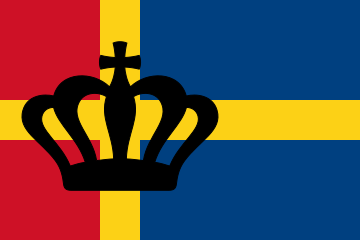 Cap Nord • Cap Nord •  Katterimunk • Katterimunk •  Esportivan Darmen • Esportivan Darmen •  Apox • Apox •  The 14 Stars • The 14 Stars •  Josifovo • Josifovo •  Nephara • Nephara •  Bongo Johnson • Bongo Johnson •  Xanneria • Xanneria •  Damukuni • Damukuni •  Macbon • Macbon •  Katzeburg • Katzeburg •  Slembana • Kanzlia • Slembana • Kanzlia •  Doubeia • Doubeia •  Eristicea • Eristicea •  The Limey Isles • The Limey Isles •  Tylastrona Tylastrona |
|---|---|