Akach national football team
 | |||
| Nickname(s) | Odum te okeala "The Lions at the border" | ||
|---|---|---|---|
| Association | Federation Akachese de Football | ||
| Other affiliation | Rabastor Sports Federation | ||
| Confederation | DSAFF | ||
| Head coach | 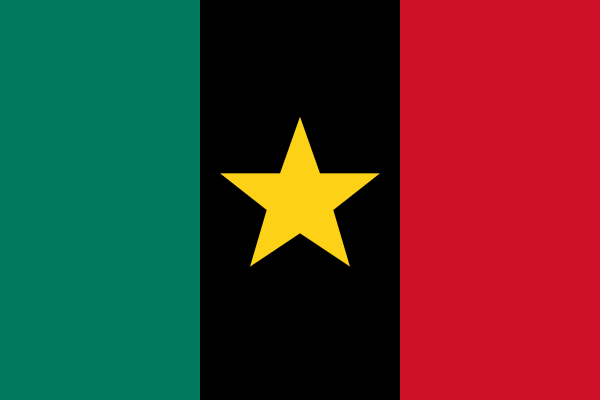 Henri Bocandé Henri Bocandé | ||
| Captain | Yannick Coquet | ||
| Most caps | Yannick Coquet (39) | ||
| Top scorer | Marie Douis (8) | ||
| Home stadium | Léopold Touré Field at Emekula Community Sports Arena | ||
| Trigramme | AKC | ||
| MexiCola ranking | 9 Decrease (559.61) (17 October 2023) | ||
| Highest MexiCola ranking | 8 (568.74) (20 July 2023) | ||
| Lowest MexiCola ranking | 18 (400.81) (3 June 2023) | ||
| |||
| First international | |||
 3-4 Akach 3-4 AkachFriendly Léopold Touré Field, Emekula, Akach | |||
| First DSAFF international | |||
 1-0 Akach 1-0 Akach2023 DSAFF Frost Cup group stage Eggetstadion, Bardvik, Nōrdustrā | |||
| Biggest win | |||
 0-3 Akach 0-3 AkachRabastor Unity Trophy 2306 group stage | |||
| Biggest defeat | |||
| 2-5 Cobrio Friendly Léopold Touré Field, Emekula, Akach | |||
| Highest scoring match | |||
 5-3 Akach 5-3 Akach2023 DSAFF Frost Cup group stage Köissär Adölf I Städken, Arkhangelsk, Lannistter | |||
| Comrades Cup | |||
| Entered | 1 (First in 2023) | ||
| Best result | Champions (2023) | ||
| Frost Cup | |||
| Entered | 2 (First in 2022) | ||
| Best result | Quarter Finals (2022) | ||
| Rabastor Unity Trophy | |||
| Appearances | 5 (First in 2306) | ||
| Best result | Champions (2314) | ||
| Solidarity Cup | |||
| Appearances | 7 (First in 2308) | ||
| Best result | Winners (x5) | ||
| Afro-Caribbean Heritage Festival | |||
| Appearances | 1 (First in ACHF II) | ||
| Best result | 8th (ACHF II) | ||
| Friendship Bowl | |||
| Appearances | 1 (First in FB 2315) | ||
| Best result | Winners (2315) | ||









- Note: This page refers to the team representing Akach at "full international" level. For the under-21 team, see Akach under-21 national football team
The Akach national football team (Akachese: Équipe de football du Akach) – nicknamed Odum te okeala ("the Lions at the border"), or simply "The Lions" – represents Akach at football and is controlled by the Federation Akachese de Football (FAF), the governing body for football in Akach. The current team manager is Henri Bocandé. The national team first played an international football match many years ago, but only tracks its history since 2306. This timing coincides with the opening of their current home stadium; Léopold Touré Field, at Emekula Community Sports Arena, in the Iton Valley region of Akach. The fans' use of traditional Akach/Cobre instruments, and rhythmic chants of "Ipa'elu Odum" ("Rise up, Lions!") and "Maripa Yoliso" ("The Almighty Force will win!") have led to Léopold Touré Field being described as a "joyful" place to play, even as the opposition.
Akach primarily contest events organised by the Democratic Socialist Assembly Football Federation (DSAFF), namely the Comrades Cup every summer, and the Frost Cup every winter. On their first entry to the Comrades Cup, in 2023, Akach emerged as the champions, defeating Ukotrium (UEC) 4-2 in the final.
History
- Main article: History of the Akach national football team
Following the successful separatist movement in Cobrio, a secession movement among the people of Akach gained widespread support, and led to the creation of a coalition party, the Akach Independence Movement (AIM). The AIM gained control of multiple city councils in Akach and were able to apply enough pressure on government to rename many prominent Akachese towns and cities – in many cases, they were simply returning to their original names, from before Osarian rule.
AIM chairperson and Emekula city council leader Léopold Touré travelled to Camaron to petition Cobre leader Tukari Kaita for support in a revolutionary movement, and in response, Kaita suggested a sporting tour. Cobrio's independence movement had grown following a lengthy tour by Kaita – and a "national" football team – across Cobrio and Osarius, and the two believed that this was a good way to drum up popular support for Akach as well, placing pressure on the Osarian authorities. The move worked, to some extent, although the Osarians were not willing to allow a full secession for Akach, as they had Cobrio. Instead, the region of Akach was granted semi-autonomy and "Dominion" status, much like Aquillian has been in years previous, along with "associate membership" to the Rabastorian Union. While this granted Akach the right to self-govern and appoint a president, the nation was still beholden to certain decisions taken by the Osarian government in Burningham. Due to the efforts of Touré, however, and the massive grassroots level support he had amassed in his hometown, Emekula was nominated as the new capital of the now semi-autonomous region of Akach, replacing Majutoyen – formerly named Hollybrent – which was traditionally seen as a hotbed for Osarian interests in the region.
Before additional pressure could build, Osarius and Cobrio were forced to ally against Kryosis in the Temporal War, with the upheaval derailing talks with Akach. The migration of Northeastern Atlantian Oceania to the new region of Anaia, along with the deaths of both Léopold Touré and Tukari Kaita, ultimately led to a loss of direction for the Akach Independence Movement, as well as a vacuum of leadership of sorts. In the wake of this, the appeal of a national team waned, only really appearing during the Rabastor Unity Trophy sporadically, while the AIM renamed itself to the Akachese People's Party (APP).
In the early 2300s, following the formation of the Anaian Open Reciprocal Travel Area (AORTA), the issue resurfaced, with Akach requiring a separate membership to AORTA from the one negotiated by Osarius. This was followed by the formation of the Federation Akachese de Football (FAF), along with the professionalisation of Ligue Akach, and its incorporation into the Rabastorian football league system. The first president of the FAF was Patrice Touré – son of Léopold Touré – who made clear his intention to continue his father's work toward an independent Akach.
The appeal of a national team once again grew, and the FAF began sanctioning friendlies outside of the biennial Rabastor Unity Trophy, as well as driving investment in sporting infrastructure within Akach. Gradually, the politics of Akach as a region shifted further left, in line with the ideals of the burgeoning Tukarist Liberation Front (TLF), which had been gaining support across several Rabastorian Union nations. Increasingly leftist local leadership saw the accessibility of sporting facilities as one of many measures that could be implemented to gain greater support from the electorate, and so the Emekula Community Sports Arena was commissioned. Once completed, the FAF invited Cobre league side CF Solidarité Akach -- so named for their commitment to supporting the Akachese fight for independence -- to play against an Akachese XI in the opening game. Akach would win the game 4-3, but the turnout was huge, prompting a deeper look at the viability of sport as a vehicle for political aims. This also marked the beginning of official records for the national team, and the official establishment of the "Akach national football team". Shortly after, the FAF would hold public polls to determine the nickname of the team, with "Odum te okeala" winning by a large margin.
DSAFF emergence
When the DSAFF announced they were opening their annual winter tournament – the Frost Cup – to national teams outside the federation, the FAF seized the opportunity and put forward a team, hoping to use the tournament as a springboard into a new wave of popularity for the independence movement. The national team's run to the quarter-finals of the 2022 Frost Cup paved the way for Akach to join the DSAFF in the aftermath.
In the wake of their successes in the Frost Cup, Akach were later extended an invitation to the Afro-Caribbean Heritage Festival (ACHF). The FAF accepted, but was met with some resistance over the release of several players. As a compromise, the FAF agreed to send a 'B' team – largely made up of under-25s – but regular manager Henri Bocandé did not want to take a weakened squad "as a matter of pride". Another compromise was found, this time with the FAF reaching an agreement with Aurelle Onguene – assistant head of football development within the FAF – to take charge of the team for this tournament. The results were disastrous, and saw the Lions lose three of four games, drawing the other, and returning with no wins.
Despite the disappointment at the ACHF, the FAF resolved to enter the DSAFF Comrades Cup later that year, and were able to negotiate with Bocandé to resume his duties as national team manager. Assurances were made about the availability of players, with the FAF suggesting they would blackball players who were called up but did not attend training camp in late May 2314. This was met with backlash from some pundits, but the majority agreed with the stance taken. Captain Yannick Coquet was particularly outspoken in his belief that players have a duty to their country, and if their club stood in their way, "perhaps you need to find another club". Elsewhere, Akach-born Osarian international Kody Theus announced her intention to represent Akach once again, echoing the captain's sentiment when she stated that "[being blocked from international callups by your club] was never a problem when I represented Osarius, and so it would be strange if it became one now".
The Odum te okeala would go on an unbeaten run during the 2023 DSAFF Comrades Cup, beating both co-hosts, Yucatan and Hortizo, as well as pre-tournament favourites Talamia, en route to the final. In the final, late goals from Kenza Ayache and Laëtitia Tatah secured a 4-2 victory over Ukotrium (UEC). The two women would later win individual awards for their performances throughout the tournament, and make moves to other DSAFF nations for a combined transfer fee exceeding NSD$ 100 million.
Culture
Rivalries
Style of Play
Since succeeding Desire Kibongé in 2311, Monsieur Bocandé has sought to shift Akachese football into a new era. Like many of his contemporaries, he draws heavily from Suzakudo (the classical Osarian school of thought) but has adjusted it to the Akachese mentality. Rather than rely on the refined technical ability of his players like his Osarian counterparts can, or exceptionally well-drilled tactics like the Cobre side, Bocandé provides merely a framework. From there, he relies on his players having enough of an "outside the box" approach – from the extensive amount of street football played in the nation's many community facilities – to surprise the opposition with something unconventional.
To that end, he prefers a balanced 4-3-3 system, as it "provides maximum flexibility for the players". Unlike the "Osarian 4-3-3", however, Bocandé's approach rarely assigns strict roles to his midfielders or forwards, instead only setting up his defence in a rigid tactical system. This, he says, is to "provide a solid foundation for the rest of the team". While his predecessor could, on occasion, call on experienced Osarian internationals and Rabastorian top-flight players such as Marios Mundi, and Celestina Favelli to fill their squads, Bocandé must settle primarily for players who ply their trade in Ligue Akach or leagues of a similar level. This, however, gives him scope to be more adventurous, as his players are "not burdened by tactical expectation".
Bocandé leans heavily on the versatility of Yannick Coquet – whose career in Akach was criminally overlooked by teams in the Rabastorian league pyramid, considering his ability – to orchestrate things in midfield, while the pace of Marie Douis and Friday Ennui is usually enough to scare most teams out of playing a high defensive line. Of course, this game plan has limitations, but it seems to be a reasonably effective approach when facing teams of a similar standard.
During the 2022 Frost Cup, Bocandé took a more proactive approach, setting his team up to attack more in general; yielding good results. As a consequence, he has since been more willing to take risks with his team selections and strategic approaches to matches where he feels his team will be pressed more aggressively. He has gone on record justifying this decision by explaining that an opponent who presses aggressively will be more susceptible to offsides and counterattacks when facing a high defensive line and a similarly aggressive press.
Team image
Media coverage
Nickname
The national team is most commonly referred to as "Odum" or "the Lions", though the official nickname is "Odum te okeala"; "the Lions at the border". This is a reference to Akach's location within Rabastor, where the nation serves as a "buffer" to would-be invaders from Calania across the Strait of Chie. This proud heritage of courage, strength, and togetherness has been present in Akachese people since antiquity; the very name of the land, Akach, is a reference to inhabitants' belief that they served as the "hand of the Almighty", and a deterrent to invasion.
Crest
The FAF crest is also used as the national team's crest. It depicts a lion's head facing left in green and red, over a golden star, in a black circle. Around this circle are further bands of colour; a golden band, and a tricolor band of green, black, and red (like the national flag). A Lion appears on the crest of the FAF, facing to the left; or "west", the direction of the Strait of Chie. This is a direct reference to the national team's nickname. Notably, the golden star in the centre does not represent a tournament win or a championship of any kind. It is the same golden star that appears on the national flag, emblematic of the "national hope for communal excellence and prosperity".
Kits
Traditionally, the Akachese team wears colours taken from the national flag. The four colours in the flag represent different concepts and ideals for the people: green for the land, which nourishes; red for the sacrifices of the ancestors, which provide the foundation upon which Akach is built; black for resilience, and perseverance through adversity; and gold for aspirational hope.
Primarily the team wears green for home games – with accents of red and gold – in reference to the "nourishing homeland", and the willingness to shed one's own blood to defend it. Away kits are primarily black – to represent the resilience and perseverance required to travel to foreign lands to do battle – with green and red accents.
Goalkeeper kits are primarily gold or red, to distinguish them from both home and away kits worn by outfield players.
Much like Cobrio, due to their shared ancestry, Akachese kits sometimes incorporate the adinkra. The adinkra are symbols used in antiquity to convey ideas and concepts, and in some cases, confer blessings and strength to the bearer. The away kits always have the kolodua ("fox tree") embroidered somewhere on the inside, if not incorporated into the design. This is because it is the symbol of Oluwu, one of the Irunashe said to be the protector spirit.
The current designs were created by Damisa, a Cobre sportswear company known for its "Panther Mask" emblem. The home kit is designed to place the green of the national flag front and centre, with prominent golden sections across the shoulder and down the arms; this is meant to represent that the hope of the nation (the gold in the flag) is in the hands of the players. The away kit is designed to evoke a warrior-hunter, with the red (bloody) claw marks and green streak (from grass); as the team "hunts" for victory to bring home. The goalkeeper kits are based on a traditional Akach pattern from the southern part of the region; it incorporates a swirling motif to represent the belief of the Moshka people -- a notable minority in southern Akach who, unlike most Akachese, do not share common ancestry with Cobre people -- that the world is in chaos, but the focus of the kit is still gold, representing hope.
Home stadium
- Main article: Emekula Community Sports Arena
Since the opening of the Emekula Community Sports Arena, the Akach national team have played all home games at Léopold Touré Field, which has a maximum capacity of 32,000. Football is played on a retractable surface which can be moved aside to allow the venue to host other sporting events, such as athletics, or combat sports. As the soil in the Iton Valley district – named for the valley formed by the River Itonne, and the location in which Emekula is located – is of very high quality, the FAF did not want to use artificial turf. Instead, a system of hydroponics is installed in a bed of local soil, on the retractable surface. While expensive to set up, the FAF justified this by highlighting that it would necessitate expert maintenance, thus creating additional work opportunities for local residents, and driving research into agricultural and horticultural methodologies.
The retractable surface allows for the FAF to decide whether to play matches indoors or outdoors, depending on conditions. When hosting football matches indoors, several of the lower stands are converted to safe-standing terraces, reaching the maximum capacity of 32,000. When hosting outdoors, temporary bleachers are erected around the pitch, providing a maximum capacity of approximately 24,000.
The construction of the stadium was a bone of contention for many, as the design necessitated some complex work, and thus, a much higher price than originally budgeted. To ease concerns, Patrice Touré lobbied for increased corporation taxes in Akach to subsidise the construction and ensured that the Arena would be a "community resource", setting up a trust to administer and manage it. The success of the Arena has led to other areas in Akach aiming to replicate the model, in conjunction with an already robust nationwide community sports program.
On occasions where Léopold Touré Field is potentially unavailable due to other events taking priority – this happens more than you might expect, but it is a community-owned facility – the national team have the option of rescheduling their matches to the Green Bowl in Karikinui, which has a much larger capacity (51,000). The FAF avoids this whenever possible, however, because the Green Bowl is privately owned, unlike Emekula Community Sports Arena. This means that a smaller percentage of gate receipts are available to be reinvested in the development of the community via the FAF-operated "Harambee Fund".
The Harambee Fund takes the majority of gate receipts from the Akach national team's home games – after accounting for operating costs – and makes them available to community-run projects that seek to provide needed services or build required facilities in underserved areas. Since 2306, the Harambee Fund has operated an "agricole" (or "farming school") for residents of the Iton Valley district, which gives young people access to cutting-edge agricultural technologies, in partnership with the Odikolo Agricultural College in Cobrio. In 2312, the Harambee Fund completed the construction of a new metro transport line linking the villages of Murom and Mogochi (combined population of around 4,000 people) to the Iton Valley Transport Network – which connects Emekula and Lindenhurst to the Grand Réseau d'Akach du Sud (GRAS).
Fans
Non-playing staff
- See also: Akach national football team manager
The first manager of the Akach national team was a woman, underlining the commitment of the FAF – and by extension, the nation of Akach – to equality of opportunity. It is important to note, however, that this was not a decision taken lightly. Before the FAF existed, Akachese teams and academies had spent considerable time and effort attempting to develop astute tactical minds. This approach was the remnant of the Osarian "national development strategy" for football, established around the time of World Cup 70, under Jermain Lewis -- himself of Akachese descent, interestingly. When the Osarian Football Association (OFA) largely abandoned this strategy, Akachese organisations picked up the slack and continued the work, centralising a lot of the tactical and technical development of sporting coaches under a single roof, based out of Emekula.
As a result of this work, the selection of both the national team manager and the national team captain hold significant weight; with those chosen considered by the FAF to embody the principles that represent the Akach nation best. For managers, this typically means tactical astuteness and excellent communication skills; for team captains, while the judgment is largely left up to the manager, the FAF will make recommendations based on experience, tactical awareness, and media skills.
Managerial history
| Name | From | To | W | D[†] | L | Pct | Achievements |
|---|---|---|---|---|---|---|---|
| Desire Kibongé | July 1, 2306 | August 31, 2310 | 7 | 10 | 2 | .421 | 2x Solidarity Cup (2308, 2310), 2310 Rabastor Unity Trophy Semi Finalist |
| Henri Bocandé | July 1, 2311 | present | 13 | 9 | 5 | .574 | 1x DSAFF Comrades Cup (2023), 2x Solidarity Cup (2312, 2313) |
| Aurelle Onguene | March 29, 2314 | April 4, 2314 | 0 | 3 | 1 | .125 | Temporarily took charge of a 'B' team for Afro-Caribbean Heritage Festival II |
† Match results counted as of the end of regular time.
Players
- For all past and present players who have appeared for the national team, see List of Akach international footballers
As the Federation Akachese de Football (FAF) has not been recognised by or admitted to the World Cup Committee, there is no rule preventing dual nationals from representing Akach. Upon confirming entry to the 2022 DSAFF Frost Cup, the FAF codified rules on eligibility, stating that only a person born within the region of Akach[Notes 1], or within two generations of someone who was, may be selected to represent Akach.
Furthermore, as Akach does not yet have an official, internationally recognised passport issued separate from Osarian passports, eligibility requirements can be somewhat tricky to pin down. The FAF defines eligibility for the Akach national team as being a criteria bestowed upon a) any person born within the Osarian region of Akach – formerly Applegrass – or b) any person registered as a resident of the Osarian region of Akach for more than eighty-five percent of the previous five year period. It is hoped that the region will increase autonomy in the near future, and be able to issue passports instead of the current identifier "resident's card".
It is also notable that Bocandé's assertion that he will only select players in DSAFF leagues to represent Akach, combined with the Lions' success at the 2022 Frost Cup, may have been the trigger behind several fairly high-profile transfers in January 2314. Most significantly, the return of Kody Theus, whose decision to walk out on the Osarian team in the middle of the CAFA Cup may have spurred others to look back toward their homeland.
Current squad
The following players are in the squad for the 2023 DSAFF Frost Cup.
| No. | Pos. | Player | Date of birth (age) | Caps | Goals | Club |
|---|---|---|---|---|---|---|
| 00 | GK | Sébastien Marcel | August 22, 2281 (aged 35) | 32 | 0 | SF Lampride
|
Recent call ups
The following players have also been called up to the Akach squad during 2314.
Captains
| Name | From | To | Games | Achievements/Notes |
|---|---|---|---|---|
| Jean-Pierre Chayriguès | July 1, 2306 | August 4, 2306 | 4 | |
| Le'Raven Rolle | February 23, 2307 | December 7, 2307 | 3 | |
| Marios Mundi | July 11, 2308 | July 10, 2309 | 6 | 2308 Solidarity Cup winner |
| Antoine Bideau | July 31, 2309 | August 2, 2310 | 6 | Rabastor Unity Trophy 2310 Semi Finalist |
| Yannick Coquet | July 1, 2311 | present | 28 | 1x DSAFF Comrades Cup (2023), 2x Solidarity Cup (2312, 2313) |
| Dean Hamby | March 29, 2314 | April 4, 2314 | 4 | Captained the ill-fated 'B' team at Afro-Caribbean Heritage Festival II |
Results and fixtures
- For a full list of Akach national football team results, see Akach national football team results history
Records
- Main article: Akach national football team records
Competitive Record
- For the all-time record of the national team against opposing nations, see Akach national football team head-to-head records
Comrades Cup
- Main article: Akach at the DSAFF Comrades Cup
[ summary ]
Gold Silver Bronze
[ table ]
Frost Cup
- Main article: Akach at the DSAFF Frost Cup
[ summary ]
Gold Silver Bronze
[ table ]
Rabastor Unity Trophy
The Rabastor Unity Trophy is a competition which often changes format, but exists to promote unity between the nations of the Rabastorian Union (RBU). Sometimes the tournament is a knockout format, sometimes it involves a round-robin stage. Sometimes other nations are invited.
Solidarity Cup
The Solidarity Cup is an annual fixture contested by the Akach national team and Cobre club side CF Solidarité Akach. The two sides alternate who will be the home side each year.
Friendship Bowl
The Friendship Bowl is a tournament hosted by the Marmaladaica Friendship Council for Football every two years. Four teams play in a single round-robin tournament, with points awarded depending on results. The team with the most points at the end of the tournament wins the Friendship Bowl – a literal bowl, filled with produce from each of the participating nations.
Other tournaments
[ one table for all other tournaments ]
- a Results settled on penalties are counted as draws.
- b Qualifying stage results include qualifying playoff games.
Honours
- DSAFF Comrades Cup
- Winners (1): 2023 (2314)
- Rabastor Unity Trophy
- Winners (1): 2314
Other honours
- Solidarity Cup
- Winners (5): 2308, 2310, 2312, 2313, 2314
- Friendship Bowl
- Winners (1): I (2315)
See also
Notes
References
Cite error: <ref> tags exist for a group named 'Notes', but no corresponding <references group='Notes'/> tag was found